



The Indian solar sector faced a “dark Wednesday” as shares of market leaders cratered following a massive trade ruling from Washington. The US Department of Commerce announced a preliminary countervailing duty (CVD) of 125.87% on solar cells and modules imported from India, Indonesia, and Laos, alleging that these products are unfairly subsidized by their respective governments.
The market reaction was swift and severe. Waaree Energies plunged as much as 14.99%, while Premier Energies and Vikram Solar dropped 14.23% and 7.47%, respectively. Government data shows that solar imports from India to the US skyrocketed from $83.86 million in 2022 to nearly $793 million in 2024, making India a primary target in this latest trade enforcement.
Waaree Energies Responds to US Duties: Supply Chain Strategy and FY27 Capacity Outlook
Addressing the media reports head-on, Waaree Energies stated that the company remains confident despite the US regulatory proceedings. In an official communication, the company highlighted that it successfully increased US deliveries during 9MFY26 despite existing 50% duties, proving the strength of its “alternate and diversified supply chains”.
The company continues to reinforce this strategy, including announced investments in Oman aimed at securing fully traceable, non-Chinese polysilicon supply,”
stated Waaree emphasizing that its localized US capacity is expected to reach 4.2 GW by the end of FY27.
Waaree explicitly reaffirmed that it does not anticipate any material adverse impact on its ability to service its existing U.S. order book.
Domestic Growth: 300 MW Wind Award Provides “Silver Lining”
While the stock plummeted 10.17% to ₹2,716 on the NSE amid the US tariff news, the company’s fundamental growth continues. On February 25, Waaree announced that its subsidiary, Waaree Forever Energies Private Ltd, received a Letter of Award (LoA) from the Solar Energy Corporation of India Ltd (SECI).
- The Project: A 300 MW wind power plant in Dwarka, Gujarat.
- Revenue Visibility: The Power Purchase Agreement (PPA) is valid for 25 years, ensuring decades of stable cash flow.
- Additional Wins: This follows a February 23 announcement of a 500 MW solar module supply order for FY27 from a leading domestic Independent Power Producer (IPP).
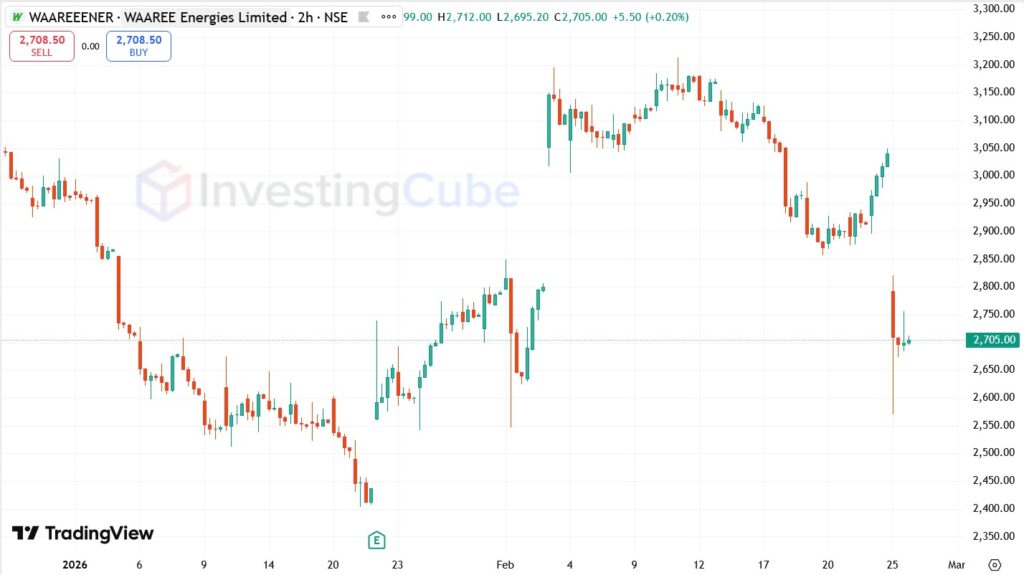
Waaree Energies Secures Domestic Growth Boost as 300 MW SECI Wind Project Offsets Tariff Shock
While the stock plummeted 10.17% to ₹2,716 on the NSE amid the US tariff news, the company’s fundamental growth continues. On February 25, Waaree announced that its subsidiary, Waaree Forever Energies Private Ltd, received a Letter of Award (LoA) from the Solar Energy Corporation of India Ltd (SECI).

- The Project: A 300 MW wind power plant in Dwarka, Gujarat.
- Revenue Visibility: The Power Purchase Agreement (PPA) is valid for 25 years, ensuring decades of stable cash flow.
- Additional Wins: This follows a February 23 announcement of a 500 MW solar module supply order for FY27 from a leading domestic Independent Power Producer (IPP).
Why Waaree Energies Shares Fell 10%
- 126% US Duty Shock: The primary trigger was the U.S. Department of Commerce’s announcement of a 125.87% preliminary countervailing duty (CVD) on Indian solar imports.
- High Export Vulnerability: Investors reacted sharply because 32.6% of Waaree’s Q3 FY26 revenue is derived from overseas markets, with the U.S. as a critical destination.
- Margin Concerns: Analysts warned that such high tariffs could lead to severe margin compression, as manufacturers may have to absorb costs to remain competitive or face a significant drop in order volumes.
- Anti-Dumping Threat: Market sentiment was further dampened by the anticipation of a second ruling next month regarding anti-dumping duties, which could add even more levies on top of the 126% CVD.
- Decoupling from Domestic Wins: The negative impact of the U.S. trade policy overshadowed a major positive development: Waaree’s subsidiary securing a 300 MW wind project from SECI with a 25-year revenue guarantee.
Waaree’s Future Outlook: The Road to 4.2 GW
Waaree’s long-term strategy is now clearly one of localization. By absorbing the Meyer Burger facility and expanding its aggregate US capacity, the company is effectively transforming from an Indian exporter into a domestic US manufacturer. This shift, combined with massive domestic wins like the SECI wind project, suggests that while the “US Duty” headline is loud, Waaree’s operational engine is far from stalled.
Waaree FAQs
Shares plunged over 10% primarily due to the U.S. Department of Commerce imposing a preliminary 125.87% countervailing duty on Indian solar imports. Investors are concerned about export margins, as Waaree derives roughly 32.6% of its revenue from overseas markets.
Waaree management stated there will be “no material adverse impact” on its U.S. order book. The company is mitigating the duty by expanding its local U.S. manufacturing capacity to 4.2 GW by FY27 and sourcing “non-Chinese” polysilicon through its new Oman facility.
Despite the share drop, Waaree’s subsidiary, Waaree Forever Energies, secured a 300 MW wind power project from SECI in Dwarka, Gujarat. This award includes a 25-year Power Purchase Agreement (PPA), providing the company with significant long-term revenue visibility.