- Intel's upbeat performance in 2025 had substantial contribution from headline investments by the US Government, Nvidia and Softbank
- The struggles in February 2026 is primarily linked to a weak guidance, which neutered the impact of its Q4 2025 earnings call
- Intel faces competition from AMD and needs to prove that it can scale its 18 A technology
After a jubilant 2025 where Intel stock rallied on the back of massive government subsidies and high-profile investments from Nvidia and SoftBank, the start of 2026 has been a reality check. While Intel entered the year with an 25% head start in January, February has wiped away a chunk of those gains.
As of this writing, the stock is trading near $44.62, reflecting a pullback of more than 5% over the past four weeks. So, why the sudden cold shoulder from Wall Street?
Why Intel Stock Is Struggling In February
This weakness follows the company’s Q4 2025 earnings release in late January, where results beat expectations on the top and bottom lines but forward guidance disappointed investors. While Intel technically beat revenue expectations by hitting $13.7 billion, its guidance for Q1 2026 was dismal. Management projected revenue as low as $11.7 billion with near-zero earnings.
Adding to the fire, reports that highlighted severe CPU supply constraints in China, where delivery lead times have stretched to six months. When you consider that China accounts for over 20% of Intel’s revenue, a 10% price hike on scarce server chips isn’t enough to calm investors worried about losing further ground to AMD.
Stiffening Competition and 2026 Outlook
Even though TSMC dominates chip production without question, Intel aims to step in where advanced packaging might need support. Right now, most investors see Intel trailing behind when stacked up against Nvidia and Broadcom in AI. As Nvidia rakes in massive returns from its H100 and B200 processors, Intel works quietly to show its 18A technology can actually work at scale.
Looking ahead to 2026, Intel stays cautious while others race forward. While Nvidia surges on strong chip demand, Broadcom sees its AI-related sales jumping by two times. Not far behind, TSMC predicts a rise close to 30 percent in income that year. Growth like that hasn’t reached Intel just yet.

Meanwhile, AMD’s grabbing more space in data centers for both CPUs and GPUs, helped by quicker progress on its MI300 and MI350 chip lines. Analysts see it outpacing Intel soon, thanks partly to a leaner business setup that demands fewer physical resources. While Intel struggles to keep up, AMD’s momentum builds – not from hype, but steady delivery.
Intel Stock Price Forecast Today
Now trading under its 20-day average, Intel finds itself at a shaky turning point. Right now, $42.50 stands strong as the first layer of defense. Below that, everything hinges on staying above $41.00 – that’s where the 50-day line sits. Any move upward runs into tough opposition near $51.50. That mark blocked advances three times already this month.
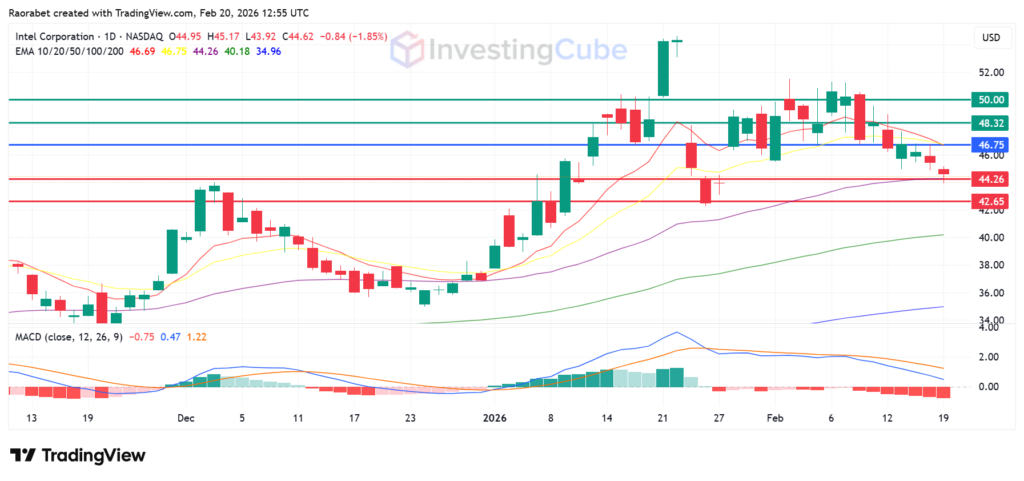
Intel stock price with its key levels of support and resistance on February 20, 2026. Created on TradingView
Fueled by a bleak outlook for early 2026, shares slipped sharply. Because of tight production capacity in China, pressure built fast. Earnings targets barely holding steady made matters worse. Manufacturing setbacks dragged on confidence.
Beyond competition from AMD, execution fatigue looms larger than AMD’s challenge. Should the 18A node miss landing a key outside client by late 2026, heavy spending won’t stop draining cash reserves.
Key triggers of a rebound include stronger Q1 delivery numbers, positive updates on foundry capacity, and clearer AI product wins. Until then, the stock remains vulnerable to further downside.