- Tesla stock has gone below $400, creating a psychological battle to restore shaky investor sentiment
- Tight competition from Chinese EV manufacturers, expiry of EV tax credits delayed production of cheaper models pose immediate pressure points
- Investors will be keen at the cybercab production ramp up, which is set to start in April, and that could catalyse a revival
Since reaching a peak near $498 in late December 2025, Tesla stock (NASDAQ:TSLA) has experienced a downward trend and recently fell below the key psychological threshold of $400, closing around $395 on Thursday. This prompts an examination of the factors behind this decline and whether the drop represents a short-term correction or a deeper structural issue.
Why Is Tesla Stock Under Pressure?
The primary factor contributing to Tesla’s stock pressure is the weakening performance of its core business. In Q4 2025, Tesla delivered 418,227 electric vehicles, missing Wall Street’s estimate of 422,850. For the full year, deliveries totaled 1.63 million, marking an 8.5% decrease compared to 2024.
This represents the second straight year of declining deliveries for a company that once dominated the global EV market. Additionally, Tesla’s operating margin has narrowed significantly, falling to 5.8% from 10.8% the previous year. This contraction casts doubt on Tesla’s ability to support its ambitious AI and robotics initiatives through internal cash flow alone.
Spending might hit $20 billion by the end of 2026, possibly dragging free cash flow down to -$5.19 billion. Elon Musk has said that production of the $25,000 Cybercab robotaxi will be “agonizingly slow,” even though he wants to churn out 2 million of them a year.
Meanwhile, intensified competition, particularly from BYD, which has overtaken Tesla as the global EV leader. Losing ground across both Europe and the United States hasn’t helped its position one bit. On top of that, American buyers lost access to federal incentives, up to $7,500, making purchases less appealing just when rising inflation and interest rates began pinching wallets. Price competition has compressed margins, with automotive gross margins at a 4.5-year low and revenue per vehicle declining 20.4% to $45,626.
Is This the Beginning of an Extended Decline?
Technically, the picture is cautious and Tesla trades below its 50-day moving average, which is currently descending in the $415 to $420 range. If current trends persist, marked by falling deliveries, margin pressures, and no new mass-market model, the stock may experience a deeper downside. Some analysts have downgraded Tesla to strong sell amid weakening fundamentals. However, the upcoming April 2026 start of Cybercab production could serve as a catalyst for recovery.

The Cybercab’s manufacturing ramp-up in April 2026 is still the wild card that could cause a change. At this time, investors want assurance that Tesla’s $20 billion AI bet will yield a profit.
Tesla Stock Forecast
Tesla stock remains above its 200-day simple moving average of approximately $393. If it fails to go above the psychological $400, it could go down to the $393 support level. Further control by the sellers beyond that mark could lead toward $381. On the upside, primary resistance is at the $400-$406 zone, with the next barrier likely at $412.
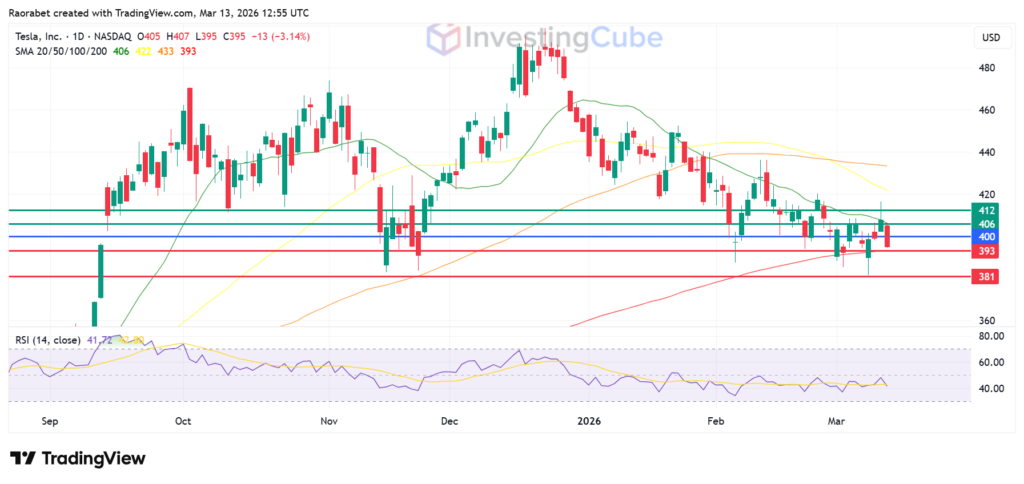
Tesla stock daily chart showing the main levels of resistance and support on March 13, 2026. Created on TradingView
A combination of declining EV deliveries, shrinking operating margins, rising competition from BYD, EV tax credit expiry and high valuation concerns have collectively weighed on investor sentiment.
Currently, yes. The stock is below its short-term moving averages. However, the $393 level (200-day SMA) is a critical floor. A break below this could signal further losses.
The main risk to Tesla’s AI ambitions in 2026 involves the timing and cost of innovation. Investors are concerned that the Robotaxi and Optimus projects may not produce meaningful revenue swiftly enough to justify the current price-to-earnings ratio.