- Silver price has recently broken below $80 support, barely six weeks after rising to all-time highs above $120
- What silver's safe haven appeal has in Middle East war premium is also pressure by gloomy outlook in industrial production amid rising oil prices
- The current silver price level aligns with J.P. Morgan previous forecast for the year, although the forecast didn't include the war's impact
Silver’s price movements in 2026 have been among the most dramatic in recent commodity market history. After reaching an all-time high of $121.62 on January 29, the metal has experienced significant volatility.
As of this writing, silver price has declined sharply, trading below $80, a notable drop from its peak earlier this year. This decline continues even amid rising geopolitical tensions in the Middle East, prompting reassessment of silver’s traditional status as a safe-haven asset during uncertain times.
Why Silver Is Falling When Risk Is Rising
Silver is often viewed as a safe haven to put their money, but right now it is facing three major issues that carry more weight than the war premium. A lot of the recent drop is because of a spike in profit-taking. After the 70% rise in January, major institutional paper traders are taking their profits.
Silver price fell amid a strengthening US dollar, stable US inflation data, and increasingly low expectations of interest rate cuts. This trio of forces are structurally hostile to a non-yielding asset already trading at extended valuations.
Additionally, silver’s price pressure reflects a strengthening US dollar, steady inflation data in the US, and diminishing expectations for interest rate cuts. These conditions tend to work against non-yielding assets like silver, especially when valuations are already elevated. Furthermore, silver’s dual role complicates its price dynamics. Unlike gold, silver serves both as a safe-haven asset and an industrial metal.
An analysis by J.P. Morgan highlights that industrial demand remains a significant factor in 2026 but warns that rising prices could dampen consumption and increase price volatility. This dual identity makes silver more sensitive to concerns about tighter monetary policy, slower economic growth, or decreased affordability among industrial users.
Surging oil prices above $100 per barrel, triggered by Strait of Hormuz disruptions and US-Iran clashes, have stoked fears of slower global growth and reduced manufacturing output. China’s recent PMI data already signals softening industrial activity, directly curbing silver consumption in the world’s largest buyer.
Meanwhile, the US Dollar Index is close to a nine-month high around 99.40. Since silver is priced in dollars, a stronger dollar increases costs for buyers outside the US, naturally suppressing demand.

Accumulation or deeper correction?
From a technical perspective, silver stands at a critical juncture. It has fallen below its 200-period moving average, currently at $84.60, and is testing the important psychological support near $80. Should geopolitical tensions persist without resolution and oil prices remain elevated, industrial demand may weaken further, potentially pushing silver’s price toward $70 or even lower. Several major banks have revised their short-term price targets downward, citing the continuing strength of the dollar and modest industrial orders.
For silver to recover and resume an upward trend, three key developments are likely necessary. First, sustained or increasing geopolitical risks that drive safe-haven buying across precious metals, not just gold. Second, a notable weakening of the US dollar, possibly influenced by weaker US retail sales or indications of earlier Federal Reserve rate cuts.
Third, signs of industrial demand picking up, particularly in China and Europe, supported by stronger PMI data or renewed investment in solar and electric vehicle sectors. Without these factors, silver is likely to remain range-bound or experience further declines throughout the coming months.
Silver Price Forecast
Silver price pivots at $80 psychological level and the RSI signals likely continuation of the downside. The first support is at $77, below which the next support will likely be at the 100-day EMA level. If prices fall further, the next significant support zone is near $70, reflecting the lower boundary of the consolidation period seen in February. The upside has the first key barrier at $83.62, with the next one likely at $85.92.
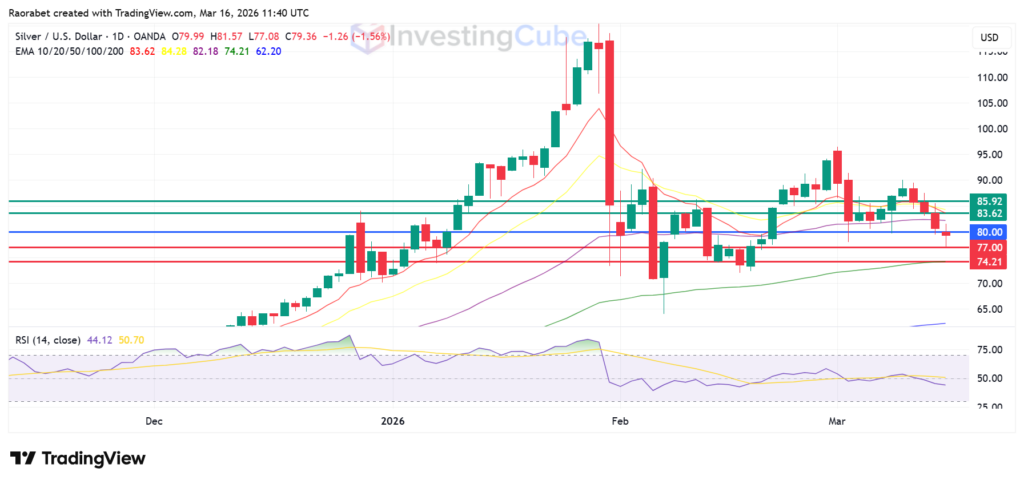
Silver price with key levels of resistance and support on the daily chart on March 16,2026. Created on TradingView
Because silver’s dual identity as both safe haven and industrial metal creates a ceiling that gold doesn’t face. War fears spike safe-haven demand initially, but stagflation fears simultaneously pressure industrial demand.
Silver trading near J.P. Morgan’s forecast of $81 suggests a return to more typical valuation levels, rather than an excessive drop. That forecast was established before the physical supply squeeze in January and the recent Middle East developments, both of which could add upward pressure not yet reflected in current projections.
For investors considering silver, a cautious, selective accumulation approach may be appropriate for long-term holders at present prices. However, clear signals regarding geopolitical stability and currency trends will be important to watch before making more decisive investment moves.