



- Reliance Industries stock stock lost 11% of its value in January, fueled by soft earnings figures
- Global oil prices have shown weakness in 2026 and reduced demand could add pressure on Reliance margins
- Rumours of Jio IPO and Jamnagar Battery Giga factory are likely strong tailwinds for the stock in the coming months
Reliance Industries (NSE: RELIANCE)had a rough start to 2026, dropping about 11% in January because of market worries. Still, the stock has bounced back a bit in February, gaining around 3% and trading at about ₹1,441 as of this writing. We take a closer look at the nuanced dynamics that could shape Reliance Industries share price performance throughout the year.
Why Did Reliance Industries Decline in January?
That big drop in January wasn’t by chance. It mainly came from weak Q3 FY26 results released in mid-January. Net profit was almost the same at ₹18,645 crore, even though consolidated revenue rose 10.5% to ₹2.69 lakh crore.
Investors were not happy with the slow growth in key segments like retail and refining margins. This was made worse by unstable global oil prices and worries about how fast new energy investments are going. The retail part struggled with higher costs, and a 12.7% fall in earnings for the Oil & Gas exploration part scared the market. Many people sold off large Indian stocks, and Reliance didn’t do as well as the Nifty 50 then.
Making Sense of February Rebound
The recent 3% rise in February is mostly because of a shift in the narrative. There’s some bargain hunting going on, and there’s good feeling about Reliance’s plans for new energy and online services. Higher crude oil prices in early February helped the refining business, and Jio’s growing number of users and efforts to make money from 5G helped bring back some trust.
The market is paying attention to the not-so-great Q3 numbers, but some investors are watching two big things. First, the company said that the Battery Giga Factory at Jamnagar is still planned to launch in 2026. This is more than just a factory; it’s a move away from a changing commodity business to a tech business with high profit margins. Second, there are rumors again about a Jio IPO in the first half of 2026. A Nasdaq report suggests that Jio’s ARPU (Average Revenue Per User) is climbing to ₹213.7, which makes it a valuable company ready to go public.

Reliance’s performance in 2026 will depend on stable crude oil prices, successful new energy projects, and continued growth in Jio and retail. Higher oil prices would help refining margins, and progress in green hydrogen and solar could create new revenue. Still, there are risks from fears of a global recession and competition in online services.
Reliance Share Price Prediction
Reliance share price has its pivot at the Volume Weighted Moving Average (VWMA) at ₹1,415 and the RSI is around 49, so it’s neither oversold nor overbought. The upside will encounter primary resistance at ₹1,446. A break past that mark will bring the second barrier at ₹1,457 within reach. Conversely, going below 1,415 will signal the onset of control by sellers. In that case, look out for the first support at ₹1,403. Action below that level will invalidate the upside narrative. Also, a stronger downward momentum could pull the price lower to test ₹1,290.
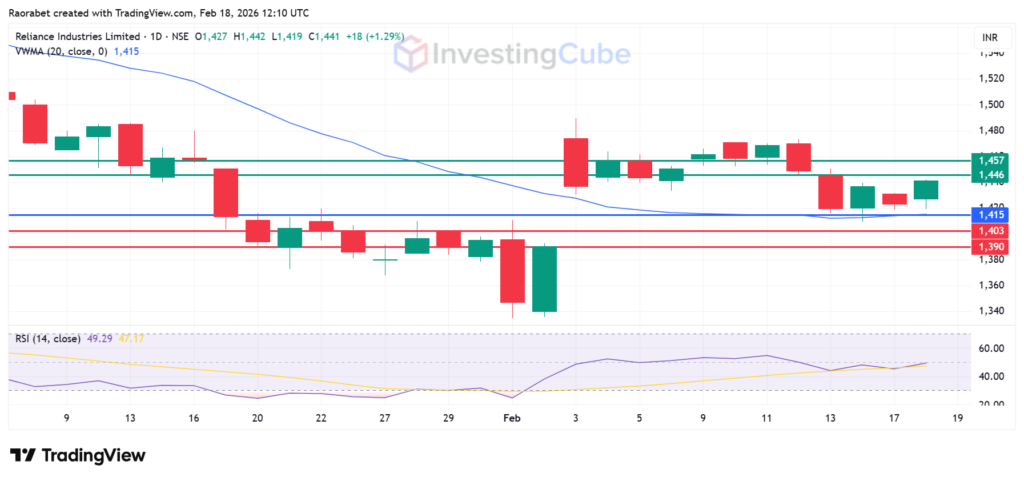
Reliance Industries share price on the daily chart on February 18, 2026. Created on TradingView
The drop was fueled by a miss in Q3 earnings, specifically flat profits and weak margins in the retail and upstream oil segments.
Bargain hunting, higher crude oil prices, and positive sentiment around Jio’s growth have helped the recovery.
Watch for stable oil prices, new energy projects, and Jio/retail growth. However, global slowdowns remain a risk.