



- Nvidia earnings rose by 73% YoY to $68.1 billion, beating consensus forecasts by $3 billion
- AI hyperscalers have lined up $700 billion in capex in the next year, but they are also building their own systems to reduce reliance on Nvidia
- Nvidia's valuation is at 47X trailing earnings, leaving little-to-no room for error in execution
People thought the AI craze was finally dying down, but Nvidia (NASDAQ: NVDA) has changed the rules again. The semiconductor giant’s fourth-quarter earnings for fiscal 2026 came out on February 25, right after it had won five sessions in a row. The company’s performance was so good that it could only be called a masterclass in market dominance.
The Numbers That Silenced the AI Bubble Bears
Start by looking at what Nvidia actually delivered, since the numbers are tough to grasp. Revenue hit $68.1 billion in the company’s 2026 fiscal fourth quarter, that’s roughly $3 billion above forecasts. Growth compared to the same period last year was up 73 percent.
Across fiscal year 2026, revenues grew every single quarter, from $44.1 billion in Q1 to $68.1 billion in Q4. Adjusted earnings per share reached $1.62, surpassing estimates of $1.53. That is not the trajectory of a company running out of runway.
The Capex Wave
There is a lot of talk about this rally, but the real reason for it is a sharp increase in infrastructure spending. Microsoft, Meta, and Amazon, three of the biggest tech companies, have all said that their AI capital expenditures (Capex) could reach $700 billion this year.
What’s particularly striking is that Nvidia’s guidance for the next quarter. Nvidia says it expects $78 billion, a number that towers over the $72.9 billion analysts had gathered around. Sure, people figured there’d be strong results followed by an upward revision. This pace hints at a shift happening quicker than even those betting big on GPUs imagined.
Underlying Risks and a Challenge to Market Consensus
Even so, some risks need attention. The forecast leaves out income from China, due to current limits on exports that might block a big chunk of potential revenue. Rivals are stepping up their game, big tech companies now crafting private silicon, while AMD pushes forward alongside homegrown designs from companies like Google.
Also, even after the latest big earnings, Nvidia’s valuation still sits high, and that means there’s little space for letdowns. With a price-to-earnings ratio near 47x trailing earnings, plus a total value nearing $4.8 trillion, expectations rest on steady success far into the future. Though recent performance lifts confidence, such levels demand flawless follow-through.

Market consensus largely views AI infrastructure spending as an unstoppable multi-year wave that will propel Nvidia to new highs with minimal interruption. This point of view is backed up by current order books, but it doesn’t take into account the fact that hyperscalers will eventually need to show clear returns on their huge investments. If monetization of AI apps slows down or the economy gets worse, capital expenditures plans could change more quickly than expected.
What This Means for Nvidia Stock Price
Growth looks set to speed up, with income expected to climb each quarter until late 2026. This environment is good for more share price growth, especially if upcoming platforms like Vera Rubin meet their production deadlines in the second half of the year.
Nvidia Stock Price Forecast
NVDA enters the post-earnings session having closed at $195.56. The first barrier is at YTD highs of $198, with the next one likely to come at the $200 psychological level . Lower down, price finds footing around $190, then again at the 20-day SMA at $187, matching recent average levels. A drop past $186 could spark selling pressure.
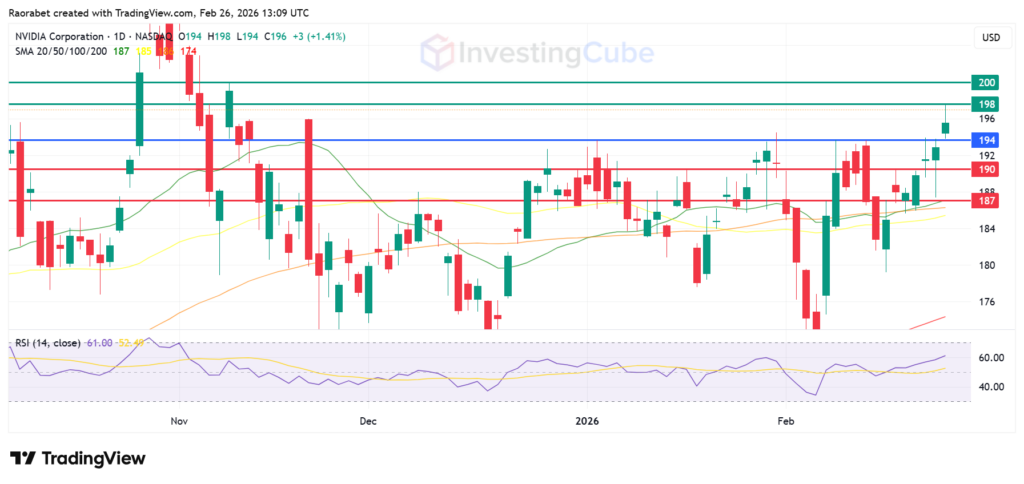
Nvidia stock price with key levels on February 26, 2026. Created on TradingView
The stock rose because Nvidia’s guidance of $78 billion far exceeded the market’s expectation of $72.9 billion. This “beat and raise” confirmed that the AI infrastructure buildout is actually accelerating rather than slowing down.
The main risks are geopolitical tensions, specifically export bans to China, and the company’s increasing dependence on the data center segment. Any slowdown in cloud spending or a shift toward in-house silicon by customers could hurt the stock.
Yes, in a way. A big part of that capital expenditure is going to custom silicon programs at Google, Amazon, and Microsoft that are meant to make GPUs less important. The same wave of spending that is helping Nvidia grow now is also building the infrastructure that could hurt it in the future.