


- Netflix stock has risen significantly since the company withdrew from Warner Bros. acquisition bid, with investors seeing it as money-saving
- Paramount's acquisition of Warner Bros. creates a stronger long-term competitor for Netflix in the streaming business
- Netflix stock price has failed to build traction above $100 despite the recent strong momentum, indicating creeping uncertainty
A sharp move upward in Netflix stock followed news that it stepped back from pursuing Warner Bros. Discovery. On February 26, 2026, when word spread about the pulled offer, investor confidence appeared to grow overnight. Instead of pushing forward, the pause brought relief, with stock rising as if rewarding restraint.
Even so, after these wins, Netflix stock has touched near $100 many times lately but slips back each time it gets close. This pattern raises questions about potential barriers to further upside and whether deeper risks lurk beneath the surface.
WBD Withdrawal Triggers NFLX Upsurge
Back in December 2025, Netflix said it would buy Warner Bros. for $82.7 billion. Yet when Paramount Skydance stepped forward with a bigger bid at $111 billion, things shifted fast. For Netflix, pulling back made sense and the decision got approval straight from Warner Bros. Discovery’s board. Right after news broke, investors reacted, with Netflix stock jumped more than 9% on the day.
Why $100 Has Proven Difficult
For a stock that traded above $120 earlier in 2025, a downtrend is the reason $100 functions as a ceiling. Netflix management said they expect revenue to grow by 12% to 14% in 2026. This is lower than the 17.6% growth they reported in the last quarter of 2025.
Looking ahead, steady progress seems likely because Netflix has strong basics going for it. Revenue climbed in late 2025, helped by more users picking the ad plan and tighter controls on sharing logins. Still, failing to push clearly past $100 hints at some doubt hanging around.
Underlying Risks and Potential Correction
There are a few things that could cause problems. First, Netflix CFO Spencer Neumann sold 57,260 shares on February 27. This was the same day the stock jumped 13.77% after opting out of WBD bid. Even if he had a good reason, it doesn’t look good when someone at the top sells shares right after good news.

Second, concerns around too much industry control grew louder when the Warner deal fell apart. Regulatory eyes are now watching streaming more closely, raising questions about fairness. If profits start shrinking, shares could drop hard. That tension builds as Forbes points to a $69 value line, calling current prices stretched thin.
Third, the new Paramount-WBD acquisition, though in debt, has a large collection of content, including HBO Max, Paramount+, Warner Bros. studio, CNN, and Paramount’s movies. This makes them a bigger competitor to Netflix. The market where Netflix is working in 2027 is very different than it was in 2025.
Netflix Stock Price Forecast
Netflix stock pivots at 100-day SMA at $96.76 and the RSI hints at a possible upward turn on the daily timeframe. Initial resistance will likely be at $98.70, and if the buyers manage to turn that into a support, the stock could retest the psychological $100. Downward pressure may pause near $94.80, though stronger backing emerges further down at $93.50.
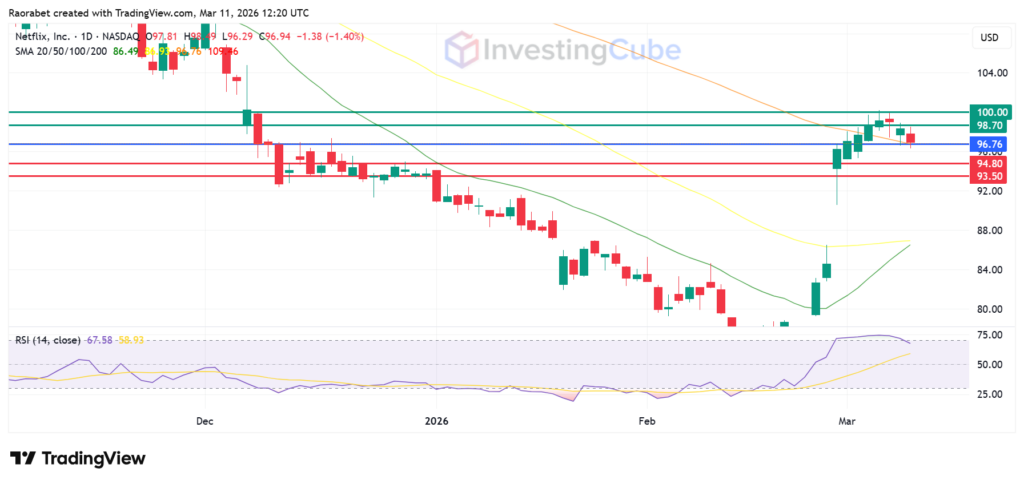
Netflix stock daily chart with key support and resistance levels on March 11, 2026. Created on TradingView
While it doesn’t change Netflix’s current business model, it creates a much larger competitor with a deeper content library. This could raise the costs for Netflix to license content and make it harder to charge more for subscriptions.
The market views the decision as financially disciplined, avoiding overpayment for Warner Bros. Assets. Shares rose from $84.59 on February 26 to $99.17 by March 5, reflecting relief and focus on core operations.
Possibly, if subscriber growth decelerates further. Analysts like those at Forbes project a drop, citing overvaluation, contrary to bullish views on organic expansion.