



- Netflix stock is up by over 10% this week and the market's reaction to Warner Bros. bid exit signals potential further gains
- Warner Bros deal was seen by many as a daring exploration that would have burdened Netflix with debt and disrupted its business model
- Netflix has resumed its share buyback program which it had paused after announcing the bid
Netflix’s stock took a hit after Q4 2025, mostly because of its big $82.7 billion offer for Warner Bros Discovery’s studio and streaming stuff. This made the stock drop 41% from its high point in June 2025. But, things have changed in the last few trading days.
As of February 27, 2026, the stock jumped over 10%, getting close to $92 in after-hours trading. This happened right after the company said on Thursday they were backing out of the bid.
Why Walking Away Was the Right Call
Some might say Netflix lost the Warner Bros. deal. But, think about the fact that Paramount won with a $111 billion bid, using over $57 billion in debt. That’s a bold and risky move.
Netflix, on the flip side, gets a $2.8 billion breakup fee from Warner Bros. They plan to use this money for content and buying back shares. Instead of getting stuck with a struggling cable business like Warner Bros. Discovery, Netflix keeps its finances in good shape and stays focused on its proven business strategy.
For much of the time since Q4 2025, many thought Netflix was making a risky move. The $83 billion deal for WBD could have loaded the company with debt and messed up its balance sheet. By backing out, co-CEOs Ted Sarandos and Greg Peters are sticking to what works for Netflix: growing on its own instead of buying other companies. Company leaders felt the deal wasn’t worth it after Paramount Skydance offered a better price of $31 per share.
This isn’t just a no but a yes to shareholders. Netflix also said they’re starting their massive share repurchase again, which they paused during the bid.
Is Netflix Fairly Priced, or Cheap After the Selloff?
At around $84–92 per share, Netflix’s price-to-earnings ratio is about 31–38x, while its peers in the industry are at 67x, according to Simply Wall St. This lower price shows the selloff, not a major problem with the company. In 2025, Netflix made $13 billion in operating income, with revenue growing 16% from last year, and operating margins going up to 30%. For 2026, the company expects revenue of $50.7–$51.7 billion.

The withdrawal, announced after Warner Bros saw Paramount’s $31 per share bid as better, takes away a major overhang. Shares went up 13% after-hours to cross $92, showing relief from avoiding financial strain and getting back to growing on its own. For the rest of 2026, this could keep things steady by saving cash for content and buybacks, possibly increasing earnings per share.
The stock is still down roughly 20% from its all-time high of $134.12 set in June 2025. While this creates an opportunity to buy, it also means people are changing how they value the stock, which might not go back to normal until there’s good earnings news. The next earnings call is on April 21, 2026.
Netflix Stock Price Forecast
Netflix stock RSI went from oversold to 55, showing that the buyers are strengthening their control. It has its pivot at $82.72, from which it will likely encounter the first key resistance at $86.50, which is the previous session’s high and just above the 50-day SMA of $86.30. If it manages to flip that into a support, NTFX could target psychological $90 next. The stock has primary support at the psychological $80, and a break below that could expose $78.00 as the next support.
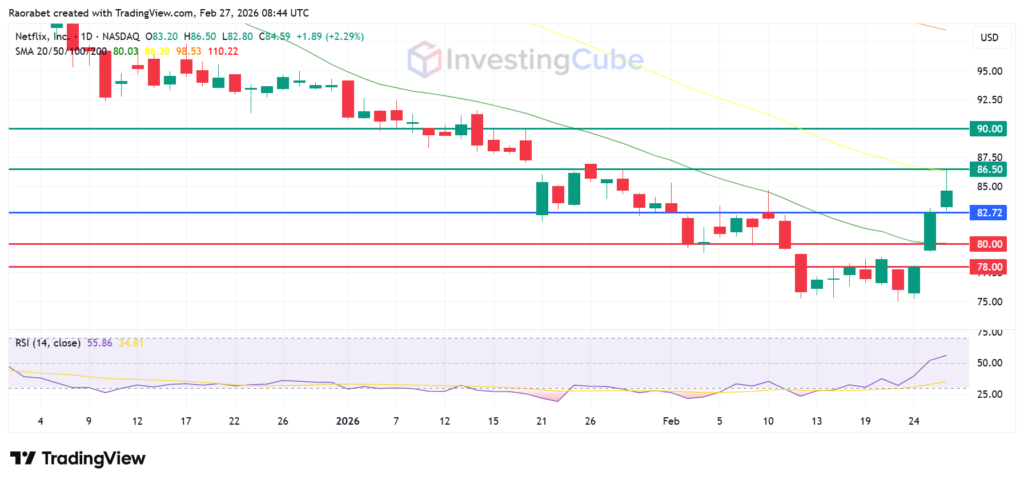
Netflix stock price on the daily time frame on February 27, 2026 with key levels of resistance and support. Created on TradingView
Investors feared the $82.7 billion acquisition would saddle Netflix with enormous debt, distract management from its proven streaming model, and expose the company to Warner Bros.’s struggling cable business.
Compared to its peers in the industry, yes. Netflix is trading at about 32–38x earnings, while similar media companies are at 67x.
It appears to be a fundamental repricing. By backing out of the bid and starting buybacks again, Netflix removed the main reason for investor worry. The increase shows a return to valuing the company based on its streaming and advertising work.