
- Nestle India is facing pressure primarily due to narrow margins in its most recent quarterly earnings call
- Demand in rural India is growing fast and the strategic shift to smaller packaging by Nestle India aims to accommodate that consumer base
- Analysts point to primiumisation and launch of new products as main growth drivers for 2026
The beginning of 2026 has been unusually frigid for Nestle India (NSE: NESTLEIND), following a great 2025 in which it rewarded investors with a nice 18% increase. Many are questioning whether the fast-moving consumer goods (FMCG) behemoth has lost its mojo as of mid-February, when the stock fell approximately 1.3% year-to-date.
Why Nestle Is Struggling
The fundamental reason for this problem is not bad performance. In fact, Nestle had historically good returns in the third quarter of fiscal year 2026, which ended in December 2025. The company had its best-ever quarterly turnover of ₹5,667 crore, with sales up an amazing 18%. Even for a top FMCG firm, the stock is selling at premium, considering its forward price-to-earnings ratio of roughly 68 times, as pointed out in Motilal Oswal’s February 2026 sector update.
But the margins are where the catch is. In order to maintain its position in a very competitive industry, Nestle increased its advertising and promotion (A&P) budget by an astounding 42%. Volume increase was driven by this aggressive strategy, while EBITDA margins were compressed to 21.3%, below the average projection of 22.1%.
Also, major growth drivers like milk products and drinks have continued to have poor volume growth, and rural demand has recovered more slowly than expected. Nestle India said in January 2026 that global commodity inflation, notably in the dairy and cocoa markets, has cut profit margins by a lot in the third quarter of FY26.
Chances of a Near-Term Rebound
There may be a breakout or rebound in the near future, but it will probably take some obvious positive signals to set it off. The catalyst could be strong Q4 FY26 results, which are anticipated in late April and should demonstrate a return in volume and improvement in margin.
When you consider everything, 2026 isn’t going to be a particularly exciting year. Analysts say that premiumization and new product releases should lead to revenue growth in the mid-single digits. If the cost of raw materials goes down, EBITDA margins are expected to go up little. The company’s strong distribution network and brand strength give it a good base, although growth is not expected to be as fast as it was in 2025.

Whalesbook data shows that demand in rural areas is growing faster than it has in the past five years, which is a healthy development. The timing of Nestle’s strategic shift to smaller packaging for brands like Maggi and KitKat couldn’t be better. Current “Hold” ratings don’t fully account for the potential quick margin expansion that could occur if inflation moderates by the April wheat harvest, as expected by management.
Nestle India Stock Prediction
From a technical standpoint, Nestle India stock is through a time of consolidation right now. At 44.69, the relative strength index (RSI) is downward-leaning. The level of immediate support is at 1,273 rupees, and there is a secondary floor at 1,266 rupees. Upside, the stock encounters a resistance level at the 100-day EMA at ₹1,265.65.
The upside has primary resistance at ₹1,303, and if the buyers manage to turn that into a support, it will likely aim higher to test ₹1,315.
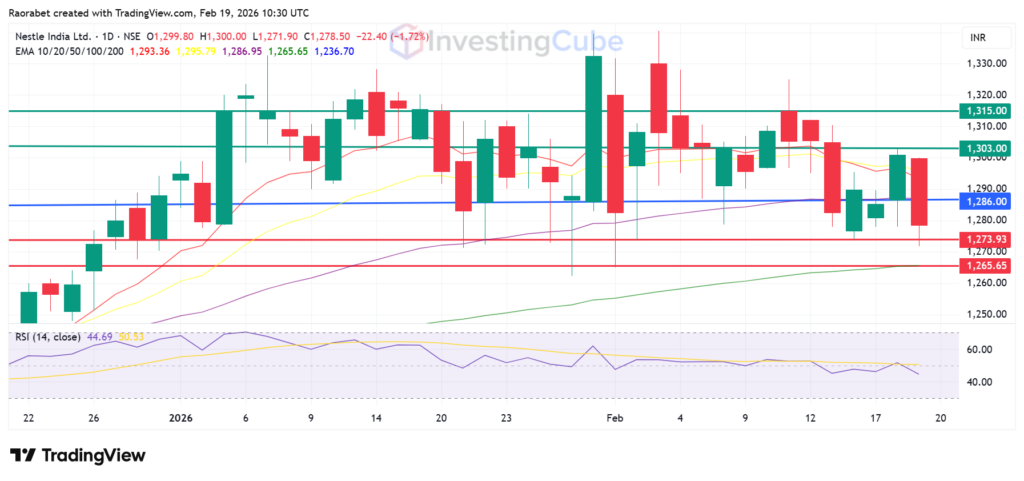
Nestle India stock on February 19, 2026 with main levels or resistance and support. Created on TradingView
Mostly, margin compression is responsible for the decline. A 42% increase in advertising expenditures and strong commodity prices reduced profitability despite an 18.5% increase in sales.
The primary risks are persistent inflation in edible oils and coffee prices. Furthermore, the large expenditure on advertising and marketing could hurt profits if the rural recovery doesn’t happen as strongly as expected.
Key drivers for 2026 include premiumisation, new product launches, and easing raw material costs. However, competition in rural markets and sustained high valuations pose bigger risks than many expect.