


- -HSBC share price forecasts for 2026 will depend on the bank surpassing some key performance indices.
- - The HSBC share price surged to new record highs after the release of its FY2025 earnings report.
The focus for HSBC share price forecasts for 2026 will focus on higher NII targets, capital returns and its Asia-wealth execution strategy which includes unlocking value from offloading low-performing assets.
HSBC Live Chart
What has been the performance of the HSBC share price in its various listed markets? The performance of the day has been dominated by its latest earnings report, which was released on 25 February 2026.
HSBC Holdings PLC reported a 5.5% year-on-year increase in revenue to $17.41 billion while also reporting adjusted quarterly earnings per share of $0.37 for the quarter ended 31 December. This represented a YoY increase over the same quarter of the previous year, when adjusted quarterly earnings per share were $0.28. The figure also beat Wall Street analysts’ expectations of $0.31 to $0.36 earnings per share.
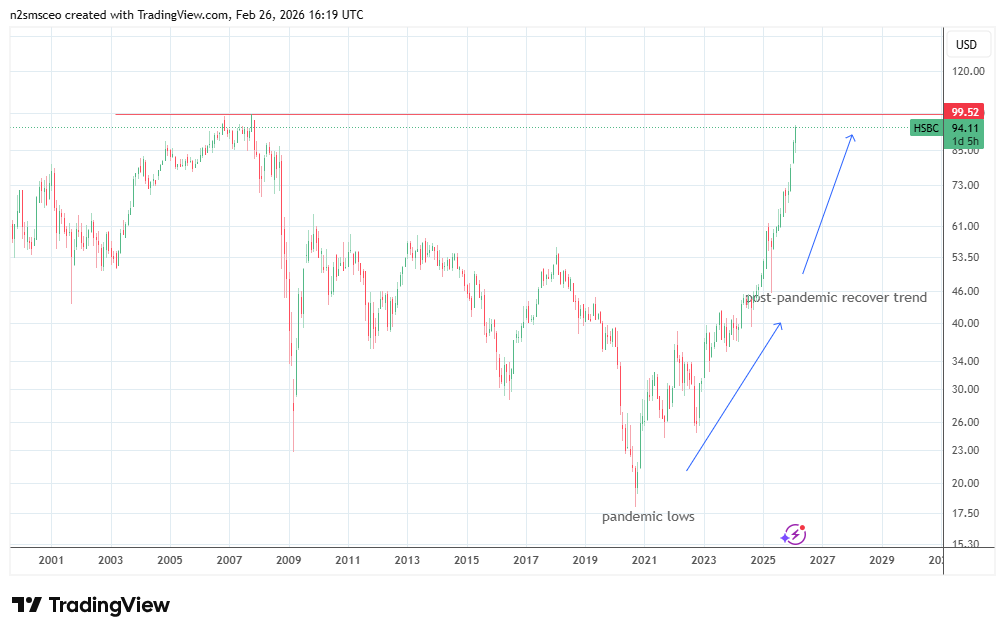
The news sent the stock soaring, with the Hong Kong-listed stock rising 5.47% on 25 February and an additional 3.71% in today’s trading session. The NYSE-listed stock rose more than 7% on the report’s upgraded guidance, bringing the stock closer to a retest of its October 2007 record highs. The HSBC share price in London (HSBC.L) is trading around 1290p, which is at a record level.
HSBC Share Price Forecasts: Macro Drivers
The macro drivers for the HSBC share price forecasts are as follows:
- 2026 Banking NII Guidance
- Cost discipline
- Strategic operational overhaul
- Boost in wealth and transaction banking
- Improvement in capital returns
1. 2026 NII Guidance
HSBC provided boosted guidance for net interest income (NII) of at least $45 billion, based on current policy rate expectations. The bank’s 2026 NII guidance exceeded analysts’ expectations, which had been $43.5 billion. The upbeat NII guidance is partly responsible for the stock’s recent spike in trading over the last two days.
2. Cost discipline
HSBC’s management has succeeded in instilling cost discipline in its operations. Costs for the fiscal year are said to be up just 1%, keeping a cost base of $33.8 billion. This figure is $500m below consensus estimates, and will support returns if sustained.
3. Strategic operational overhaul
The valuation story of HSBC is set to get a major boost if the bank completes its strategic overhaul. Under this program, the bank aims to eliminate all low-value businesses to focus on higher-return areas. This process has commenced the sale of its life-insurance manufacturing division in Singapore as part of its systematic streamlining of operations.
4. Wealth and transaction banking boost

The latest earnings indicate that the boost in wealth and transaction banking was the major factor behind the earnings and profit beat. The markets typically reward businesses that operate with balance sheet efficiency.
5. Capital returns
A dividend payment is scheduled for April 2026, consistent with the bank’s history of dividend payments. These dividends, earnings, and stock buyback schemes continue to make the stock the toast of investors.
HSBC Share Price Forecasts: Institutional Targets
What are the institutional HSBC share price forecasts for 2026?
The current analyst ratings, on average, indicate that HSBC is a Buy, with a median 12-month HSBC share price target of 1240p on the LSE.
The MarketBeat consensus rating for HSBC remains a Moderate Buy, with a $63.00 HSBC share price target for the NYSE-listed stock. Investing.com has a range of targets for the London-listed stock, with the boundaries staying at 1464p (upper limit) and 779p (lower boundary).
Jeffries has maintained its Hold rating on HSBC, calling for a 1120p HSBC share price on the London-listed stock.
Base case: the base case scenario relies on improvement in earnings quality, with the stock consolidating higher as a consequence. HSBC must deliver on the $45 billion in banking NII, keep costs below the guided figure of $33.8 billion, and continue to grow the wealth and transaction banking business to offset any other margin compression in other aspects of its business.
Bull case: the bull case calls for a higher re-rating of the bank’s capital returns, unlocking further value through its streamlining of operations, and continuing to compound its wealth revenues. Dividend payments and buybacks have to remain robust. Attainment of these performance indices allows the stock to challenge the upper boundaries of analysts’ estimates around the mid-1400p price level.
Bear case: If the guidance proves too ambitious and the bank fails to meet the banking NII guidance, or if costs exceed guidance, this could spell trouble for the HSBC share price. Some analysts have already flagged a potential for its AI investment costs to rise more than expected. The HSBC share price will, in this scenario, aim for the lower end of analysts’ estimates.
HSBC Share Price: What to Monitor for 2026
- Banking NII: actual vs $45 billion consensus target
- Cost base: actual vs $33.8 billion guidance
- Capital returns (dividends and share buybacks)
- Growth of wealth and transactional banking operations
- Streamlining and value unlocking
HSBC Share Price Forecasts: Technical Outlook
The weekly chart shows a strong parabolic uptrend that has carried it from pandemic lows in 2021 to its current levels. The ascending trendline that began in 2022 is well noted. As long as the price remains above this trendline, the multi-year bull case stays intact.
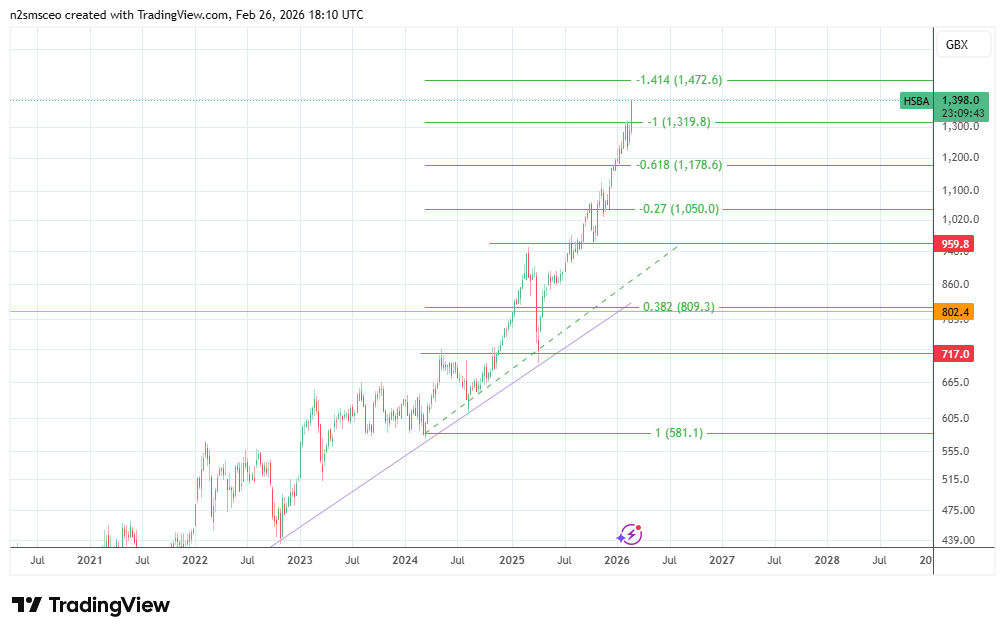
The recent price action shows a breakout above the 1319.8 100% Fibonacci extension level, with 1472.6 (141.4% Fibonacci extension level) now the major target for the bulls. As long as price holds above 1319.8, the 1472.6 price level remains a relevant magnet for the bulls.
On the flip side, any correction below the 27% Fibonacci level at 1050.0 makes the 959.8 support an attractive level, as it was the prior high on 3 March 2025, which was uncapped and now serves as a role-reversed pivot. Below this level, 802.4 and the 38.2% Fibonacci retracement become the new downside magnet.