



- Duolingo shares cratered 25% in pre-market trading after issuing a 2026 revenue forecast that fell significantly short of Wall Street estimates.
- CEO Luis von Ahn announced a deliberate shift to prioritize free user growth and long-term expansion into math, music, and chess over immediate profitability.
- Adjusted EBITDA margins are projected to drop to 25% from 29.5% as the company reinvests $50 million of "foregone bookings" back into the free learner experience.
Duolingo Shares Sink After Issuing Poor 2026 Guidance
Duolingo Inc. (DUOL) shares sank 25% before the bell on Friday after reporting fourth-quarter earnings, which beat analyst expectations, but issued disappointing guidance for 2026. The company said it is changing its strategy to prioritize user growth over near-term profitability. This strategic “about-face” has startled investors who had grown accustomed to Duolingo’s rapid monetization and high-margin growth.
Dissecting the Duolingo Numbers: Record 2025 vs. A Cautious 2026
While the backward-looking results were strong, the forward-looking trajectory is what triggered the massive sell-off. The language-learning giant is essentially trading immediate cash flow for a larger future user base.
- Q4 Beat: Reported adjusted EPS of $0.84 (vs. $0.83 estimate) and revenue of $282.9 million, up 35% YoY.
- Revenue Warning: Full-year 2026 guidance was set at $1.20-$1.22 billion, trailing the consensus estimate of $1.26 billion.
- User Growth Deceleration: Daily Active Users (DAU) grew 30% to 52.7 million, but growth is expected to slow to 20% in 2026, half the rate of prior periods.
- Bookings Reset: The company expects bookings growth of only 11% in 2026, compared to the 20% growth it could have achieved under its previous strategy.
Why Duolingo Is Sacrificing $50 Million to Accelerate User Growth
In a bold move, Duolingo is moving its Video Call feature from the premium “Max” tier down to the standard “Super Duolingo” subscription. This move, along with reducing friction for free users, represents a $50 million investment of potential revenue being funneled back into the free user experience to drive “word of mouth” growth.
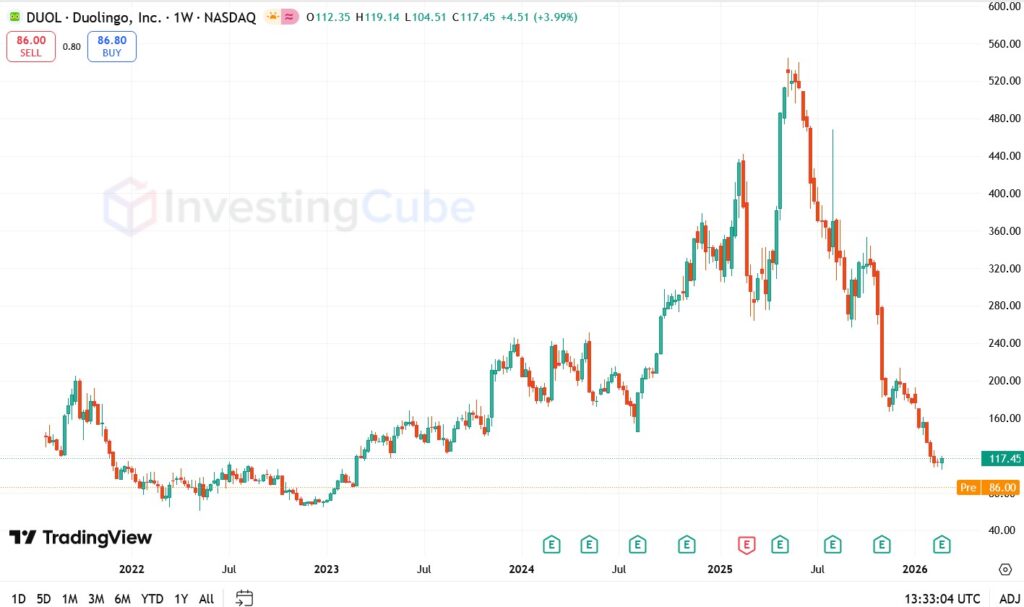
DUOL Weekly Chart Analysis: Breaking the Long-Term Support
The technical damage to Duolingo’s chart is severe. The 25% drop has forced the stock to gap down below several key psychological and technical floors.
Duolingo’s Chart Technical Breakdown:
- Immediate Resistance ($117.45 – $120.00): Yesterday’s close near $117 is now a distant ceiling. The stock would need a massive fundamental catalyst to “fill the gap” created by this morning’s news.
- The $87 Floor: Pre-market trading shows the stock bottoming near $87.17. This area must hold on a weekly closing basis; otherwise, the stock risks a slide back toward the 2023 lows near $70.
- Volume Surge: The massive selling pressure at the open suggests institutional “re-rating.” Analysts are likely moving from “Growth” to “Hold” as the 17% growth midpoint fails to justify the previous premium valuation.
Why the Market is Penalizing “User Growth”
Wall Street typically rewards a shift toward profitability, not away from it. By prioritizing the “free learner experience” to grow new engines like chess, math, and music, Duolingo is asking for investor patience in a market that currently demands immediate ROI.

We closed 2025 with strong momentum… In 2026, we are deliberately prioritizing user growth and teaching better… even though that moderates near-term financial growth”.
stated CEO Luis von Ahn in an attempt to defend the move.
To soften the blow, the Board authorized a $400 million share repurchase program, utilizing a portion of their $1.04 billion cash reserve.
Conclusion: A Bold Long-Term Bet or a Growth Trap?
Duolingo has chosen to cannibalize its own short-term growth to build a wider “top-of-funnel” for the future. While this may be the right move for the brand’s longevity, it is a painful transition for shareholders who bought in for high-velocity monetization.
My Analytical Take: The $400 million buyback is a clear signal that management believes the stock is oversold at these levels. However, until DAU growth proves it can stabilize at the 20% mark, the stock is likely to remain in a “penalty box.”
Watch the $87 support level closely; a recovery above $100 in the coming weeks would signal that the market is beginning to trust von Ahn’s long-term vision.
The stock fell because 2026 revenue guidance ($1.21bn midpoint) and DAU growth (20%) were significantly lower than what analysts expected.
The company is prioritizing long-term user growth over near-term profits by improving the free user experience and expanding into math, music, and chess.
Yes. The company generated $93.7 million in free cash flow in Q4 and remains profitable, though margins are expected to compress to 25% in 2026.