


- BP stock was on the rise from earlier in the year before the Middle East war began, with investors buying into the company's internal transformation
- Middle East war has added momentum on BP stock but successful negotiations could result in a sudden sharp drop in oil prices
- The company has paused its share buyback program, redirecting its effort to improving its finances
BP stock (LSE: BP.) is off to a good start in 2026, up over 16% year-to-date and trading near 493p as of March 3. This follows a shaky 2025, where the company dealt with changing oil prices and pressure to change to new energy sources.
While BP stock is clearly up, it’s not entirely accurate to attribute the upsurge to the US and Israel vs Iran conflict and the jump in oil prices it has triggered. There’s more to it than that. The rise actually started months before the conflict.
The Turnaround Before the War
Back in 2025, Elliott Management, a hedge fund, increased its stake in BP to 5.006%, made it public, and this led to some important announcements. Within weeks, BP said it would increase investments in fossil fuels, drop its renewable energy targets, and focus on fixing its finances.
Under CEO Murray Auchincloss, BP stopped aiming to increase renewable energy production 20 times by 2030 and is going back to focusing on fossil fuels. This change makes sense in the present situation. BP’s net debt was down to $22.2 billion by the end of 2025, its Return on Average Capital Employed increased to 14%, and total revenue for the year was about $192.5 billion. These numbers show that the company is actually changing for the better, not just talking about it.
Middle East War Propels Oil Price Gains
The most obvious reason for the recent rise is the growing conflict in the Middle East. In early March 2026, Brent crude prices jumped to a one-year high of $80 per barrel after reports that Iran was blocking the Strait of Hormuz, an important route for about 20% of the world’s oil supply.
Analysts have said that oil producers outside the Middle East will likely see higher revenues and cash flow in the near future. But here’s a point that most news is missing: the war is hiding a real issue. BP has stopped its share buyback program, is putting all extra cash towards improving its finances, and is selling off $20 billion worth of assets.
BP’s CFO Kate Thomson said that net debt is expected to increase in the first half of 2026 before dropping a lot in the second half. This creates a period of risk if oil prices drop before the financial targets are met.

Internal Pivot and Risks
It would be wrong to give all the credit for the rise to the current global geopolitics. BP is going through a significant transformation under its new leader. In February 2026, the company made a bold move to stop buying back shares in order to focus on lowering debt and improving its assets.
The main risks include a quick end to the war that lowers oil prices, ongoing inflation that hurts demand, or faster changes in energy policy. A long conflict means rising oil prices and inflation. The New York Times noted investors preparing for supply problems but a possible unstable market in the long term.
BP Stock Forecast
BP stock price is on a bullish run, as shown by action above the Volume Weighted Moving Average (VWMA) and its RSI at 62.91. It will likely encounter initial resistance at 498p, beyond which it will target the psychological 500p level. If the buyers manage to convert that level into a support, the next target will be at 510p.
Alternatively, going below 484p will signal control by the sellers. the first meaningful support level is at 4785p. Below that, 474p is the next significant floor, aligning with the February consolidation band.
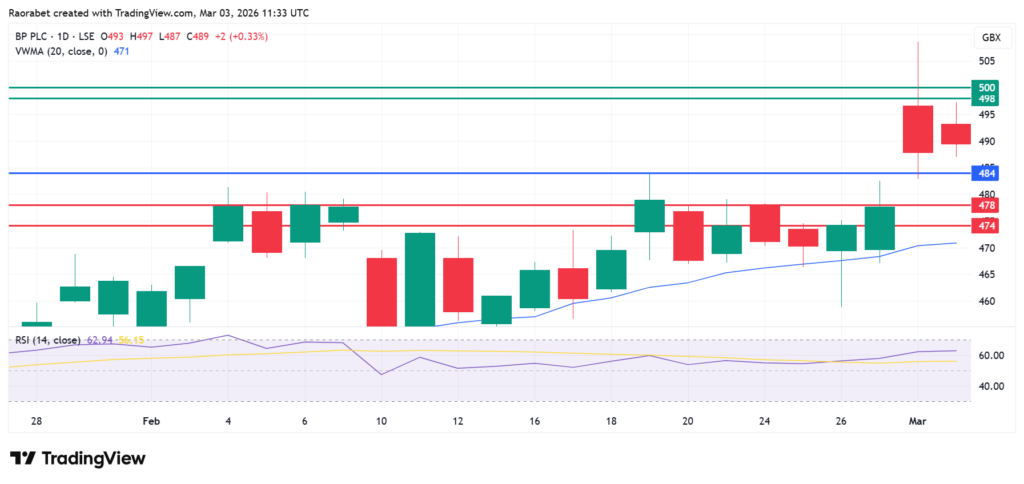
BP stock price chart on the daily time frame with key levels of resistance and support on March 3, 2026. Created on TradingView
It is a primary catalyst. The closure of the Strait of Hormuz has pushed Brent crude to $80, which is directly increasing BP’s profit margins and attracting investors who want a safe investment during this conflict.
The war premium in oil prices deflating before BP completes its divestiture programme and balance sheet repair would be the most damaging combination.
The main risks include a quick end to the war that could lower oil prices, ongoing inflation that reduces demand, and faster movement towards new energy sources.