



- The Middle East war has driven oil price into the triple-digit mark straining global economic outlook and impacting equities
- Tech stocks helped absorb the immense shocks on the S&P 500 Index, with investors betting on the safety of resilient AI performance
- Fed interest rate decision and PCE data are the key focus points in the coming week
The trading week ending March 13, 2026, reflected a dynamic interplay between resilient mega-cap tech stocks and growing geopolitical tensions. While elevated energy prices posed notable challenges for the broader market, the technology sector helped cushion the impact, preventing a deeper sell-off across major indices.
On March 12, the S&P 500 closed at 6,672.62, registering about a 1% decline over the week. The Nasdaq Composite finished at 22,311.98, down nearly 0.3%, while the Dow dropped 739.42 points to 46,677.85, marking its lowest close so far this year. All three indices reached new lows for 2026 during this period.
Tech Stocks Lead the Market
Even as oil nudged toward triple digits, the Magnificent Seven lent strength, cushioning the S&P 500 and Nasdaq from steep drops. Market nerves calmed slightly around those bets, despite pressure building from energy costs. Investors seemed to favor companies with robust balance sheets and clear AI-monetization paths as a “safe haven” against the inflation concerns sparked by oil prices hovering near $100 per barrel.
Palantir Technologies (PLTR) was one of the best-performing tech companies this week. Its stock rose as investors showed a lot of interest in AI-driven platforms. Broadcom (AVGO) did well because there is still strong demand for chips, and Micron Technology (MU) did well thanks to positive sentiment around memory solutions. These gains show that the sector can handle bigger problems in the market. For example, software companies like Salesforce also saw big daily gains that helped keep the market stable over the course of the week.
Oil, Iran, and the Fed’s Tight Corner
On the macroeconomic front, escalating tensions among the U.S., Israel, and Iran significantly affected global energy markets. Iran’s new Supreme Leader, Mojtaba Khamenei, insisted that the Strait of Hormuz will remain closed. The news sent West Texas Intermediate (WTI) crude futures up by nearly 10% to $95.73 per barrel. Meanwhile, Brent crude prices topped $100 per barrel for the first time since August 2022.
This surge in energy prices placed the Federal Reserve in a challenging position. Market participants largely anticipate the Fed will hold its interest rates steady at the upcoming meeting, pending clearer insights into how the conflict may influence the economy. Friday’s release of the Personal Consumption Expenditures (PCE) index, the Fed’s preferred inflation measure, attracted close attention. However, analysts have cautioned that it might not yet reflect the full inflationary effects stemming from the conflict.

The Week Ahead
With the Fed meeting scheduled for March 18, any hawkish rhetoric regarding higher for longer rates in response to oil prices could dampen the tech rally. The upcoming PCE price index will be scrutinized for how much of the recent energy spike has already seeped into consumer prices. This week, the VIX climbed close to 26.42. Should it stay past that mark, what looked like a healthy correction may become real strain across markets.
S&P 500 Forecast
From a technical standpoint, the S&P 500 Index market is indicating control by the sellers. The daily RSI is at 35, affirming this setup, if the action stays below 6,745 pivot point. Immediate key support is at the weekly lows of 6,636 points, below which the Index could test 6,600. Conversely, the upside momentum will likely be dominant if the Index pops up above 6,745. In that case, primary resistance will likely be at 6,797. A break past that level will likely test 6,850 points.
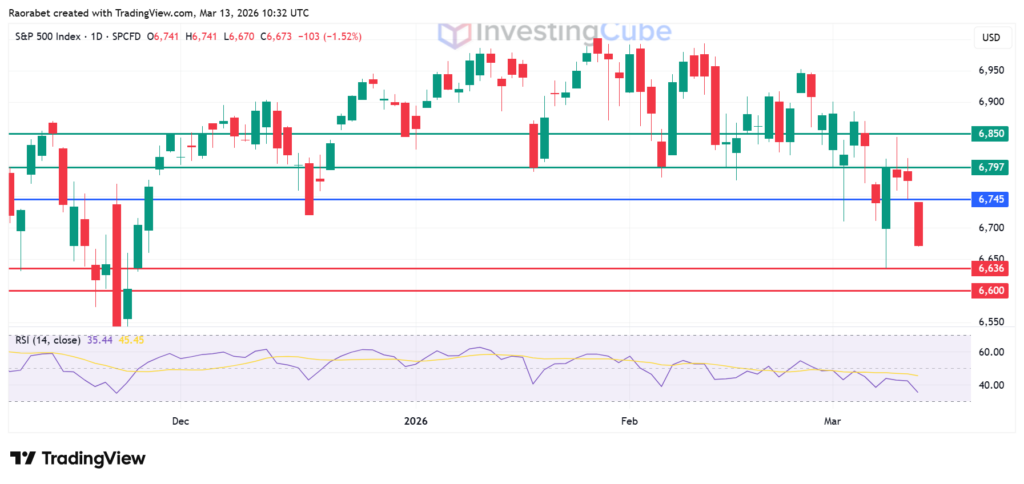
S&P 500 Index daily chart with key support and resistance on March 13, 2026. Created on TradingView
The main reason was that Iran’s new Supreme Leader closed the Strait of Hormuz, which sent crude oil prices above $100 per barrel and raised fears of inflation. That is putting pressure on the Federal Reserve and lowering the value of stocks in general.
Investors viewed mega-cap tech as a safe haven due to their strong balance sheets and AI growth potential, which offered a hedge against inflation caused by oil prices hitting $100 per barrel.
Palantir Technologies, Broadcom, and Micron Technology were the biggest winners, showing that the AI and chip industries are doing well. Mega-cap tech stocks kept the S&P 500 and Nasdaq stable by doing better than other sectors and limiting overall drops.