
- The BSE Sensex Index is approaching the psychological round-figure support of 74,000, near 52-week lows
- Rising crude oil prices have raised pressure on India's dollar reserve, with import bill potentially rising by $70-$80 billion
- IT stocks were already strained prior to the current war-induced decline, with perceived AI bubble risks
Since mid-February 2026, the BSE SENSEX hasn’t stopped slipping – losing over 10 percent in just four weeks. On March 13, it ended trading at 74,563.92, down nearly 11.24 percent compared to where it stood around 83,000 earlier that February stretch. That kind of drop stands out among recent downturns, making investors wonder how much further the decline might go.
The Forces Behind the Decline
Oil price spike is currently the biggest cause of the declining investor confidence in markets. Since 80% of India’s oil needs are met by imports, an increase of $50 per barrel from pre-war levels of about $70 would result in an additional annual import bill of about $70–$80 billion. Surging energy costs have fueled inflation concerns, weakened the Indian rupee to near-record lows around 92 against the dollar, and amplified import burdens for oil-dependent India.
Banking stocks also contributed significantly to the downturn. At one point, the Nifty Bank index slipped nearly 1.94%. HDFC Bank, ICICI Bank, Bharti Airtel, Axis Bank, Mahindra & Mahindra, plus Reliance Industries saw sharp drops. These alone erased more than 700 Sensex points that day.
Heavy selling in banks often hints at deeper worries. The focus is not just about profits now, but concerns abound credit risk and liquidity strain could start spreading. Such moves carry greater weight compared to drops seen in one isolated segment of the market.
Thirdly, Foreign Institutional Investors (FIIs) have been aggressive sellers, offloading over ₹32,000 crore (about $3.4 billion) in the first two weeks of March alone. High US bond yields and geopolitical risk are making emerging markets like India look expensive relative to the risks.
Adding to these pressures, the information technology sector, which is a big part of the index, has come under a lot of scrutiny. Prior to the current war-driven decline, investors were worried that an “AI bubble” burst could hurt profits and margins and that sentiment continues to stay in place. As a result, IT stocks have dropped significantly. The Nifty IT index fell more than 8% in mid-February alone.
Is a Rebound Likely? Is Now a Good Time to Buy?
Looking ahead, rising inflation limits the Reserve Bank of India’s ability to lower interest rates aggressively in support of economic growth. Coupled with the current inflationary environment driven by energy costs, the scope for additional monetary stimulus appears constrained.

For long-term investors, such market corrections can present opportunities, especially given India’s revised GDP growth forecast of 7.4%. However, caution remains prudent. While some sectors like IT have seen valuation adjustments that may enhance their appeal, overall market participation remains weak.
A measured investment approach focusing on fundamentally sound companies with minimal exposure to oil price fluctuations or global trade uncertainties may be advisable as geopolitical risks persist.
Sensex Index Forecast
The sellers are currently in control, as seen on the Sensex Index RSI at 24.63, and action below the middle and lower Bollinger Bands. The index pivots at 75,266, approaching its 52-week low of 71,425 points. Immediate support is likely around the psychological 74,000 mark, with potential further downside toward 73,092 if this level is breached. On the upside, the primary resistance level is at 76,028 and the second one will likely be at 76,810. The Index will have to create support at 76,000 points to build traction for the upside.
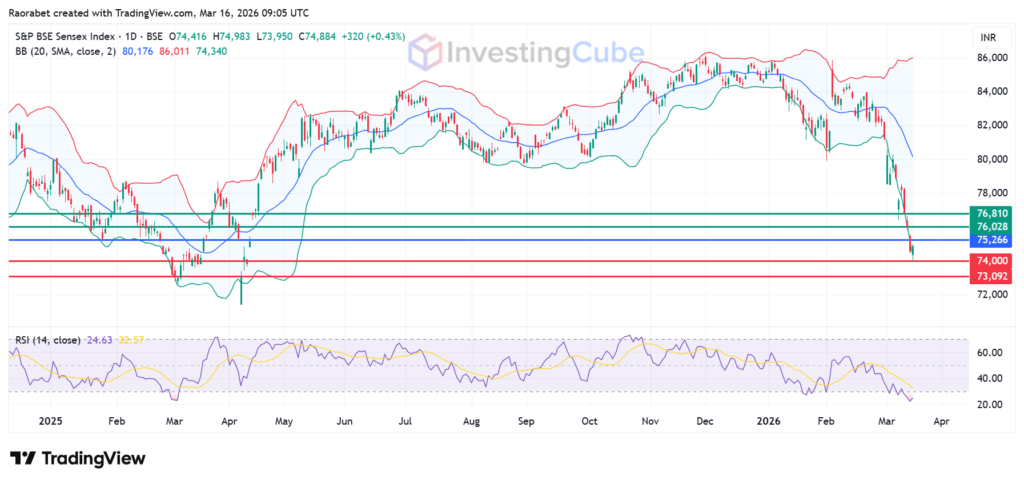
Sensex Index daily chart on March 16, 2026 with the key levels of support and resistance. Created on TradingView
India’s economy is the most vulnerable of the major Asian economies to a closure of the Hormuz Strait because it relies on oil imports for 80% of its needs. The index is facing three headwinds at the same time. It had record FII outflows of $49 billion in March, rising domestic inflation, and rising domestic inflation.
Prolonged Middle East conflict, sustained FII selling, rupee weakness, and poor market breadth could push the SENSEX toward lower supports like 74,000.
Long-term investors may want to buy quality stocks at lower prices, but they should be careful because there is a chance that prices will go down even more.