



- The Nikkei 225 has experienced a violent selloff, plunging nearly 4% to break the 55,000 support level following a peak of 59,332 in February 2026.
- The Bank of Japan (BOJ) has entered a state of "strategic paralysis," likely delaying its planned March interest rate hike to April or July as it weighs imported inflation against recession risks.
The 2026 Macroeconomic Shock
The Japanese equity market is currently in turmoil following a deep and complex economic crisis as of March 5, 2026. The shattering collapse of the Nikkei 225 index defines this period, a startling turnaround following all that cheery talk just months ago. Global financial markets have turned aggressively risk-averse in the wake of sudden and massive escalation of military conflict involving the United States, Israel, and Iran.
The Nikkei Index has since endured it’s steepest drop since late last year, tumbling nearly 4% in a single trading round. And in doing so, it practically obliterated the important 55,000 barrier line, losing more than 2400 points from recent highs to become stuck between 53.8k to 54.6k. This geopolitical crisis has box-up the kind of bullish action that previously delivered and all time high 59332.43 as recently as February 2026 and calls for a complete reassessment of both near-term volatility and long-term price dynamics.
Geopolitical Catalyst: The Strait of Hormuz Crisis
The catalyst driving this violent equity selloff is the immediate freezing of global energy supply chain, namely the functional shutdown of the Strait of Hormuz. As a strategic maritime checkpoint for the movement of nearly 20% of the world’s daily oil supplies, its blockade has provoked a vicious and instant repricing in the commodities market.
Brent Crude: Future contracts are up above $81 a barrel.
WTI: West Texas Intermediate also broke above key resistance at $70.
For Japan- a resource-poor country that accounts for about 80% of its oil and natural gas imports from the Persian Gulf — this is a “worst-case” macroeconomic scenario. This possibility of a continued disruption to supply has caused panic selling in energy-linked and cyclical sectors. Why shadows are hanging over heavyweight transportation and technology equities as investors price in higher operational costs. Japan has strategic petroleum reserves that could sustain its economic for over 200 days, but the psychological and inflation toll is suffocating, investors risk appetite.
Monetary Policy: The BOJ’s Strategic Paralysis
A factor weighing on the outlook for equity is Japanese yen inverse relationship and its corresponding flow-on effect through monetary policy domestically. Traditionally seen as a war-time safe haven asset, the yen is being weighed down by the sheer scale of the energy shock and the US dollar dominant. This has propelled the USD/JPY exchange rate closer to the 157.70 mark.
Such persistent currency weakness and surging energy import bills, threatens to trigger a bout of debilitating imported inflation. This imperils corporate profit margins and the real disposable income for Japanese consumers with the results that the Bank of Japan (BOJ) has been left in a position of strategic paralysis:
- Previous expectations: Before the conflict, it was widely expected that the BOJ would implement the 25 basis point interest rate hike at its March 18-19 meeting to normalize policy after decades of deflation.
- Current pivot: Sources now say the central bank is very likely to hold off on such a hike and will need further time to determine whether oil-driven inflation will kill economic growth, not boost it.
- Market repricing: Swap market pushed to call for the next hike out to April, or July 2026

Technical Outlook: Short-Term Volatility
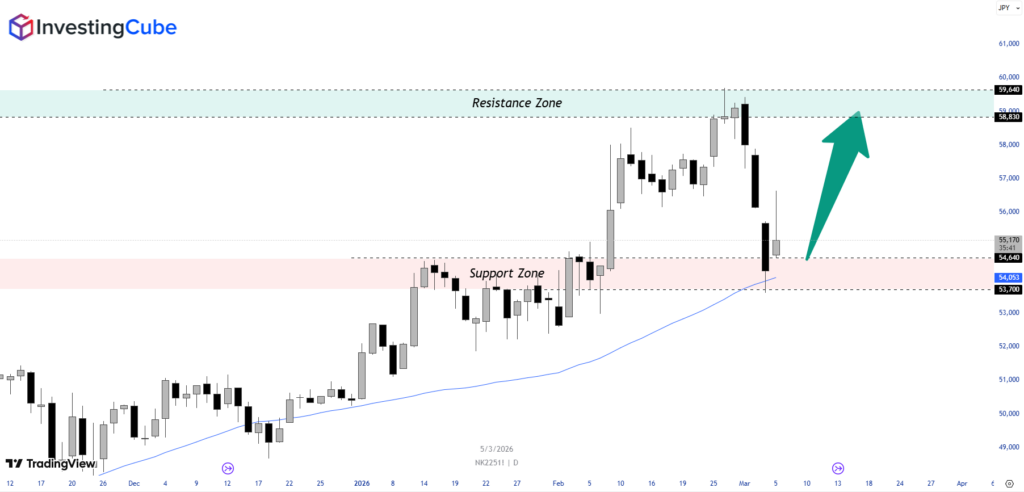
Technically, the short-term prospects for Nikkei 225 are exceedingly volatile and skewed to the downside. The index is also receiving short-term technical support around its 50 days simple moving average (SMA) at 54,638 and it can be defined as a hazy point of stabilization.
But future markets — in particular of the Chicago and Osaka contracts — do exhibit continued weakness, assigned that there is practically zero conviction on the part of buyers at rates we are seeing now. A sustained geopolitical panic would mean that the 50-day moving average may get crushed, as a result of which the index is set to test its secondary support zone at 53,370. Institutional “worst-case” scenarios already charted downside risks two word 51,700 should fears of a global recession begin materializing in tandem with energy shock.
Medium to Long-Term Forecast: Structural Optimism
Despite the immediate bearishness, medium to long-term price predictions on Nikkei 225 remaining structurally optimistic in nature. Such an outlook is dependent on a stabilization of Middle Eastern geopolitics and easing of their energy risk premium.
Japanese corporate fundamentals remain extraordinarily solid. More than half of Japanese companies have exceeded recent assumptions for earnings, reflecting strength in a post-pandemic world. Moreover, two significant domestic factors are likely to act as a huge tailwinds for demand:
- Fiscal stimulus: ¥21.3 trillion economic stimulus package by Prime Minister Sanae Takaichi.
- Corporate Reform — continuing governance reforms intended to increase the efficiency of capital and maximize returns to shareholders.
Institutional analyst at Goldman Sachs and Sumitomo Mitsui predict that once the current crisis passes, the Nikkei 225 will return to its upward trajectory aiming for between 58,500 and 61,500 by the end of 2026.
Investor Advisory
Prudence continues to recommend against reflexive “dip-buying” over the near term. Instead, the market must be watched through the prism of 54,638 support level and international crude rates. Japanese equities will only find a durable floor once energy prices settle.
Frequently Asked Questions
The main reason is energy insecurity. Japan gets almost all of its oil through the Strait of Hormuz. That route is blocked by conflict, and surging oil prices and a weak yen corporate profits and investor confidence.
Likely not in March. The BOJ initially had a intention of a rate hike only to become in “strategic paralysis”. They have to wait and see whether high oil prices generate a recession before they take the risk of tightening monetary policy further.