- Hang Seng Index has entered a consolidation phase after strong gains earlier this year.
- Technology stocks weakness and global uncertainty are driving recent market pullbacks.
- Energy and commodity shares show relative resilience amid rising oil prices and geopolitical tensions.
After a spike earlier this year, the Hang Seng Index (HSI) has recently entered a phase of consolidation. A combination of global uncertainty, sector rotation, and near-term technical pressures continues to apply moderate pressure on Hong Kong equities, even as a broader macro environment remains mixed. Investors are now monitoring if the index can find stability above crucial support levels or whether more downside correction may take place in the short term.
Market Background
Hong Kong shares were in the selling vanguard again in the most recent session and pressing on beyond the 25,500 handle by the close of that trading day — down around one percent for it. The pullback was largely powered by weakness in the biggest technology stocks, which have been some of the best performers in recent months. Shares of major Internet companies, such as Alibaba, Baidu and Meituan, retreated after investors cashed out their profits following an earlier rally.
At the same time, sentiment around the broader market is cautious. Global investors are still trying to gauge the outlook for monetary policy in a major economies, especially the United States. While inflation data has suggested some moderation, uncertainty regarding the timing and scale of potential interest rate cuts continue to add to volatility in global equity markets.
Geopolitical events are another reason for market caution. The shifting tensions in the Middle East have sent crude oil prices up and given energy stocks a lift even as they raise concerns about inflationary pressures in the economy and disruptions to growth. As a result, investors have started moving capital into more defensive or commodity-linked sectors such as the energy and resource companies.
This rotation has been very clear within the Hong Kong market. As some tech and growth stocks have faltered, energy-oriented shares, and select commodity producers have held up relatively while enjoying windfalls from rising world resource prices. On the other hand, gold related stocks have witnessed some profit booking after the global prices jumped in recent weeks.
In conclusion, we find ourselves in a balanced market-enhancing cautious optimism and simultaneously safeguarding against short-term risks as all investors keenly observed macroeconomic indicators alongside geopolitical shifts.
Technical Structure
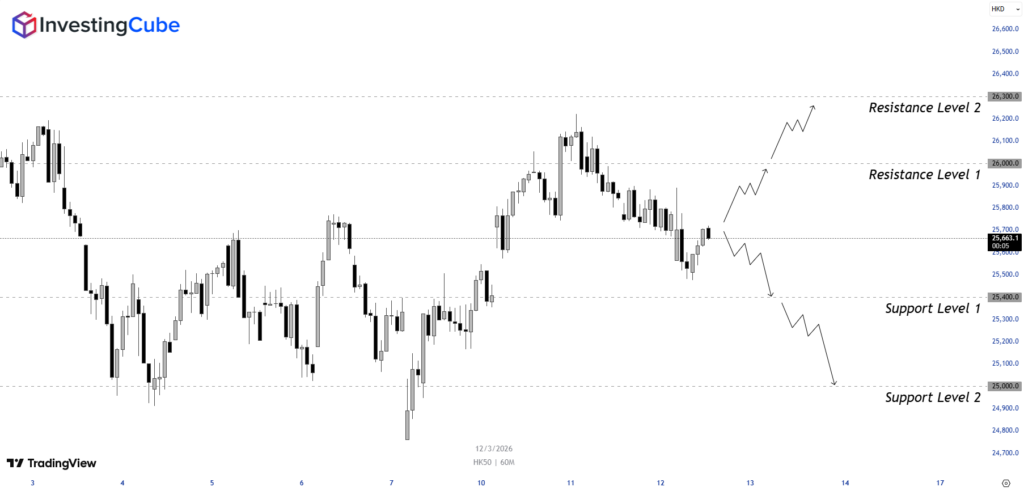
Technically, the Hang Seng index seems to be shifting from a bullish trend into a short-term consolidation structure. The latest drop sent the index below its 10-day moving average, a sign that short-term momentum has soured.
We have a pull back, but if key support levels hold, the broader structure remains quite constructive. The index continues to test multiple technical levels that were previous resistance backing earlier phases of the rally.
Key levels to watch include:
Resistance Levels:
- 26,000
- 26,300
Support Levels:
- 25,400
- 25,000

Derivatives market positioning data suggest that weekly risk matrix are marginally skewed toward in bullish sentiments above bearish positioning. Nevertheless, these products are heavily concentrated around the 26,300 mark, indicating that if the index attempts another rally to refill the area, it may face substantial resistance.
Short-Term Outlook
Moving forward, it may continue to be sensitive to global macro developments and sector specific flows for the Hang Seng index. The near term outlook could play out along three lines.
Scenario 1: Sideways Consolidation (Most Likely)
Assuming a continued relatively stable global market and no major macro shocks. It can move into consolidation zone between 25,000 to 26,000. Such an evolution would allow the market to digest recent gains, as investors re-evaluate valuations and policy expectations.
Scenario 2: Deeper Correction
If tech stocks underperformed further or global risk sentiment continues to weaken, then the index could break below 25,400 and expose a deeper back towards 25,000 or 24,800 area. Such a move would tend to reflect an overall risk-off rotation in equity markets worldwide.
Scenario 3: Renewed Upside Momentum
Or if positive catalysts come in waves — be it more upbeat Chinese economic data, policy stimulus or rebound in global technology stocks — the Hang Seng Index could catch wind and retake 26,300. A consistent move past that would open up space for another rally.
Conclusion
Now it seems the Hang Seng index is in a mini consolidation phase after early rally. Although the macro uncertainty and sector rotation have initiated a mild pull back, the broader market structure has not yet turned sufficiently bearish.
Provided that the 25,400 to 25,000 support zone remains intact. The index could continue trading in a consolidation range before establishing its next directional move. Investors should thus keep track of the evolution of global interest-rate expectations risks from geopolitics and the performance of leading technology stocks, all likely to play a critical role in deciding how the Hang Seng index trend looks next.
Frequently Asked Questions
A pullback was largely spurred by profit-taking in major technology, shares and caution throughout the world as investors reassess interest-rate expectations and geopolitical risks.
The index has important support around 25,400 and then add 25,000 which could determine whether the index stabilizes or goes for a deeper correction.
More robust Chinese economic data policy stimulus or renewed strength in global tech stocks could provide the index with a much needed bounce and challenge resistance close to 26,300.