


- The Middle East conflict has created a dual safe haven effect, with the US dollar's attraction partially affected the the US' direct involvement in the war
- The yen is considered the alternative to the USD but rising oil prices amidst the war increases Japan's oil import bill, favouring USD/JPY gains
- Interest rate differential between the US and Japan is still relatively big, keeping carry trade attraction alive
The USD/JPY pair has been down in the last two sessions, testing the 156.00 level after a period of calm. March’s start was anything but calm for currency markets. The war between the United States, Israel, and Iran began on Monday, with the US launching a big attack against Iran’s leadership and military with Israel, reportedly killing Supreme Leader Ayatollah Ali Khamenei.
The Dollar’s Safe-Haven Status Under Examination
Usually, when war breaks out in the Middle East, people seek safety, which usually helps the Japanese Yen. But March 2026 is different. We’re seeing a clash of havens. The yen may stage resistance up because investors fear a wider conflict. The U.S. Dollar is also up because it is still the world’s main source of cash.
Bloomberg mentioned that traders looked for safe assets in early Asian trading, with the US dollar rising against some currencies. The yen didn’t change much, showing a balance between dollar demand and safe-haven yen flows.
Interest Rate Differential a Key Attraction
But there’s another factor. The interest-rate difference between the US and Japan is still big. ING forecasts that USD/JPY will test the 155–160 area in 2026, expecting another BoJ rate increase in late 2026 that would bring the rate to around 1%, still much lower than the Fed’s rate. This difference keeps carry-trade pressure alive, supporting USD/JPY even as geopolitical risk pushes it lower.
As the war increases global uncertainty, the dollar’s exposure to risk is also growing. The US’s involvement increases the risk of actions that hurt supply chains and energy prices, which could weaken dollar support if it causes higher inflation or a slower economy.

Oil Factor in USD/JPY Trajectory
Energy markets are key to understanding the war’s impact on USD/JPY. Iran is a big producer and is located near the oil-rich Arabian Peninsula across the Strait of Hormuz, which handles about 20% of global oil supply. A long conflict that affects Hormuz traffic could push oil to $100 per barrel, restarting global inflation.
In the next few days, watch USD/JPY as a reflection of oil prices. If Brent crude keeps climbing toward $100, the Yen will likely suffer due to Japan’s rising import costs.
USD/JPY Forecast
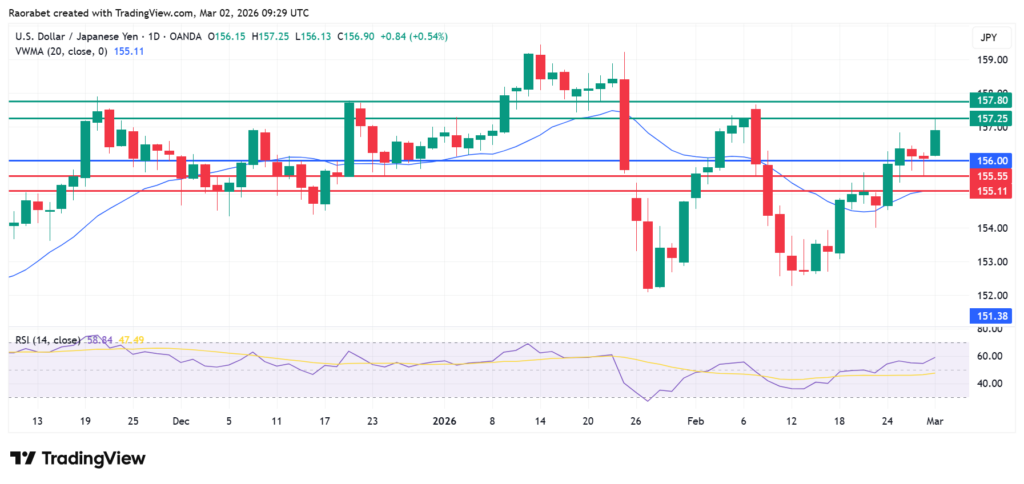
The USD/JPY pair is has its RSI at 58, signaling control by the buyers. The pivot is at 156 and immediate resistance is at 157.25, beyond which a stronger momentum could test 157.80. Immediate support is at 155.55, with a stronger support at the Volume Weighted Moving Average (VWMA) at 155.11.
In this conflict, the US is a direct participant, and that erodes a significant portion of the US dollar’s neutral safe-haven appeal.
The conflict has created a dual haven effect. The yen registered gains initially due to fear, but the dollar’s liquidity and U.S. energy independence often cause it to outperform the yen as energy prices rise and trade balances change.
Japan relies heavily on imported oil. Instability in the Middle East hurts energy supply chains, which affects Japan’s economy more than the U.S. economy, weakening the Yen’s safe-haven appeal.