


- Today's U.S. CPI release is the primary driver; a reading of 0.2% or lower could solidify expectations for a June Fed rate cut and weaken the dollar.
- A potential Bank of Japan hike to 1.00% in April is narrowing the yield gap, threatening to trigger a massive unwinding of the yen carry trade.
Macro Fundamentals
At 158.30 level in the early Asian session, the USD/JPI currency pair is involved in a make or break situation of price discovery, as it seeks to resolve the limbo between conflicting bullish and bearish narratives with no clear driving force from either side. Current market conditions are shaped by a high stakes environment in which signs of United States economic cooling start to collide with a BOJ awash in caution, but steadfastly will be closer to further policy normalization.
However, with the US consumer price index CPI expected later today, volatility should be getting loud as traders assess whether a long-standing yield advantage of dollar — the key engine behind its multi#year rally is finally close to its structural climax. The greenback’s main relationship in early March has been to a run of softening labor print underscoring the Fed’s restrictive stance starting to bite.
February’s jobs report revealed an unexpected contraction of 92,000 non-farm payrolls and the unemployment rate ticked up to 4.4%. A CPI reading in line with 0.2% monthly forecast or below today would likely consolidate expectations for a mid-year pivot, putting further pressure on the dollar.
Japanese Policy Dynamics: Rate Hike Expectations and Energy Pressures
In Japan, domestic political dynamics and external shocks intertwine with the policy landscape. The new Prime Minister Sanae Takaichi has come under fire recently for her reticence towards a monetary policy reversal, while Bank of Japan governor Kazuo Ueda has insisted the central bank will continue to raise rates if the economic outlook is realized. Current swap market price in 60% to 65% probability of a further 25 basis point increase in April, which would raise the policy rate to 1.00%.
After nearly 30 years of ultra loose policy, this shift marks a seismic change for a Japanese economy. The geopolitical landscape also has been an important driver of recent Yen strength. That fears of conflict sent oil prices to $120 per barrel earlier this month, which has historically weighed on the yen because Japan relies on imports for its energy. But recent diplomatic optimism has sent Brent back to the $90-$92 range. This fall-off in energy cost has eased pressure on Japan’s trade deficit, letting the yen recover as a regional safe haven.

Technical Analysis
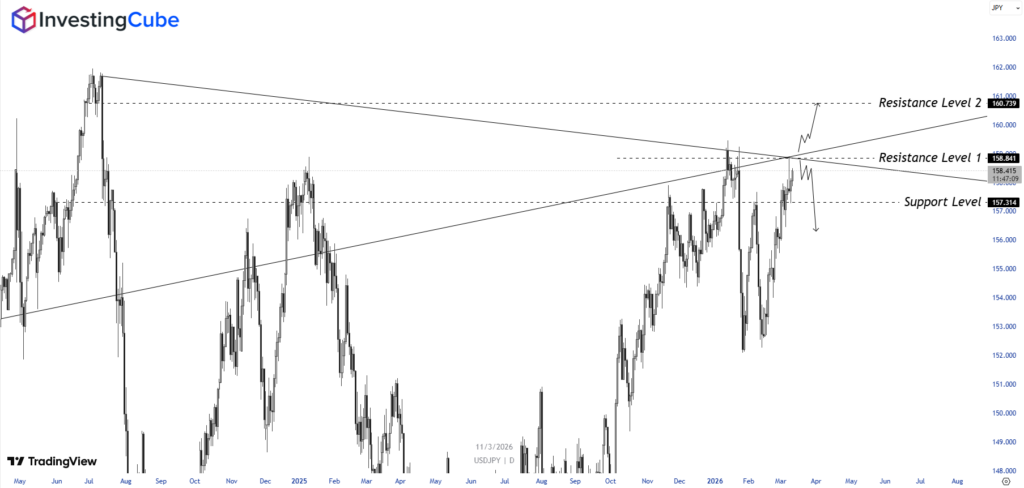
Daily chart-wise, from a technical perspective, the USD/JPY remains trapped in a high conviction “Squeeze Play” at an important structural crossroad. Currently, price wavers at resistance level 1 (158.84) where multiple key trendlines intersects and serve as a crucial pivot point. More precisely, the confluence of a major descending trendline starting from mid-2024 highs and a steep ascending trendline that has guided recovery since late 2025. This is forming a tight apex, and it leads to either decisive breakup or rejection. If the bulls can clear and hold above 158.84, then the technical path continues towards resistance level 2 (160.73), effectively retesting those highs around a psychological figure over the last year or so. However, looking at the price action currently, it is indicative of some sort of “double top” or rejection scenario up at this apex, which has historically resulted in steep corrective moves.
Trend Outlook: Carry Trade Unwinding and Currency Realignment
A confirmation of cooling inflation by tonight’s CPI data could see an accelerated and potentially volatile unwinding of the yen carry trade. The long dollar story relies on attractive yield differentials between US 10-year treasury and Japanese government bonds (JGBs) which is becoming less and less of a fundamental argument as yield converge. Financiers who have borrowed yen to invest in dollar assets with greater yield could scramble to close positions, possibly driving the pair into a range of 148.00 to 152.00 by mid year.
Japanese companies will likely begin repatriating dollar-denominated earnings to guard their profit margins against a stronger domestic currency, as well. In conclusion, now is momentous from a technical and fundamental perspective for USD/JPY. Geopolitical risk are even present, but the current technical setup suggest a corrective move lower. For investors in the ramp-up to Q2/2026, the defense or breach of 157.35 support will likely determine the primary trend
Frequently Asked Questions
The most important level is Resistance Level 1 at 158.84. This is where major long-term and short-term trendlines intersect. A break above this could lead the pair toward 160.73, while a failure here could trigger a sharp drop toward the 157.31 support level.
The market is looking for a monthly increase of 0.2% or less. If the data confirm that inflation is cooling, it will likely strengthen expectations for a Federal Reserve cut in June. This would put downward pressure on the dollar and potentially trigger a massive unwinding of the yen carry trade.