
- The USD/JPY dropped sharply in early-mid February, declining by about 2%
- Interest rate differentials are still in play, but US Supreme Court trade tariff ruling has disrupted the market
- The 15% blanket tariffs have created caution around the dollar with the Japanese yen seen as a safer shelter
Early February 2026 brought wild swings for the USD/JPY currency duo. Right before the middle of the month, it plunged nearly two percent without warning. Yet just days later, a turnaround began out of nowhere. Gaining back about one percent lifted it close to 155 again by now. Downward pressure had dragged it fast from heights beyond 155 down toward 152.65 only briefly before reversing.
What’s Behind the Recent USD/JPY Movements?
A sudden plunge just before mid-February came mostly as rumors spread about possible joint moves by Japan and U.S. officials. Meanwhile, stable government debt returns in Japan gave the currency extra backing. Even so, Japan’s core CPI dipped just a bit to 2.0% – data out from the country’s stats team – yet traders now bet harder on a BoJ rate rise come April. That idea acts like a lid. Whenever the dollar gains steam, worries about shrinking interest gaps drag it down again.
The Trade Tariff Wildcard
The market consensus is that USD/JPY is stuck in a range between 152 and 157, just waiting for a central bank to make a move. While many analysts view the recent US Supreme Court ruling as a turning point, it is clear that the situation remains complex and uncertain. Reciprocal tariffs are often seen as a reason for the dollar’s strength because of safe-haven flows. But I think the recent ruling might actually be a yen-positive catalyst in disguise.
The February 20 US Supreme Court ruling and Trump’s aggressive new global tariff response has boosted the Japanese yen’s safe-haven appeal. Investors are buying yen amid uncertainty over US trade policy, global growth risks, and potential retaliation from trading partners.
Is an Extended Decline Below 156 in the Making?
Even though the latest bounce cheered up those betting on the dollar, slipping under 156 again soon wouldn’t be surprising. Right now, prices are bumping into a wall near 155.00–155.50. If they can’t push through, sellers might jump back in, aiming for 152.00–153.00. According to BNP Paribas, where the yen heads over time may depend more on how debt and rising prices play out, not just interest gaps – hinting at room for small gains ahead.

This shakes up the idea that USD/JPY will smoothly hold levels beyond 156. Intervention risks combined with a firmer stance from the Bank of Japan might limit upward moves more than expected, particularly should US economic figures weaken. Higher inflation in America or reduced worldwide expansion triggered by fresh tariffs could push the Federal Reserve toward steeper rate reductions, weighing on the dollar. On the flip side, meaningful income from those duties or trade outcomes tilted in America’s direction might revive strength in the currency.
USD/JPY Forecast
The MACD on USD/JPY is negative and the bar graphs are flashing red and denoting control by the sellers. The pivot is at the intraday high of 154.95 and primary support for the pair holds strong near 153.99. A break below that level could result in the pair going lower to test 153.50. Above the pivot, price meets resistance at 50-day EMA at 156.22, with another ceiling forming at 157.50.
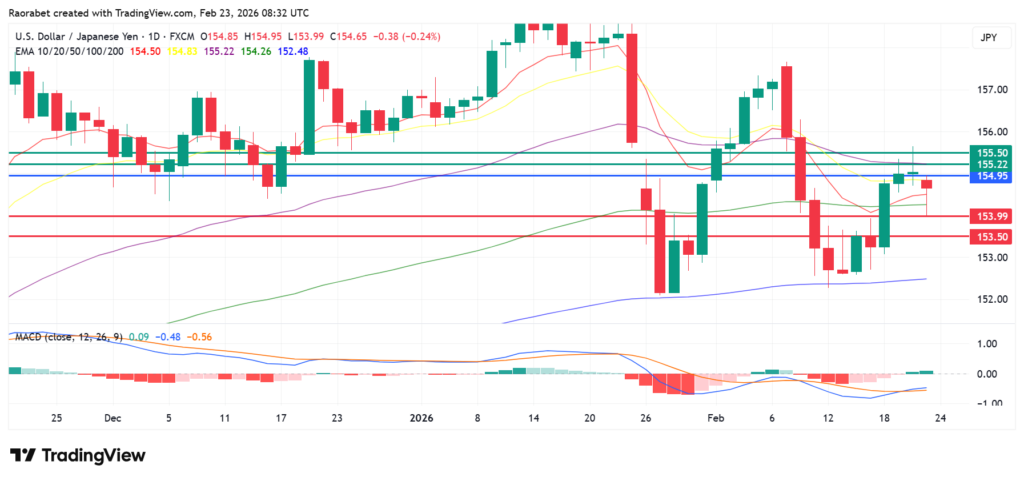
USD/JPY forex pair with key levels of resistance and support on February 23,2026. Created on TradingView
When tariffs hit, the US dollar sometimes rises right away, yet confusion spreads across markets worldwide. During heated trade clashes, investors flock to the yen, seeing it as shelter, and that move drags USD/JPY lower.
The USD/JPY decline came after the Bank of Japan sounded stricter on inflation, mixed with upbeat trade numbers. Because of that, markets started pricing in faster moves toward higher rates in Japan compared to America.
Yes. Right now, prices sit under 156.00, a number traders watch closely. When levels hold steady beneath it, pressure builds to the downside. That kind of range often signals shifting balance – downward motion starts shaping the outlook over weeks ahead.