



- The Indian Rupee plummeted to an all-time low of 91.74 against the USD, forcing a multi-billion-dollar RBI intervention to stabilize the rate near 89.27 - 89.80 range.
- While India's GDP growth remains robust at 7.4%, a domestic "liquidity paradox" has emerged, where bank deposit rates (6.90%) are significantly outstripping the official repo rate (5.25%)
As of the beginning of March 2026, the USD/INR rate has entered a phase of extreme historical volatility. This turbulence is being driven by an unprecedented combination of geopolitical shocks, changing monetary policies and intensifying protectionism. The Indian Rupee recently hit an all-time low of 91.74 against the U.S. dollar only after a vigorous multi-billion-dollar intervention by the Reserve Bank of India (RBI) did the currency manage a rebound, which is now consolidating in the 89.27 to 89.80 range. The prevailing environment demands a thin line to be walked between India’s robust domestic growth, and its acute external crisis.
Geopolitical Shocks and the Energy Transmission Mechanism
The most immediate such catalyst for Rupee stability, however, remains the sharp turn in Middle East tensions. The recent coordinated military actions by the United States and Israel against Iran, have thrown global energy markets into fundamental disarray. As a result, Brent Crude futures have surged above $82 per barrel and are sitting at multi-month peaks. Structural risk premiums now threaten to drive prices toward the $95 to $110 barrier, if disruptions in the Strait of Hormuz become real.
This is an asymmetric risk for India. India, the world’s third largest oil consumer, import more than 85% of its crude needs and roughly 40% of that over the Hormuz chokepoint. A punishing correlation becomes apparent through analytical models: for every dollar increase in crude oil prices, India’s annual import bill rises by around $2 billion.
The transmission mechanism is inexorably for the Rupee. Rising oil prices lead to higher “imported inflation”, which in turn raises domestic bond yields and squeezes equity valuations. This set up a vicious cycle of capital flight as for investors flee into lower-risk venues, further depressing the Rupee vs the Greenback.
The U.S. Economic Cross-Currents
At the same time, the U.S. macroeconomy has produced strong-cross-currents. In early 2026, the Fed implemented an emergency 50-basis-point rate cut, bringing the benchmark down to range of 3.50% to 3.75%. The unusual inter-meeting action was a spurred by pressure on short-term funding following the demise of Chicago-based Metropolitan Capital Bank & Trust on January 30, 2026, a failure linked to a rapidly souring commercial real estate environment.
A more aggressive Fed ease cycle typically begins the dollar through lower yield differentials, but two things have up and this “textbook” response:
- Sticky inflation: Core PCE staying raw, up 0.4% month-on-month.
- Safe-Haven Demand: Iran war Sparks “flight to quality. and now global capital rushes to U.S. Treasury and Dollar, no matter the interest rate cuts, just to escape geopolitical risk
Trade Wars and the Services Sector Crisis
To add to these woes, the U.S. Administration has recently gone protectionist. The introduction of 50% tariffs on crucial Indian exports and a jaw-dropping 24 hike in H-1B visa fees up to $100,000 has dealt a devastating blow to India’s services sector.

The H-1B fee increase, in fact, hits the epicenter of India’s IT exports model; it will inflate dramatically the cost of doing business for Indian technology giants. Massive FII outflows have been triggered by these measures. Foreign institutional investors sold off more than $19 billions worth of Indian equities over the previous year, including $2.7 billion worth in March 2026 alone. Such a free-fall of “hot money” places persistent downward, pressure on the Rupees spot price.
The Domestic Silver Lining and the Liquidity Paradox
Against these external headwinds, India’s internal engine is surprisingly strong. GDP growth for Q3FY26 was revised up to 7.4%, while February’s gross GST collections hit an impressive RS 1.83 lack crore.
The RBI has held its repo rate at 5.25% to facilitate this growth. But a troubling “ liquidity paradox” has taken hold. The official repo rate is at 5.25% S compared with one year rates on certificate of deposit (CD) for large banks which are close to hitting as high as 6.90%. That is because credit growth is far outstripping deposit formation. In a bid to protect the Rupee without tightening and already pressed banking system, the RBI has so far pumped in more than $2 billion through FX swaps and on-spot dollar sales, calming down speculative “long-dollar” positions while not stressing cash in India.
Technical Indicators and USD/INR Price Prediction
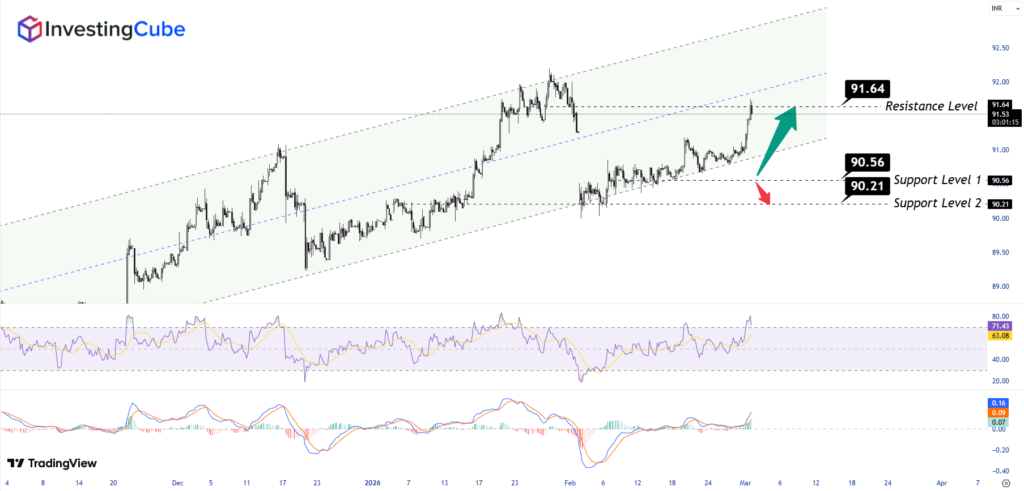
From a technical point of view, the USD/INR pair continues to be embedded in a powerful bullish ascending channel.
Momentum: The Relative Strength Index (RSI) is at 76 (overbought territory) and the MACD is still trending higher.
Essential Levels: The pair has broken significant resistance of 91.06; risk-off traders will look to 95.00 next on the upside. On the other hand, there is downside support around 90.56 and a major support at 90.21.
Frequently Asked Questions
The paradox means that while RBI wants to keep interest rates low (5.25%) to spur growth, a lack of deposits in banks is making them offer a higher rate (6.90%) to lure cash. For the consumer, this means home and auto loan rates might remain higher for longer than official “repo rate” alone indicates, as banks pass higher borrowing cost onto Main Street.
India’s information technology services sector is a significant driver of U.S. Dollar inflow into the country. If the visa fee goes twentyfold, then it becomes a lot more expensive for Indian firms to send talent to U.S. or retained contracts. Investors are being frightened by lower service exports and fewer dollars flowing into India, raising the “Current Account Deficit” phobia that makes the Rupee weak.