



- USD/CAD has recently broken below 1.3600, with the Canadian dollar standing out against the USD amid DXY index gains
- Rising oil prices favour the Canadian economy, with Canada being the only major economy outside the US among DXY currency countries with oil exports
- Interest rate differentials between the Federal Reserve and the Bank of Canada are in focus ahead of monetary policy meetings this month
While the U.S. Dollar Index (DXY) has been flexing its muscles globally, the USD/CAD pair has done the exact opposite. After failing to find any meaningful traction above the 1.3680 mark, the pair took a sharp turn, sliding decisively below 1.3600 over the last few sessions.
The Geopolitical Oil Spike
The energy markets’ enormous risk premium is the main factor causing this unexpected resilience. WTI crude prices shot up toward the $90–$100 range in early March after military actions in the Middle East and the Strait of Hormuz’s subsequent closure.
Canada makes more US dollars for each barrel it exports when oil prices rise. In order to purchase Canadian oil, foreign buyers must exchange their money for Canadian dollars, which raises demand for the CAD and makes it stronger relative to other currencies. The mechanism of petrocurrency is well known. Its relative size in comparison to the safe-haven dollar bid in this particular crisis is underappreciated.
It is not an anomaly in the market for the DXY to rise while the USD/CAD declines. Right now, during this crisis, the Canadian dollar shows how differently it behaves compared to other G10 peers. Oil prices dropping actually boost Canada’s income. Other G10 nations either rely on imported oil or lack enough economic weight to shift the balance.
Is the Performance Likely to Change?
The rise in oil prices is influencing the Canadian currency market for the Bank of Canada (BoC), but it’s also causing some uncertainty that could affect Canada’s growth in the future. The BoC has seemed more aggressive than the Federal Reserve, which has helped support the Canadian dollar, along with good news about jobs and retail sales.

What happens soon depends mainly on whether oil stays above $100 and whether the Fed makes any unexpected announcements on March 18. People are now waiting for Canada’s jobs numbers out Friday, which will give a final look at the job market before the BoC’s policy decision in March. In the U.S., everyone will be watching the CPI data on Wednesday and the PCE Price Index on Friday.
USD/CAD Forecast
Downward pressure on USD/CAD shows clearly in the MACD’s bearish crossover. The pivot is at 1.3600. Primary resistance is first at 1.3621, beyond which it could test 1.3643, currently aligning with the Volume Weighted Moving Average (VWMA). Only when prices close above that range are we likely to see a bullish reversal. Sitting just below the pivot at 1.3563 is the first nearby support, though firm ground appears further down at 1.3526.
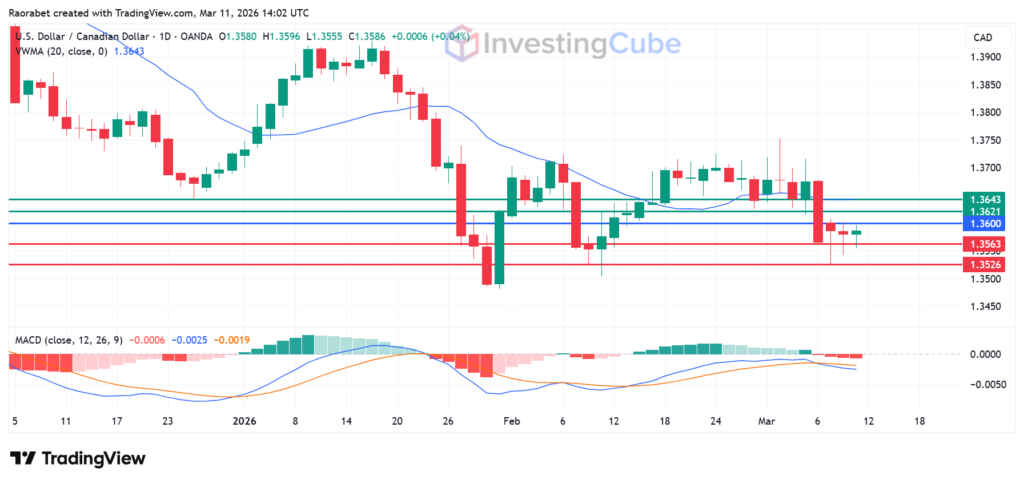
USD/CAD on the daily time frame showing key levels of resistance and support on March 11,2026. Created on TradingView
While the DXY is rising due to safe-haven flows, the Canadian Dollar is outperforming it because of the massive spike in crude oil prices. As an energy-heavy currency, the CAD is currently benefiting more from the oil trade.
It’s unlikely. Despite higher headline inflation from energy, the BoC is focused on a slowing domestic economy. Current market odds favor a prolonged pause at 2.25%, as raising rates now could further hurt struggling Canadian households.
The likelihood is slim unless oil prices drastically decline in the near future. The 1.3680 level has proven to be a hard ceiling, and the technical breakdown suggests that sellers are waiting to jump in on any minor rallies.