- USD/INR went from above 92.00 to barely holding above 90.00 in early February
- US-India trade negotiations have recently resulted in a tariff cut on Indian imports from 50% to 18%, helping strengthen the rupee
- The RBI has a record $723 billion in reserves, which it could use to intervene in the forex market
Seeing the USD/INR lately means seeing a sharp rebound unfold. Early gains had the Rupee moving up, slipping from 92 down to about 90.12 by February’s start. Yet things shifted. From February 3, 2026 onward, movement reversed – step by step, then faster, reaching close to 91.20 just recently.
Behind the Rebound
The major reason for the recent appreciation in the value of the USD/INR exchange rate has been the result of renewed dollar demand and positive US-Indian trade relations. The announcement of an interim trade deal that cuts US tariffs on Indian products from 50% to 18% gave the initial boost, but the response of the rupee was lukewarm.
Additionally, the recent increase in global oil prices due to geopolitical tensions has impacted the rupee adversely, as India is a major importer of crude oil. These factors have cumulatively contributed to the dollar’s recovery, despite the mixed market sentiment.
Risks and Outlook for Q1 2026
The main risks for USD/INR in Q1 include sharper-than-expected RBI intervention, a sudden improvement in risk appetite leading to FII inflows, or a significant drop in oil prices. On the upside, stronger US data or renewed tariff uncertainties could push the pair higher.
Most in the market expect the Reserve Bank of India (RBI) to keep the Rupee range-bound, likely through an extended interest rate pause at 5.25%. Should the Federal Reserve maintain its “Hawkish Pause” at 3.50%-3.75%, the resulting yield differential could push the USD/INR floor higher than many analysts project for Q1.
The RBI’s active intervention, primarily in the 90.70-90.80 zone, selling dollars, helps prevent extreme volatility. With record forex reserves of $723.8 billion, the central bank has a significant “war chest” to maintain orderly market conditions. The recent rebound shows a blend of trade optimism and structural dollar support. Still, the outlook remains range-bound, with risks leaning towards a modest further upside for USD/INR in Q1.

USD/INR Forecast
The USD/INR MACD now sits in positive territory, signaling control by the buyers. Above the Volume Weighted Moving Average (VWMA) at 90.92 held steady, it may fuel further gains. Should price falter beneath 90.50, expect a dip toward earlier lows. Movement hinges on these levels staying firm. Range dynamics stay intact until one boundary cracks. Direction clarity likely follows a solid close beyond either mark.
Right now, 91.05 marks the first barrier, followed by a stronger one at 91.25. Below the pivot mark, prices between 90.50 and 90.70 have turned into a spot where buyers often step in, especially with RBI stepping up activity there.
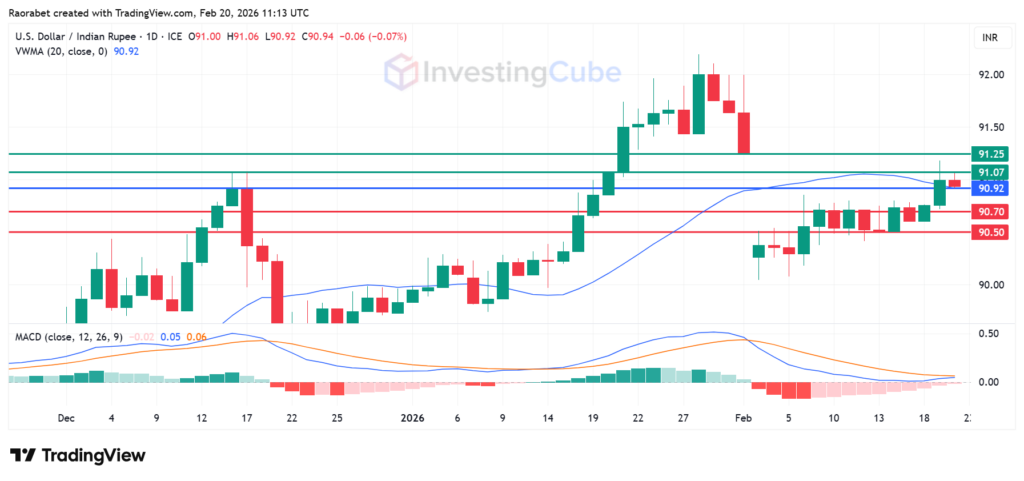
The USD/INR forex pair on the daily time frame on February 20 with its main levels of support and resistance. Created on TradingView
A sharply widening trade deficit and rising oil prices due to Middle East tensions have increased dollar demand, outweighing the positive sentiment from the recent India-US trade deal.
A small climb could happen, maybe up to 91.50 or 92.00, mostly because of what’s needed from abroad and money gaps at home. Still, hope around trade agreements might keep the rupee a bit stronger. Movement may stay limited overall.
Although analysts anticipate steady conditions, hefty import duties baked into America’s shifting trade policies may spark a temporary shortage of dollars, possibly lifting the USD/INR currency pair, regardless of India’s forecast 7% economic growth in 2026.