- Over the weekend, the Euro gained dominance as reports confirmed China has officially reclaimed its position as Germany’s top trading partner, shifting the currency’s fundamental outlook.
- Chancellor Friedrich Merz’s Tuesday visit to Beijing fuels the "Eurozone Pivot" momentum.
The Euro is effectively decoupling from its reputation as a “stagnant laggard” to take center stage as a strategic currency play. Over the weekend, the EUR/USD pair showed significant resilience, holding firm at $1.1791 as the market prepares to price in a massive shift in global trade dynamics.
While the U.S. Dollar faces internal paralysis following the Supreme Court tariff ruling, the Euro is riding a wave of renewed industrial optimism. With Germany officially pivoting its trade focus back toward the East, the Eurozone is establishing itself as 2026’s “de-risking” safe haven.
How the Germany-China Trade Pivot is Driving Structural Euro Strength
The primary engine behind this week’s bullish sentiment is a fundamental shift in European trade data. Official figures from the German Federal Statistical Office (Destatis) released on Friday confirm that China has overtaken the U.S. as Germany’s top trading partner in 2025/2026.
Market Catalysts for EUR/USD Strength:
- The Transatlantic Trade Gap: While U.S. trade policy faces legislative hurdles, the German Federal Statistical Office (Destatis) reports that German-Chinese trade hit €251.8 billion, while trade with the U.S. fell by 5.0%. This economic divergence allows the Euro to gain ground as it decouples from U.S. volatility.
- The “Merz Trip” Factor: Chancellor Friedrich Merz is scheduled to visit Beijing this Tuesday, February 24. As reported by U.S. News & World Report this high-level diplomacy acts as a massive “vote of confidence” for the Euro, signaling a period of industrial stability that protects the EUR/USD price floor.
- German Industrial Pivot: By strengthening ties with the East, Germany is effectively “de-risking” its economy. As German companies reinvest in Chinese ecosystems, the demand for Euro-denominated industrial exports creates a structural “buy signal” for the currency.
EUR/USD Technical Analysis: Breaking the Correction
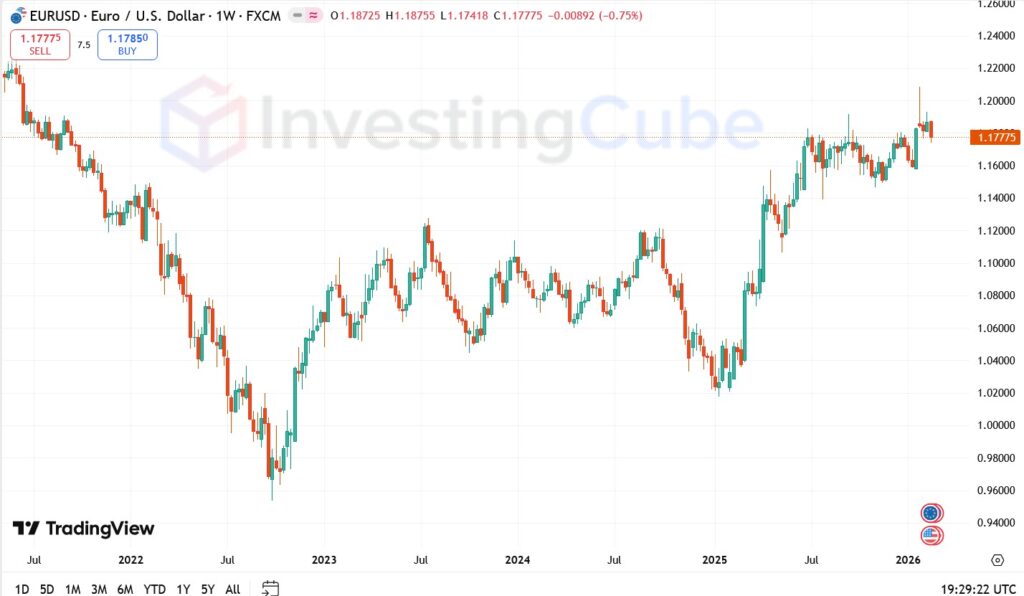
After a period of consolidation, EUR/USD has officially signaled a potential trend reversal. The weekly chart shows a strong base forming above the 1.1740 zone, with price action now testing previous resistance levels.
EUR/USD Key Technical Levels:

- Immediate Resistance: 1.1850. A break above this level during the Asian session would signify the official retreat of the “Trump Trade” and open the path to 1.2000.
- The Bullish Momentum: The pair is trending back toward its 50-EMA, triggering a “buy” signal for algorithmic traders who see the U.S. Dollar’s dominance fading.
- New Support: 1.1740. This level has flipped to a floor, serving as the primary defense line for the upcoming week.
| Level | Type | Significance |
| 1.1920 | Resistance | The major hurdle before a retest of the psychological 1.2000 mark. |
| 1.1850 | Pivot | Breaking this level confirms the end of the Dollar-dominant phase. |
| 1.1740 | Support | Critical base; bulls must hold this to sustain the Monday breakout. |
EUR/USD Trade Idea: Riding the Pivot
With the Germany-China trade deal looming, “buy the rumor” sentiment is building among institutional desks.
- Strategy: Long above 1.1810.
- Target: 1.1850 (TP1) | 1.1920 (TP2).
- Stop Loss: Below 1.1710.
Euro Outlook
The Euro is no longer a speculative laggard; it is a strategic macro asset. As long as German diplomacy continues to secure Eastern trade routes and U.S. policy remains uncertain, the path of least resistance appears to be higher. We are currently waiting for the Asia open to gauge the market’s initial reaction to the Merz-Beijing announcement.
The Euro is gaining due to a structural trade pivot where China has overtaken the U.S. as Germany’s #1 trading partner. This, combined with Chancellor Friedrich Merz’s upcoming visit to Beijing, suggests a “de-risking” from U.S. trade volatility.
The 1.1850 level is a critical technical pivot. Breaking above this mark confirms that the “Strong Dollar” trend is exhausting and signals a shift toward a pro-Euro cycle driven by European industrial recovery.
The strengthening of German-Sino ties lowers supply chain uncertainty for German automakers. This provides a “fundamental floor” for the DAX, which in turn bolsters the Euro by proving the Eurozone can sustain growth independently of U.S. tariff pressures.