



- USD/CAD has been trading sideways for the most part since mid-February
- Rising crude oil prices and safe haven demand are the two most influential factors currently in play
- Federal Reserve and Bank of Canada will announce their first interest rates decisions for 2026 in March and that could impact the USD/CAD pair
Since mid-February 2026, the USD/CAD pair has largely shunned the dramatic swings typical of major currency crosses. Instead, it’s stayed close to 1.3650–1.3700. The pair has been going down since January, making lower highs and lows, which usually means CAD will get stronger. But every time it tries to go below 1.3650, people buy dollars again, keeping it stuck in a tight range.
How USD/CAD Found Itself In An Equilibrium
USD/CAD momentum has weakened lately because opposing pressures lined up unusually. On one side, the U.S. Dollar is drawing significant safe-haven support. The U.S. Dollar Index (DXY) has been trading near six-week highs as global investors flee to the world’s reserve currency.
Normally, a strong Dollar would make USD/CAD go up. However, the Canadian dollar is putting up a fierce fight. As a major energy exporter, the loonie is reaping the benefits of a massive spike in crude oil.
US and Israeli strikes on Iran over the weekend prompted Iran’s Revolutionary Guard to declare the Strait of Hormuz closed. That has halted tanker traffic through a chokepoint that carries roughly 20% of global oil supply. WTI crude surged more than 8% on Monday after the closure of the Strait of Hormuz, lifting the commodity-linked Loonie.
Is a Near-Term Breakout Likely?
Midway through March, eyes turn to job numbers, inflation, and economic output. Any of these could shape short-term swings in the Canadian dollar. When the Bank of Canada speaks, so does the U.S. Federal Reserve, their joint timing no coincidence. Such paired decisions rarely happen, making this moment stand out. A shift in either outlook could set the pace for market moves ahead. USD/CAD Direction may hinge on how these two narratives align or clash.
If the Fed signals fewer rate cuts than expected, reinforcing the dollar’s yield advantage, USD/CAD could push through the upper boundary of its range toward 1.3800. If the BoC surprises with a more dovish tone than expected while oil remains elevated, the pair could test 1.3550 and below.

Not tied to safety plays, the loonie instead mirrors energy demand. Past wars often lifted the dollar while dragging down the Canadian counterpart. This time, though, pressure on oil routes boosts the CAD despite unrest. Should fighting stay within Middle Eastern borders, the dynamic will shift and the greenback could lose ground to an energy-linked alternative.
USD/CAD Forecast
USD/CAD’s MACD is hovering in the neutral position, confirming a lack of directional conviction. Immediate support sits at 1.3642–1.3620, with a decisive break opening the path toward 1.3550 . On the upside, the key resistance level sits near 1.3700, a breakout of which would significantly increase the likelihood of testing 1.3712.
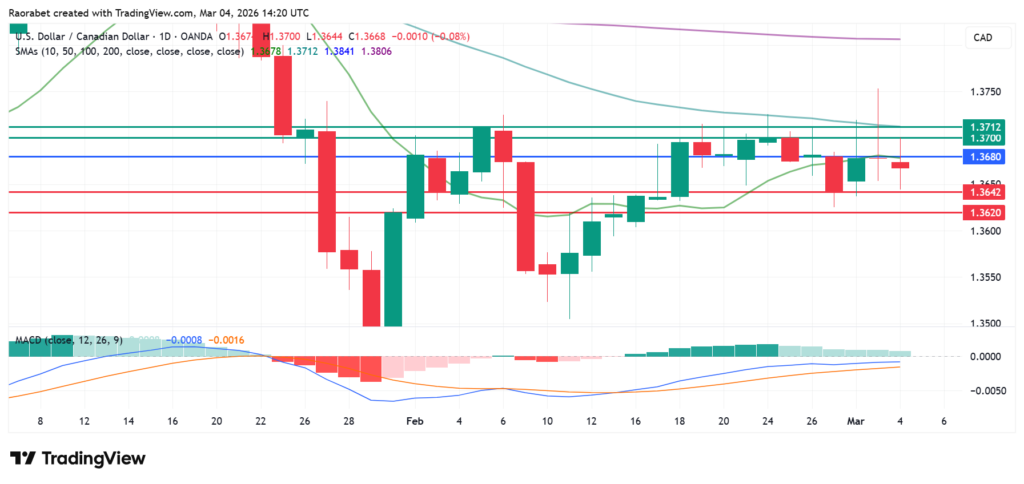
USD/CAD daily chart with key support and resistance levels on March 4, 2026. Created on TradingView
The pair is caught between the U.S. dollar’s safe-haven appeal and the Canadian dollar’s surge fueled by soaring oil prices. These opposing drivers have neutralized each other, resulting in a range-bound market.
As a top oil exporter, Canada sees increased demand for its currency when energy prices rise. The recent oil price jump has helped the CAD stay strong against the dollar.
Indirectly, yes. Canada mostly sells to the U.S., but a worldwide supply issue raises oil prices. This increases the value of Canada’s oil sales and helps the loonie.