



- The EUR/USD is consolidating, with a downside bias as USD strength and geopolitical risks weigh on the single currency.
The EUR/USD is currently hovering around 1.1838, and is down 0.14% on the day. Dollar strength has carried over from the previous day, and with a light European calendar and non-available liquidity from Asia (Chinese Lunar New Year holiday), the pair is trading with low volumes.
EUR/USD Price Action: The Week’s Pathway So Far
The pair has been locked in a tight but gradually fading range, with the pair undergoing a correction after the Euro had popped higher in the first week of February.
Feb 6-9: The pair rebounded from the 1.1775 price area, the lower band of the demand zone that extends to 1.1835. This rebound continued the next trading day (Monday, 9 February), eventually meeting resistance at the 1.1921 price level (the prior high of 17 September 2025).
Feb 10-date: The pair has moved out of a sideways trend and is now fading lower, even though it continues to trade between 1.1835 and 1.1921. A retest of support occurred on 17 February, but the bulls defended it. Price resumed the downward drift today, 18 February, and a retest of the support zone’s upper boundary at 1.1835 looks to be on the cards once more.
Summary: The near-term price behaviour is now consolidating with a mild downside bias, heading into mid-February.
EUR/USD Price Drivers in the Near-Term
The main near-term drivers of EUR/USD strength are:
- USD strength and USD data
- Geopolitics
- ECB news and policy thrust
1. USD strength/data risk

The stellar Non-Farm Payrolls report of last week has downplayed Fed easing expectations. The release of the FOMC minutes later today could be an additional factor in the mix. If the minutes signal a further “wait-and-see” stance by the Fed, this could push EUR/USD lower. Furthermore, the 4-month slump in the US Dollar has led to some bargain-hunting demand for the Dollar.
2. Geopolitics
The geopolitical climate has cooled somewhat, but remains more likely to lean towards a risk-off stance. The geopolitical risk presently comes from the US-Iran standoff. Talks are said to be in the works, but the military buildup continues. The tendency towards geopolitically-motivated risk-off scenarios is USD-positive and Euro-negative.
3. ECB news/policy
One of the key drivers of the Euro’s downside today is a report that the current European Central Bank President Christine Lagarde was planning an early exit from her role. Her term expires in October 2027. Her exit is reportedly going to take place before the French elections. However, a spokesperson within the apex bank has denied the reports.
If a new ECB head does come into place, the development is not expected to affect the ECB’s policy pathway for 2026, as markets already price in no rate adjustments for the year. This market pricing would support the Euro’s upside based on a rate differential versus the Fed’s path.
EUR/USD Price Action: Technical Outlook
In the near term, the pair is consolidating between 1.1835 and 1.1921, fading towards support. A breakdown of the support zone at 1.1768-1.1835 sends the pair towards 1.1671 as the initial downside target, being a prior high seen on 28 October and 3 December 2025. A further decline brings the 19 January 2026 low at 1.1575 into play.
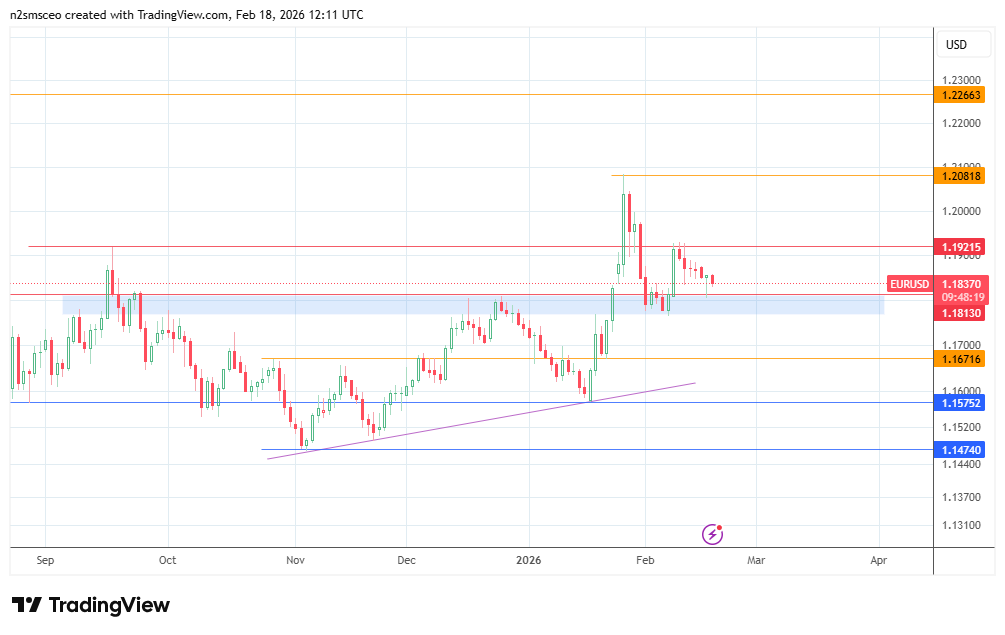
On the flip side, the uncapping of 1.1921 exposes the 1.2081 resistance (27 January high) to bullish pressure. A further advance would reset the trend to bullish mode, with the May 2021 high at 1.2266 as the next northward target. This move would require the bulls to defend the 1.1835 support.