



- AUD/JPY dropped sharply last week, going from above 110 to testing 107.70
- The primary driver is currently the reimergence of carry trade interest instigated by the Reserve Bank of Australia's hawkish stance
- Prime Minister Sanae Takaichi's election victory is interpreted as sign of continuation of loose monetary policy in Japan and that could help AUD/JPY reclaim 110 level
If you’ve been watching the AUD/JPY pair lately, you could have gotten a bruise. Just a week ago, the two seemed to be in freefall, going from 110 to 107.70 in just four days. It’s now the middle of February 2026, and the “Aussie” is back in full force, riding a three-day winning streak that has brought it close to weekly highs of 109.77. Could this be nothing more than a “dead cat bounce,” or is anything more substantial happening here?
What’s Fueling AUD/JPY Upsurge?
The main reason for the current AUD/JPY strength is the resurgence of differences in monetary policy expectations between the Bank of Japan and the Reserve Bank of Australia. The RBA’s hawkish stance has helped the Australian currency, and its rate hike in February and excellent employment figures have made it even stronger.
The RBA board took everyone by surprise on February 3, 2026, when they raised the cash rate target to 3.85%, a 25 basis point increase. According to the RBA’s Monetary Policy Statement, the central bank needs to go from a neutral stance to aggressive tightening since inflation will rise sharply by the end of 2025.
In the meantime, the yen has been under pressure since Prime Minister Sanae Takaichi’s election because Japan wants to expand its budget. Because Takaichi won, markets think that the BoJ will have to keep stimulus measures in place for a long time because she is known to support them. Investors are borrowing money in the low-yielding yen to keep their assets in the higher-yielding Australian dollar market. This has brought back interest in the carry trade.
The Hidden Risks
If the current bullish structure stays the same, a 110-level reversal could happen in the near future. At this very moment, the market is yelling “Buy the Dip,” as if to bet that the pair will be propelled back over 110.00 by the gaping interest rate gap between Japan and Australia.

But I will warn about something that isn’t in the usual bullish reports. There is real policy-driven support for the surge, which is why it has occurred, but getting to 110 is no guarantee. In the coming weeks, it will be crucial to stay vigilant about signals from central banks and the overall sentiment towards global risk.
AUD/JPY Forecast
At 57.25, the AUD/JPY RSI is indicating upward momentum. The immediate barrier is the 10-day SMA at 109.08. If the pair clears that barrier, the next hurdle will be the weekly high of 108.80, above which the psychological and technological hurdle of 110.00 will be the next target, potentially rising to 110.30. The downside has the primary support at 108.38, and the and the second support has also solidified at 107.85.
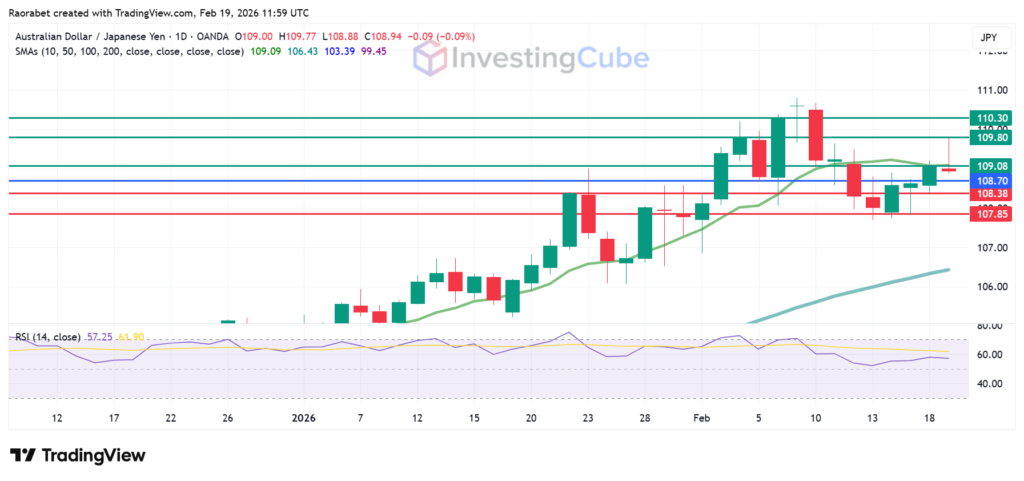
AUD/JPY FX pair with its key support and resistance levels on February 19,2026. Created on TradingView
The upsurge is driven by the Reserve Bank of Australia’s (RBA) hawkish stance in contrast to the Bank of Japan’s (BoJ) cautious stance, the return of carry trade flows, and stronger commodity prices.
Prime Minister Sanae Takaichi’s victory suggests a continuation of easy money policies. This keeps Japanese bond yields low compared to Australia, encouraging “carry trades” where investors borrow Yen to buy higher-yielding Aussie dollars.
Technically, yes. If the Australian jobs data stays strong, the pair might target 110.30. The momentum is strong. That big psychological resistance is coming up, though, so traders should be on the lookout for profit-taking.