


- USD/CAD has struggled to build traction to rise above 1.3700 since late January
- Recent US Supreme Court ruling on President Trump's tariffs have created uncertainty around US trade policy, weakening the USD's appeal
- Canada under Prime Minister Mark Carney has prioritised stability over quick wins, and that seems to be paying off
The USD/CAD forex pair is trading around 1.3693 as of this writing, edging lower by about 0.3% so far this year. Even though the US dollar keeps trying to climb back up, it just can’t hold ground past 1.3700. Each attempted push higher fizzles out. Since late January that ceiling has stayed firm, keeping gains short-lived.
We look at why the Canadian dollar has held its ground so effectively, and discuss its outlook for the remainder of the year.
Why the Loonie Stays Resilient
Much of the credit goes to how Canada has handled geopolitics and commerce. Not many saw it coming, but under Mark Carney, who was once at the helm of monetary decisions, the country now leans hard on steady growth over quick wins. Early this year, the nation’s central bank noted pain in metal exports due to tax-like border rules. Still, consumer spending has been relatively strong. Also, a quiet wave of “Buy Canadian” has fed demand for local products, helping things hold together even when global winds turn rough.
The Bank of Canada’s decision to hold rates steady at 2.25% has also helped maintain a relatively attractive yield differential compared with other major currencies, according to recent analysis from RBC Capital Markets.
Though some analysts believe U.S. trade taxes will soon drag down Canada’s economy and sink the dollar, that pressure might not hit right away. Thanks to special exemptions and talks still unfolding within the USMCA deal, room exists for the loonie to hold ground, for now. What looks inevitable today could shift if deals bend differently tomorrow.
The Struggle to Go Above 1.3700
The USD/CAD has failed to find traction above 1.3700 since late January, despite repeated attempts, with each climb shut down fast. Though buyers pushed up, sellers flooded in right away because uncertainty lingers around how strictly U.S. tariffs will be applied. Traders seem to bet on negotiated outcomes or delayed enforcement instead of immediate action. That hesitation keeps gains short-lived every time.

Beyond the near term, USD/CAD is likely to stay within a narrow corridor, though slight pressure could build on the loonie. Instead of sharp moves, sideways motion may dominate through 2026, held by broader market currents. Many analysts forecast it bouncing mostly between 1.34 and 1.39. By the end of 2026, values might settle close to 1.36 or 1.37.
USD/CAD Forecast
The USD/CAD RSI momentum indicator reads near 51, showing neutral conditions. The pivot is at 1.3700 and the primary support is at the 20-day EMA at 1.3672. A break below that will open the path to attempt the broader base at 1.3639. To spark new upward moves, price needs strength past 1.3700, which stands out as critical overhead supply. If that happens, the main hurdle will likely be at 1.3728, which aligns to the 50-day EMA. A stronger upside momentum will bring 1.3752 within reach.
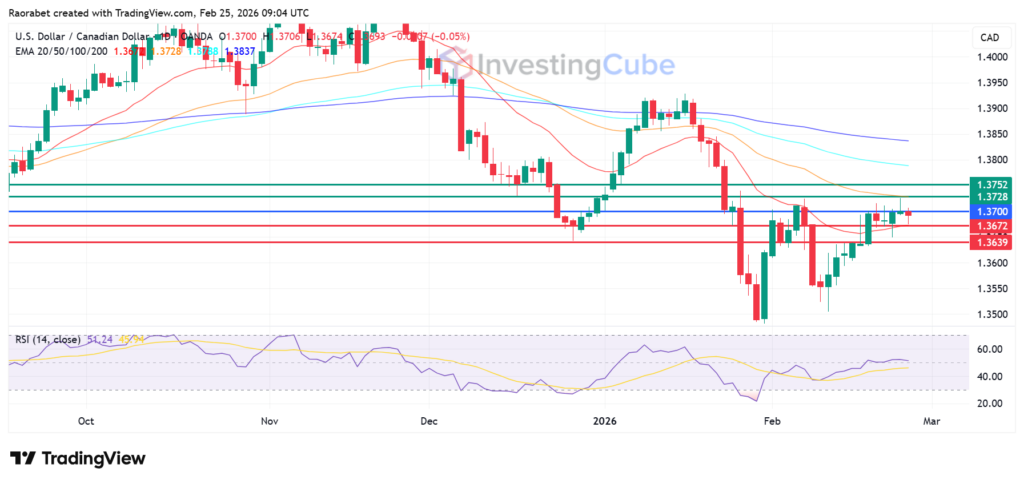
USD/CAD on the daily chart with main resistance and support levels on February 25,2026. Created on TradingView
Mark Carney’s steady hand in Canada seems to help balance things out when exports dip. Still, a push inside the country to choose homegrown products plays its part too. Across the border, US Supreme Court ruling has slowed down tariff powers and taken some strength away from the greenback’s trade-heavy edge.
Around 1.3700 lies a key barrier where traders often pause, shaped by both psychological hesitation and chart patterns. Many are cautious to buy the US dollar above that level because the Supreme Court ruling has thrown US trade policy into uncertainty, while shipments of oil from Canada hold firm without surprise shifts.
The Bank of Canada kept its rate steady at 2.25% in January, while the market expects the Federal Reserve to cut interest rate in June. As the interest rate gap shrinks, the loonie begins drawing interest from those playing the carry trade.