
- AUD/JPY has build some upside momentum recently, driven by safe haven demand
- The Reserve Bank of Australia will announce its interest rate decision this week and after a 3.85% hike in February, another raise looks unlikely
- Medium-term performance for AUD/JPY will mostly be impacted by geopolitical risk, rate differentials and China's commodity market demand
The AUD/JPY currency pair has been among the stronger performers in 2026, reaching levels not seen since the early 1990s. Since the start of the year, it has gained roughly 7%, although recent trading sessions indicate a shift. The Japanese yen has begun to recover, eroding some of the Australian dollar’s earlier advances. To determine whether this represents a temporary setback or the beginning of a trend reversal, it’s important to consider the contrasting actions of the two central banks involved.
Making Sense of AUD/JPY’s Momentum
AUD/JPY trades just above the mid-112.00s, having pulled back from the vicinity of the 114.00 mark, its highest level since 1990. Spot prices lack bearish conviction, warranting caution before positioning for an extension of this week’s modest pullback. In plain terms, the yen is finding temporary traction, but the structural forces that drove AUD/JPY to 34-year highs have not reversed. Rather, they have merely paused.
Fears of a prolonged conflict in the Middle East are boosting safe-haven currencies such as the JPY, acting as a headwind for the cross. When geopolitical risk intensifies without a visible resolution timeline, capital flows into the yen as a reflex, regardless of Japan’s domestic economic vulnerabilities.
On the other hand, the Australian dollar retains underlying support from a potentially hawkish Reserve Bank of Australia, elevated commodity prices, and resilient domestic data. If geopolitical risks de-escalate or oil prices moderate, risk appetite could rebound quickly, favouring the AUD and limiting yen gains.
Is the Yen’s Strength Sustainable?
Sustainability is the big question. While the yen has technical momentum, the fundamental gap remains wide. The Reserve Bank of Australia (RBA) just hiked rates to 3.85% in February and has signaled that another hike could be on the table this week to combat sticky inflation.
Meanwhile, RBA Governor Michele Bullock recently noted that another rate hike is possible in March if inflation expectations show signs of becoming unanchored, signaling markets to remain alert.
Current market pricing reflects about a 30% likelihood of a 25-basis-point hike in March, with more tightening expected by May. Should a hike occur next week, it would serve as the most impactful near-term driver for AUD/JPY. Meanwhile, even if the Bank of Japan raises rates, their policy rates will likely stay below 1.0%, maintaining a substantial yield advantage for the Australian dollar over time.

In the next few weeks, the AUD/JPY pair will face a number of risks. If the conflict in the Middle East goes on for a long time, it will probably keep safe-haven bids for the yen high while putting pressure on the AUD through higher energy costs and slower global growth expectations.
A sharper-than-expected BOJ tightening cycle could accelerate yen appreciation, especially if it coincides with any softening in Australian inflation data that delays RBA hikes. The AUD, which is sensitive to commodities, would also be affected by external factors like a renewed weakness in the Chinese economy or a stronger USD due to US policy.
AUD/JPY Forecast
AUD/JPY has its pivot at 111.500 and the RSI indicates control by buyers on the daily chart. It will likely meet the first resistance at 112.54, beyond which a stronger momentum could send the pair to test 113.66. If it consolidates above this zone, 114.00 becomes the next major upside target. Immediate support sits at the Volume Weighted Moving Average (VWMA) at 111.04, with 110.12 as the next significant level below that.
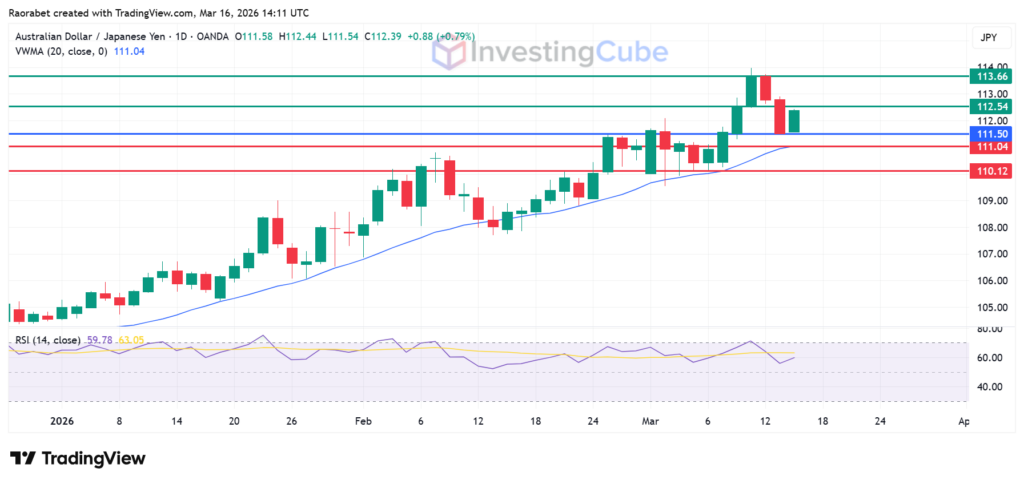
AUD/JPY on the daily chart showing key levels of resistance and support on 16th March, 2026. Created on TradingView
The pair reached levels around 113.00 due to a combination of high Australian interest rates (3.85%) and the Bank of Japan’s historical reluctance to tighten policy, making the Aussie a favorite for yield-seeking carry traders.
Yes. Some market analysts think that a rate hike could happen as soon as the March meeting. The Bank of Japan is under pressure to bring rates back to normal so that the Yen doesn’t lose more value against major currencies. This is because inflation has been above 2% for a long time.
The cross could go down even more if there is more geopolitical instability, sharper BOJ rate hikes, a slowdown in China, or a stronger US dollar.