



- Prime Minister Sanae Takaichi’s historic election victory paves the way for aggressive fiscal expansion, including a ¥21.3 trillion stimulus and long-term increases in defense and strategic spending.
- The proposed measures could significantly widen Japan’s budget deficit in the near term, with potential implications for the yen, government bonds, and equity markets.
The USD/JPY advances for the second straight day, reaching over a one-week high of around 155.35 earlier on Thursday. All focus is on Japanese GDP growth and Sanaenomics implications. Japan’s economy grew weakly in the fourth quarter, increasing pressure on Prime Minister Sanae Takaichi to introduce additional stimulus measures to support growth.
However, the International Monetary Fund warned against cutting the consumption tax, saying it could reduce Japan’s fiscal flexibility and increase debt risks. At the same time, a generally positive market mood has reduced demand for the safe-haven Japanese Yen (JPY). Combined with mildly bullish sentiment toward the US Dollar (USD), this has provided support to the USD/JPY pair.
Let’s take a technical look at the USD/JPY trading chart before delving into the implications of Sanaenomics and how it could shape the yen, Japanese government bonds, and equities.
The Technical Outlook for USD/JPY:
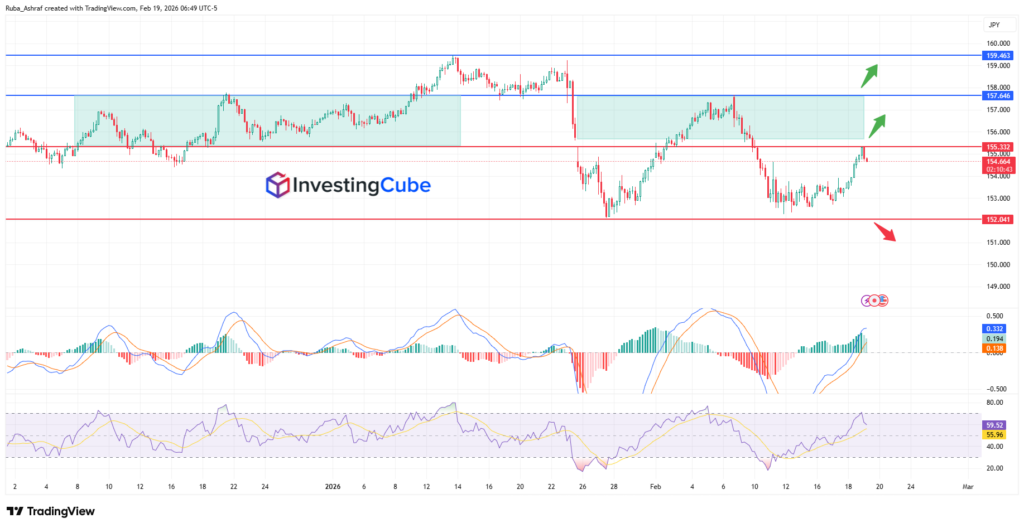
The chart shows USD/JPY trading within a well-defined range, with the highlighted green zone acting as a strong resistance area. Previously, the price consolidated inside this zone before breaking higher. This led to a strong bullish extension toward the upper blue resistance near 159.40.
This suggests that the green area represents a key supply zone, if the price manages to break and hold above it again. It couldencourage another move toward higher resistance levels, similar to the earlier breakout.
Currently, the price is approaching this highlighted resistance after rebounding from the 152.00 support area. A decisive breakout above the green zone would likely open the door toward 158.00 and potentially 159.40. However, failure to break it may result in another pullback toward the mid-range support around 155.30 or even the lower boundary near 152.00.
The MACD indicates improving momentum and supports the short-term recovery. However, momentum is not yet at extreme levels, meaning the breakout still needs confirmation. As for the RSI, is now hovering near the 60 level, indicating strengthening bullish momentum but not yet overbought conditions. Overall, the structure suggests bullish recovery momentum, but the green resistance zone remains the key trigger for continuation toward higher levels.
What Takaichi’s Spending Plans Mean for the Yen, JGBs, and Equities?
Prime Minister Sanea Takaichi secured a historic supermajority in Japan’s lower house, marking the largest electoral victory in the post-war era for the Liberal Democratic Party (LDP). The strong mandate gives her government room to push forward an aggressive fiscal expansion plan.

Takaichi has proposed a 21.3 billion yen stimulus package, about 3.7% of GDP, focused on defense, artificial intelligence, semiconductors, quantum technology, shipbuilding, fusion, and cost-of-living support.
She also suggested suspending the 8% consumption tax on food for two years. This could reduce government revenue by around 5 trillion yen. Most of this stimulus is expected to be injected into the economy before the fiscal year ending March 2027.
In addition to the one-time package, annual government spending could permanently increase by 7-10 trillion, mainly for defense and strategic sectors. As a result, Japan’s budget deficit could widen sharply from 2.5% of GDP last year to around 6% in fiscal 2026-2027 before stabilizing near 4% in the following years.
What Impact Will Sanaenomics Have on the Yen, JGBs, and Japanese Equity?
- The Impact on JPY Currency and JPY/USD Pair:
- Since 2012, the yen has largely weakened against the dollar, losing nearly half its value.
- Recent years show the JPY as one of the weakest among major currencies.
- Impact of fiscal stimulus:
- Large government spending could further weaken the yen due to concerns over higher budget deficits.
- However, if Japan’s economy grows faster as a result, it could support the yen and offset some of the weakness.
- The Impact on the Japanese Bond Yields:
- Rising costs:
- Yields on Japanese government bonds (JGBs) are increasing as the rate rises.
- Higher yields mean Japan will pay more to refinance maturing debt, potentially increasing the budget deficit.
- Debt dynamics:
- A significant portion of Japan’s debt matures each year, so any rise in interest rates quickly raises financing costs.
- Growth link:
- Fiscal stimulus boosting growth and inflation can push bond yields higher, adding pressure on government borrowing.
- The Impact on Monetary Policy:
- BoJ rate adjustments: The Bank of Japan has started raising rates even as other central banks cut, due to persistent inflation.
- Rising growth, inflation, and bond yields may force further monetary tightening, affecting both the currency and debt costs.