- As the conflict between the United States and Iran has driven global uncertainty, investors have pushed silver higher as a safe‑haven asset, but if the war ends soon prices could calm and pull back from recent elevated levels.
- However, if the war drags on and energy prices stay high because of market disruption, industrial demand and ongoing risk fears might keep silver supported rather than letting it fall sharply.
The silver price attracted buyers during the Asian trading session on Thursday, allowing prices to rise by 1.45% and hold above $85. The white metal is currently trading around $86.90 per ounce, reflecting heightened volatility in price action. However, silver prices fell on Wednesday as energy costs increased. Meanwhile, Asian and Western governments are trying to cap rising oil prices. One troy ounce of silver is currently priced almost the same as one barrel of US crude oil. This highlights how oil prices have surged while silver remains relatively undervalued compared with oil.
As energy costs remain high, Austria and Germany joined South Korea in proposing limits on how often petrol pump prices can be increased. Meanwhile, several Asian countries have restricted air-conditioning use in government offices, and Pakistan has announced a four-day workweek to help save energy.
Before discussing the latest updates on the US-Iran conflict and what could happen if the war ends, let’s first take a look at the technical outlook on the silver trading chart.
Silver Price’s Technical Outlook:
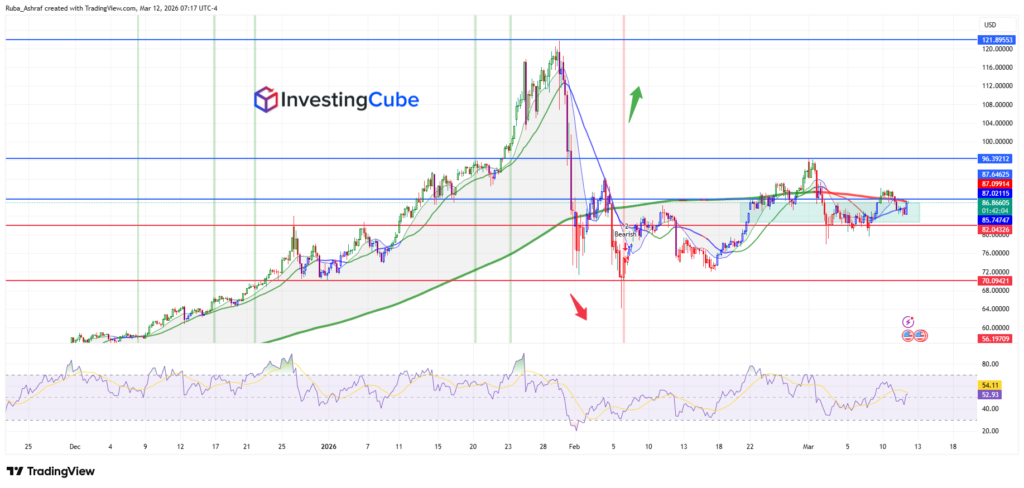
Silver, once the US-Iran war started, recorded a strong bullish rally, pushing the price close to $120. During this period, the price stayed above the moving averages. This confirmed strong upward momentum. However, the rally ended with a sharp correction. Prices dropped quickly, and volatility increased. After the decline, silver entered a sideways consolidation phase.
The chart shows that silver has been trading within a wide range between $81 and $87. The highlighted zone represents this consolidation area. Buyers and sellers are currently competing for control inside this range.
The important resistance level sits at the $87-$88 area. Prices have tested this zone several times but failed to break above it. On the downside, the $70 level acts as a key support area. Buyers previously stepped in around this level and prevented deeper losses.
Looking at the moving averages, the short-term averages have flattened. Prices are crossing them frequently. This indicates weak short-term momentum and a lack of a clear trend. More importantly, the price is now trading below the long-term moving average line. This reflects declining momentum and suggests that the broader trend has weakened.

The RSI indicator is currently near the mid-50 level. This indicates neutral market momentum. The market is neither overbought nor oversold. Overall, silver remains in a consolidation phase. A break above $88 could pave the way toward further gains. However, a move below $70 may trigger another bearish wave. This scenario is unlikely as long as the US-Iran war continues.
What Could Happen to the Gold & Silver Price If the US-Iran War Ends?
As per Bernard Dahdah from French bank Natixis, once the war ends, gold prices could fall back to around $4,600 per ounce. This level was their level before the conflict. He also said that the gold price has been pushed up by $750 per ounce so far, driven by market fears and reactions.
However, Dahdah warns that if war continues for more than two weeks, gold prices might not stay steady because of higher energy costs. The rising energy costs weigh heavily on global inflation and affect the economy. On Wednesday, gold and silver saw a drop from recent highs, trading at $5,153 and $84.50 per ounce, falling 1.6% and 5.3%, respectively, from yesterday’s one-week peaks.
Right now, silver prices have been volatile and reacting to war fears. If the war comes to an end, that uncertainty would likely fade. With markets calmer and fewer fears about oil price shocks or inflation, some investors might sell metals like silver, causing the price to fall or stabilize after recent highs.
So the most likely post-war scenario is that silver prices would cool down from wartime highs, but not necessarily crash, especially if global industry and economic growth remain strong.
The Latest Updates on the US-Iran Conflict:
- Iran has intensified its military operations since the beginning of the war. Iran fired some of its most advanced ballistic missiles toward Tel Aviv and Haifa in Israel.
- According to a British monitoring agency, at least three ships came under attack this morning near the Strait of Hormuz.
- The ongoing war creates the largest supply disruption in the history of the global oil market. As a result, the IEA has announced the release of 400 million barrels of oil from its member nations’ strategic reserve. This is more than twice the quantity released from IEA stockpiles during Russia’s invasion of Ukraine in 2022.
- Iran reported that more than 1,300 civilians have been killed and many thousands of buildings have been hit so far by U.S. and Israeli strikes.
- The World Health Organization confirmed attacks on hospitals and health facilities in Iran and Lebanon, with health workers among the casualties.