- Gold remains in a bullish long-term trend, supported by ongoing geopolitical tensions and inflation risks from the US-Iran conflict, though strong US yields and a firm dollar are currently limiting further gains.
Gold prices remain in a bullish structure, trading above the key long-term moving average. However, they are currently trading sideways ahead of the release of the US PCE data. Gold’s gains were capped near $5,100 as traders wait for the key US data, betting that the Federal Reserve may delay cutting interest rates. This decision could be fueled by the ongoing war between the United States and Iran, as the conflict rekindles inflationary pressure, especially due to the growing surge in energy prices.
Key Headlines on US-Iran Tensions Influencing Gold Prices:
- Middle East tensions are escalating, with Iran’s new supreme leader, Mojtaba Khamenei, warning that the US military bases in the region should be closed immediately or face attacks.
- Khamenei said Iran will keep targeting US bases in the region despite seeking goodwill with neighboring countries.
- US President Donald Trump said that the most important thing is stopping Iran, not keeping oil prices low.
- Since the US-Israel war with Iran began, crude oil prices have been climbing. Fears of oil supply disruptions are rising because of the closure of the Strait of Hormuz.
Apart from that, rising inflation risks have pushed investors to scale back expectations for US Federal Reserve rate cuts in 2026. Moreover, the US dollar is supported by higher treasury yields, capping gold’s upside. However, ongoing geopolitical tension risks may help limit further downside in gold prices. Investors are closely watching the US PCE price index for signals about future Fed policy.
Gold (XAU/USD) Price Technical Outlook:
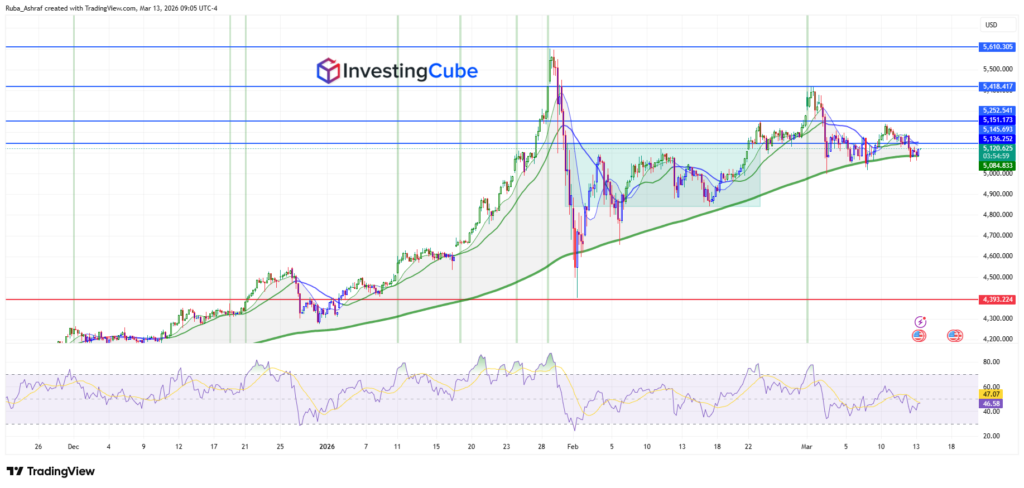
This chart shows that gold (XAU/USD) remains in an overall bullish trend, but the price is currently moving sideways after the recent rally.

Gold is still trading above the long-term moving average (green line), which indicates that the broader trend remains positive. After the sharp drop from the February peak near $5,610, the price found strong support around the $5,000–$5,050 area and started forming a consolidation range. Recently, gold has been trading around $5,110–$5,150, suggesting that the market is waiting for a new catalyst before making the next move.
Gold is still trading above the long-term moving average (green line), which indicates that the broader trend remains positive. After the sharp drop from the February peak near $5,610, the price found strong support around the $5,000–$5,050 area and started forming a consolidation range. Recently, gold has been trading around $5,110–$5,150, suggesting that the market is waiting for a new catalyst before making the next move.
The RSI is around the mid-40s, showing a neutral momentum. This suggests that the market is neither overbought nor oversold and is currently in a cooling phase after the previous rally. Overall, the price action indicates that gold is consolidating within a bullish structure, and a breakout above $5,150 could revive upward momentum.
Gold is consolidating as investors balance safe-haven demand from the US-Iran conflict with the pressure from a stronger US dollar and rising Treasury yields.
Support is seen around $5,080–$5,100, while a breakout above $5,150–$5,250 could signal renewed bullish momentum.