


- Crude oil prices surged sharply amid rising geopolitical tensions and fears of supply disruptions around the Strait of Hormuz, pushing the market into a strong bullish trend.
- While the broader technical outlook remains positive, recent volatility suggests the market could see short-term corrections as traders assess geopolitical developments and supply risks.
Crude oil prices remain in positive territory despite the heavy volatility fueled by geopolitical tensions. The light crude oil futures are currently trading around 88.50, declining 6.62%, or 6.28 points. The price retreated after climbing to $113.38 in the previous trading session. This high has been reached before, since June 2022.
The crude oil price pulled back from this high after US President Donald Trump signaled that the administration may temporarily waive oil-related sanctions to ease pressure on the global energy market. At the same time, Donald Trump said the conflict with Iran could end “very soon.” These rising oil prices and intense market volatility increase economic and political pressure on his administration. However, crude oil price finds support near the $81.00 level, remaining in positive territory and trading above the long-term moving average line.
Before examining the latest developments in U.S.–Iran tensions, let’s first review the technical outlook for crude oil prices on the trading chart.
The Technical Outlook of Crude Oil Prices:
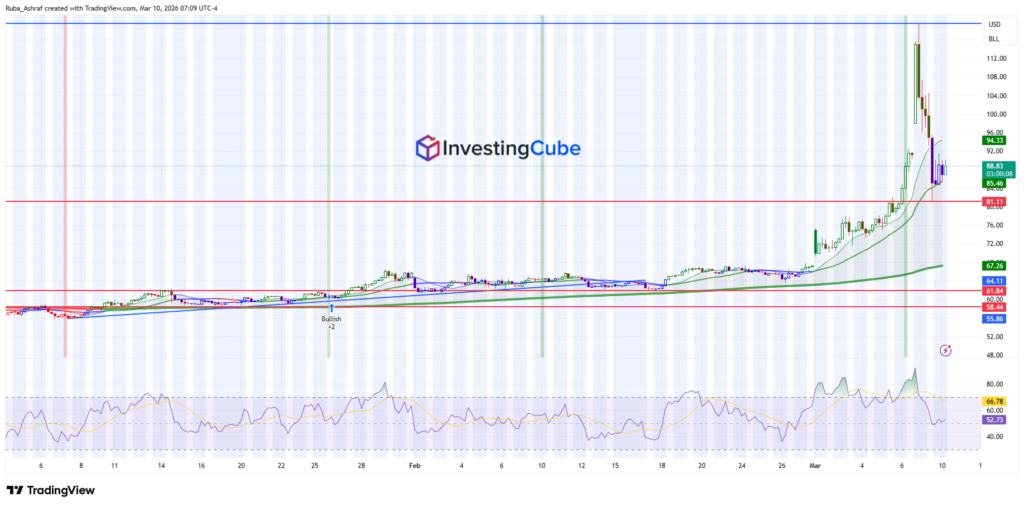
The chart shows that crude oil has been in a strong bullish trend over the past several months, with prices steadily moving higher after forming a base near the $58-$62 support zone. The horizontal red support area from $60-62$ previously acted as a key consolidation range where buyers repeatedly stepped in. Eventually, price triggered a breakout that initiated the current uptrend.
The ascending trendline drawn from the early January lows highlights a series of higher lows, confirming the strengthening bullish structure. Once the price moved above the area of $64-$67, the momentum accelerated, leading to a sharp rally toward the recent peak near $115. This is also fundamentally fueled by the ongoing tensions between Iran and the United States. However, after reaching this peak, the market experienced a strong pullback fueled by Trump’s comments that the war could end “very soon.”
Crude oil price action remains above the longer-term moving average (thicker green line). This indicates that the broader trend is still positive despite the recent correction. The shorter-term moving averages have steeply turned upward during the rally. It is currently attempting to stabilize as the price consolidates around the $88–$95 region.

As long as crude oil continues to trade above the key support zone near $81 and the rising long-term moving average sits around $67, the broader bullish trend structure remains intact. A sustained move back above the $96 area could signal renewed upward momentum, while a break below $81 may open the door for a deeper correction toward the $67–$70 support region.
The RSI reflects this shift in momentum. During the rally, the RSI moved into overbought territory above 70, confirming strong bullish momentum as prices surged. Recently, the indicator has pulled back toward the neutral zone near 50-55. This indicates that the market is cooling off after the sharp rally. However, the momentum has not yet turned bearish. If the RSI stabilizes and begins to rise above 60, it could support another upward move in crude oil prices.
The Latest Developments in U.S.–Iran Tensions and Key Market Movers:
- The US and Israel continue military strikes on Iran, with Washington signaling that some of the most intense attacks of the war may take place soon.
- Iran has vowed to keep fighting and rejected calls for a ceasefire, while its leaders say the country will determine how and when the war ends.
- Iran has threatened to block all oil exports from the region if US and Israeli attacks continue, raising fears of a major energy shock.
- The conflict has disrupted shipping in the Strait of Hormuz, a route that normally carries about 20% of global oil supply, making markets extremely sensitive to any escalation.
- US President Donald Trump said the war could end “very soon,” which helped calm markets and pushed oil prices lower.
- Trump also warned Iran not to interfere with oil shipments through the Strait of Hormuz, threatening severe retaliation if the route is blocked.
Oil prices are increasing mainly due to geopolitical tensions and concerns that supply could be disrupted in the Strait of Hormuz, a key route for global oil shipments.
Traders are monitoring key support levels, moving averages, and the RSI indicator to evaluate whether the bullish momentum will continue or if a deeper correction may occur.