



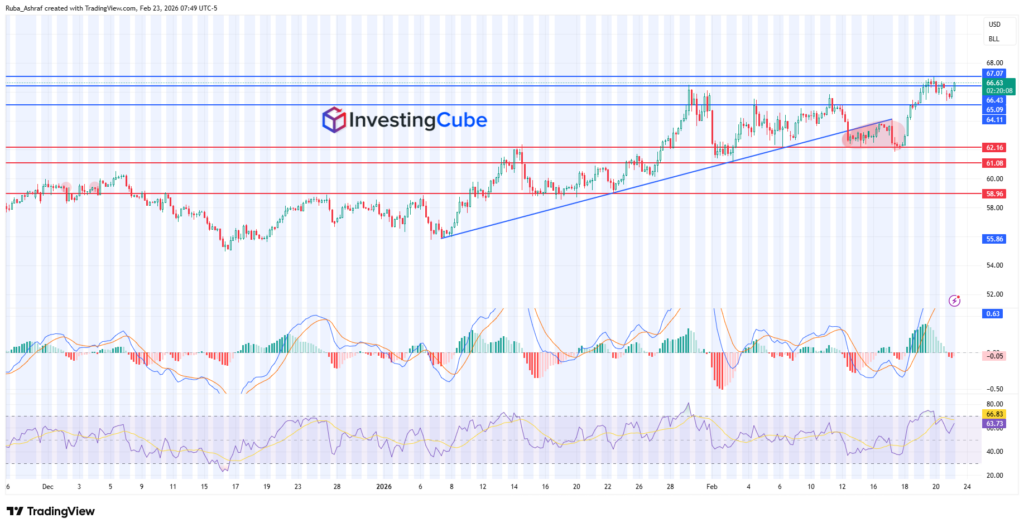
- Crude oil prices remain supported in the short term after breaking above key resistance near 66.43, confirming a bullish technical structure with strengthening momentum indicators.
- However, according to the EIA, rising global supply and growing inventories are expected to weigh on prices longer term, with Brent projected to decline through 2026 and 2027.
Crude oil price slips 0.56% or 0.36 points on future contracts trading around $66.13 at the time of writing. According to Deutsche Bank, Brent crude has eased slightly after posting a strong two-day rally, fueled by rising US-Iran tensions.
The bank stated that part of the “weekend risk premium” is now being priced out of the market, despite reports of possible US strikes on Iran. Deutsche Bank also highlighted that Brent recorded its biggest two-day gain since October 2025, driven by intensified rhetoric toward Tehran.
Let’s take a technical look at crude oil price movements before exploring the EIA forecasts for oil prices in 2025 and 2027.
The Technical Outlook for Crude Oil Prices | Key Levels to Watch:
In our last analysis, the price was standing in the red-highlighted area at 61.12. We were expecting that a break above66.43 could support the price to build a higher high, and that’s exactly where we stand now.
Crude oil has successfully cleared the 66.43 resistance level and is now consolidating just below the next key barrier near 67.07. The breakout confirms a continuation of the broader bullish structure, especially after the price rebounded strongly from the ascending trendline support.
The previous pullback toward the 62.16–61.08 support zone acted as a healthy correction within the uptrend rather than a trend reversal. With price now holding above 65.09 and 64.11, these levels turn into immediate support zones.

The highlighted ascending trendline remains intact, reinforcing the bullish bias. As long as price holds above the 64-65 region, buyers remain in control. A sustained move above 67.07 could open the door toward fresh upside extension. A break below 64.11 may trigger short-term consolidation toward 62.16 again.
The MACD indicates increasing buying pressure. Although momentum is strong, traders should watch any signs of divergence if the price struggles near resistance. The RSI is hovering around the mid-to-upper 60s, near 66-67, reflecting strong bullish momentum but approaching overbought territory.
EIA Forecasts for Crude Oil Prices for 2026 and 2027:
As per the Energy Information Administration (EIA), global petroleum and liquids production is expected to continue exceeding demand over the next two years, putting sustained pressure on crude oil prices. The agency forecasts that Brent crude will average $69 per barrel in 2025 before declining to $58 per barrel in 2026 and further to $53 per barrel in 2027.
The EIA noted that rising global oil inventories are a key factor behind the projected price decline. Despite ongoing uncertainty surrounding crude exports from Russia and Venezuela, persistent inventory builds are weighing on the market.
According to the EIA’s Short-Term Energy Outlook (STEO), global oil stock changes are calculated as the difference between supply and demand. Inventories have been increasing as OPEC+ members raise production targets. At the same time, output growth from non-OPEC+ countries, particularly Brazil, Guyana, and Argentina, is expected to add further supply this year and next.
Combined with slower growth in global petroleum demand, this expanding supply outlook has gradually pushed crude oil prices lower since early 2024, and the trend is expected to continue through 2027.
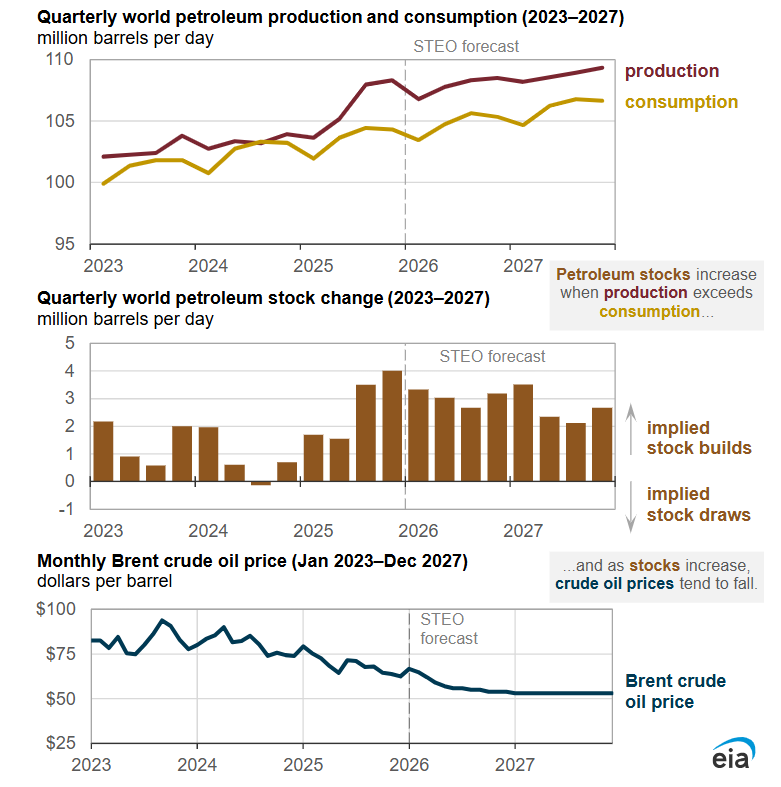
The charts indicate that global petroleum production is projected to outpace consumption over the forecast period (2026–2027), leading to sustained stock builds. As inventories increase, this surplus supply environment typically exerts downward pressure on prices. Consistent with this relationship, Brent crude oil prices are shown trending lower in the outlook, reflecting expectations of continued supply growth and weakening market balance.