


- The recent escalation between the US, Israel, and Iran has shaken global oil markets.
- Higher oil prices can lead to increased fuel costs and inflation globally.
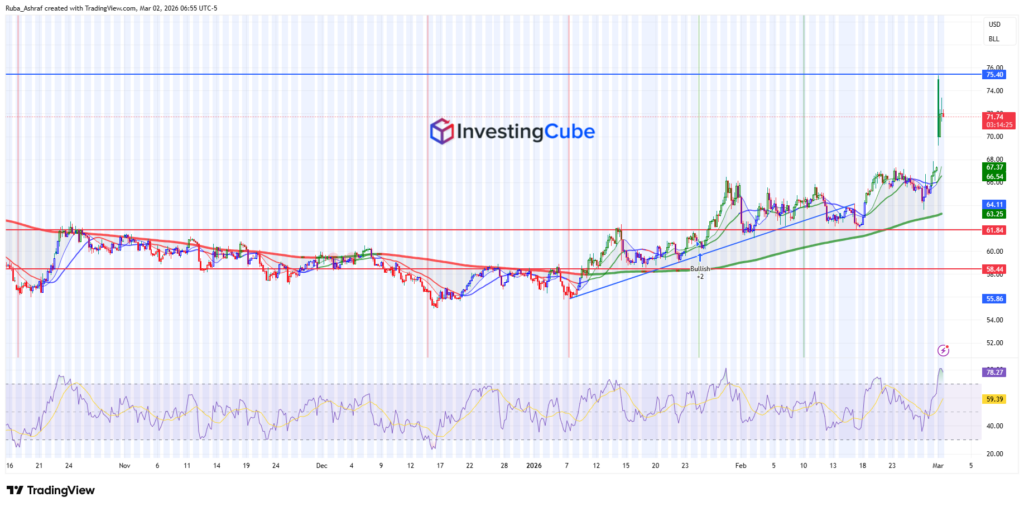
Crude oil price opens on a wide gap driven by the US-Iran war. Iran’s Islamic Revolutionary Guard Corps (IRGC) said that no ships would be allowed to pass through the Strait of Hormuz. As a result, West Texas Intermediate (WTI) crude opened with a strong gap higher and climbed above $75. This level is the highest since June. At the time of writing, light Crude oil futures are trading around the 72.04 level, up 7.88% or 5.28 points.
Let’s take a technical look at the light crude oil futures chart before examining the key factors driving prices and the latest US-Iran updates.
Technical Outlook for Crude Oil Price:
The chart clearly shows a shift into bullish momentum for light crude oil futures. After spending an extended period trading below the 200-day Simple Moving Average (SMA-200), the price has now broken above the SMA-200. This is a technical sign that long-term selling pressure has eased and buyers are gaining control of the trend.
Most notably, the market opened with a sharp bullish gap from roughly $66 to nearly $75 at the last session. Such a large gap higher reflects strong buying pressure and a sudden surge in risk premiums being priced in by traders.
This price reaction has a clear fundamental backdrop:
- The U.S. and Israeli strikes on the Iranian targets, followed by Iran’s Islamic Revolutionary Guard Corps (IRGC) warnings that no ships are permitted to transit through the Hormuz. This has intensified fears of supply disruptions. As per multiple sources, the vessels have received radio transmissions from the IRGC indicating that passage through the strait is not allowed, halting tanker traffic in the region.
- While Iran itself is responsible for 3%-4% of global oil output, disruption to Hormuz indirectly affects the exports not only of Iran but also of major producers such as Saudi Arabia, the UAE, Iraq, and Kuwait, because almost all their crude must also flow through this narrow passage.
Key Technical levels to watch:
The $74 area represents immediate resistance, as it marks the recent spike high. A sustained break above this level would confirm the bullish breakout and open the door for further gains. On the downside, the $66-$69 zone, where the sharp gap began, now serves as key support, and holding above it would keep the bullish structure intact.

Below that, additional supports appear around $64 and $63, which reflect previous consolidation areas and align with medium-term moving averages.
The RSI suged intro the overbought region, indicating that upside momentum is strong following the gap higher. This suggests that buyers are in a surge, but it also indicates that there is a potential for a pullback or consolidation before any fresh leg higher.
US–Iran Crisis: What It Means for Crude Oil Markets:
- Fighting between the US-Israel alliance and Iran has shaken global oil markets.
- The Strait of Hormuz is a key shipping route that carries around 20% of the global oil supply. Any blockage there could seriously disrupt energy markets.
- Major oil producers like Saudi Arabia, the UAE, Kuwait, and Iraq rely on this route to export crude oil to global markets.
- Brent crude jumped sharply after the strikes, rising about 13% at first, before settling near $77 per barrel.
- Tensions increased after Iran reported that attacking oil tanker, slowing commercial traffic in the strait.
- Saudi Arabia temporarily shut its largest domestic refinery following attacks, and other oil and gas facilities in the region were also affected.
- OPEC+ announced plans to increase oil production from April to help stabilize the market.
- Even if alternative routes are used, experts estimate that 8–10 million barrels per day could still be lost from global supply.
Tensions and military actions in the Middle East have driven fear of supply disruptions, especially around the vital Strait of Hormuz. This has pushed crude oil prices up sharply, with analysts warning prices could reach $100 per barrel if disruptions persist.
The Strait of Hormuz is a key shipping route for about 20% of the world’s oil. Any halt or risk to traffic there from attacks or insurance can tighten global supply and push energy prices higher