- Yes Bank is struggling for momentum and has been trading sideways for much of the time since early February
- A Supreme Court ruling on ₹8,400 crore debt could have significant ramifications on the bank's standing
- The ₹20 is a critical support and the recent sideways action by Yes Bank share price raises the prospect of breaking below it
Since early 2026, Yes Bank stock has stayed in a tight range, not joining the wider Nifty Bank rally. As of this writing, the share price remains around the ₹20.89 mark. The stock has also reached lows of ₹20.75 mark, causing many to wonder if the psychological floor of ₹20 will hold.
Why Yes Bank Is Struggling for Momentum
The stock isn’t going up because investors are taking profits, are wary of mid-sized private banks, and worry about deposit growth. Even though net profit jumped 55% to ₹952 crore in Q3 FY26, the stock hasn’t stayed above ₹21.50–₹22. Investors seem more interested in how strong the growth is and if the bank can keep growing deposits consistently, rather than just the profit numbers.
The main problem is the earnings quality. The profit increase was mostly due to a 95% drop in provisions. The bank didn’t need to save as much money for bad loans this quarter. Core business growth is still slow.
A sharp fall of nearly 95 percent in loan loss provisions lifted profits sharply. This time around, reserves for troubled loans barely rose. This depicts good news at first glance, but underneath, real business activity drags. Growth in day-to-day operations shows little sign of life.
Is Yes Bank Stock About to Break Below ₹20?
Recent trends have raised concerns among investors as the stock price struggles to hold steady. Market watchers are paying close attention to how it performs in the coming days, since a drop below this level could impact confidence and trading strategies. It will be important to monitor both external factors and the bank’s financial updates to understand what might drive the stock’s movement next.
A drop under ₹20 looks likely in the coming days, should trading stay flat without good news. Since the bank reorganized, that price has held firm as a mental floor. Falling through might lead prices down toward ₹17 to ₹15, areas where past buying showed strength.

Right now signs point to range-bound movement, upward drive missing until new favorable events appear. In early December in 2026, Supreme Court sessions restarted over the bank slashing ₹8,400 crore in AT-1 debt back in its 2020 bailout. Though most analysts believe the impact is already baked into numbers, an unfavorable outcome might trigger large-scale capital shifts or payouts.
This heavy legal issue drags everything down. Not everyone agrees, yet the truth might hit when shares drop under ₹20, not because profits fall short, instead a sudden regulatory jolt could push big investors out of long-held stakes.
Yes Bank Share Price Prediction
Yes Bank stock is trading below its 20-day, 50-day, 100-day and 200-day Simple Moving Averages, which is a common sign of a downward trend. The pivot is at ₹21.18, while immediate floor is ₹20.68. A stronger support is at ₹20.50, below which the psychological ₹20 will be in sight. A weekly close below ₹20 could trigger stop-losses and push the stock down to ₹18. On the upside, ₹21.30 is the first resistance zone. For a trend reversal, the stock must break and hold above ₹21.50.
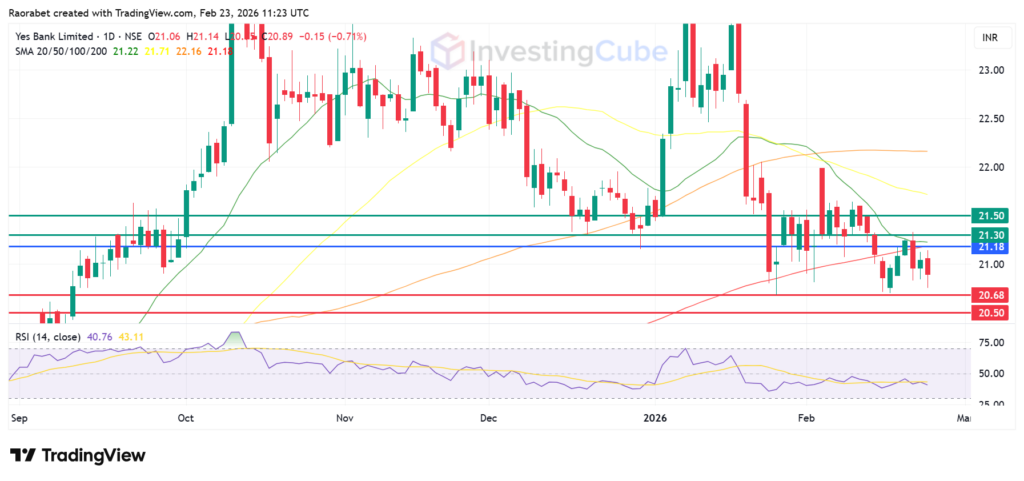
Yes Bank share price on the daily chart with key levels of support on resistance on February 23, 2026. Created on TradingView
Investors are skeptical because the profit growth came from lower provisions and one-time recoveries rather than robust interest income. Core loan growth of 5.2% is too low compared to industry leaders like HDFC or ICICI.
Moderately high if consolidation continues without fresh positive triggers, the ₹20 level is a key psychological support, and a break could lead to accelerated selling.
The stock is seen as fairly valued but lacking strong upside catalysts in the near term, challenging the consensus view that improved asset quality alone is enough to drive sustained gains.