


- AMD stock price declined in early February with the market concerned that it still trails rivals in data center infrastructure
- It rebounded by over 8% on Tuesday on the heels of news of a major investment by Meta
- Nvidia will release its earnings results today and that will influence AMD stock price trajectory
Monday saw AMD shares drop below the $200 mark, following a failed push past $220 that had fizzled out slowly. Painful losses piled up until Tuesday turned things around sharply. Instead of sinking further, the stock surged by 8.8%, finding footing near $214.03. Bears blinked first, caught off guard when momentum flipped without warning.
AMD’s U-Shaped Rebound
The dip was mainly fueled by worries about how AMD stacks up in the AI data-center race. Market sentiment shifted when news broke that big cloud operators are spending more on Nvidia’s new Blackwell system, according to CNBC’s analysis on February 17.
Even as AMD’s MI300 chips picked up speed, doubts lingered around how easily they could be made at scale and also how they matched up in power consumption relative to rivals from Nvidia. That uncertainty sparked a shift away from second-tier AI names, dragging shares lower even though the company’s base remained strong.
The primary fuel for this sharp rebound was the announcement of a massive, multi-year strategic partnership with Meta Platforms. According to official company filings on February 24, 2026, Meta will deploy 6 gigawatts of AMD gear, including Instinct MI450 chips and Venice CPUs over several years.
Instead of just signing contracts, AMD handed out performance-linked warrants for as many as 160 million shares. That move ties Meta’s success directly to AMD’s stock gains. Now one of their biggest buyers has skin in the game. Not simply a sale – it became an alignment of interests. The market noticed right away.
Nvidia Earnings Impact and 2026 Outlook
Nvidia’s quarterly report set for release on Wednesday, might just set the tone for how AMD fares next. Should numbers come in way above expectations, with brighter forecasts too, that lift could spill over. Yet if hints emerge about softer demand in artificial intelligence, or profits getting thinner, pressure may follow AMD close behind.
Should Nvidia hit its typical strong results, AMD might ride along, maybe touching $220 again. That level has held firm before. A softer forecast from Nvidia around AI spending could change things fast. Right now, AMD sits higher by about 8%. But that gain may not last. If expectations shift, so could the price. Momentum drives much of this move. Without support from sector sentiment, gains often unwind quickly. Investor sentiment plays a big role here.

If Nvidia’s stats beat forecasts, AMD will probably follow that trend and test the $220 barrier level again. But if Nvidia’s guidance shows that AI capital spending is slowing down even a little, AMD’s recent 8% surge could go away. Some of the biggest dangers are Nvidia’s increased rivalry, possible delays in new chip ramps, and a general lack of interest in AI investing if it doesn’t pay off.
Deloitte has also named “advanced packaging” as an significant issue for 2026. If AMD can’t get enough capacity for its complex chiplet designs, then a $100 billion merger with Meta won’t help it get its products to customers on time. One strong name boosts others, but only until it doesn’t.
AMD Share Price Prediction
The RSI for AMD shares has gone up from close to being oversold to 49 and rising, which means that the stock is neutral to bullish. The pivot is at $210 while immediate support level is at $203.80. A break below that will expose the $200.00 psychological level to testing. The first barrier on the upswing is the $217.99, which corresponds to 20-day EMA. If the price breaks out here, it might reach the 52-week high of about $223.60 in the near-term.
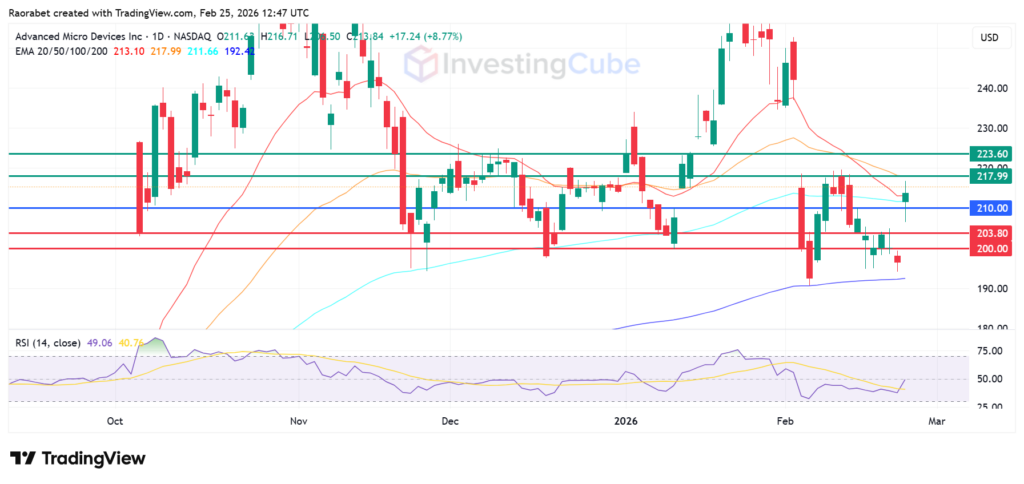
AMD stock price on the daily chart showing the main levels of support and resistance on 25 February, 2026. Created on TradingView
The jump was caused by a historic 6-gigawatt AI infrastructure agreement with Meta Platforms. The deal includes the use of bespoke MI450 GPUs and gives Meta the right to buy AMD shares, which is in line with their long-term goals.
Concerns about Nvidia’s supremacy in AI accelerators and AMD’s MI300 series production ramping up more slowly than expected led to severe selling pressure that caused the fall.
The rebound’s long-term health rests a lot on Nvidia’s earnings today. If the competitive gap gets bigger, consensus may overestimate AMD’s capacity to take advantage of sector tailwinds.