


Now that the war between the US-Israel coalition on one side and Iran on the other has broken out, many traders are wondering what assets they should be trading to capitalize on the situation. However, the proper question should not be “what should I buy now?” It should rather be “how do different markets react to such situations, and what risks am I taking?”
It is all about pricing and repricing, with any market shocks and inefficiencies constantly factored into the pricing of these assets, driving the volatility markets are seeing. For instance, the following markets are already being repriced as follows:
Oil and gas assets have seen prices jump 7-8% in a single day due to the Iran attacks and the subsequent closure of the Strait of Hormuz, which has disrupted the shipping of crude and LNG. This situation has impacted 15-20% of global crude oil and LNG shipping.
Global stocks are down, with airlines and travel companies hit the hardest. These are stocks of companies that depend on fuel for their operations. Higher fuel costs compress margins for these companies, especially if there is no allowance for such shocks in their operational budgets. Paradoxically, stocks of energy and defence companies are up, as war and higher oil prices boost margins.
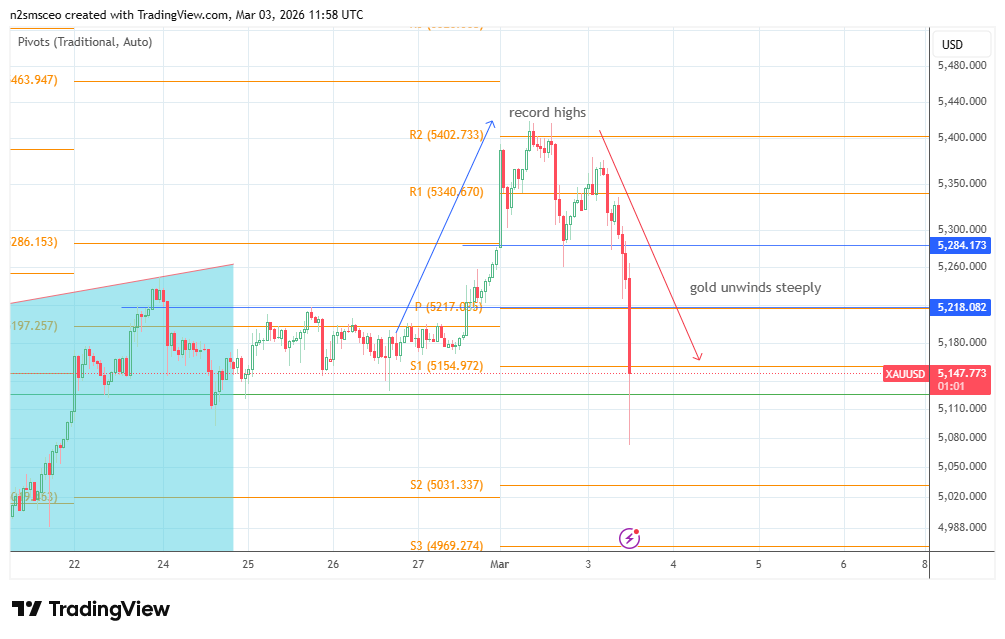
There is also a safe-haven demand during war situations. War is a shocking event that creates global uncertainty, forcing traders to ramp up demand for safe-haven assets. Gold and the Swiss Franc have seen record jumps in price, with XAU/USD and EUR/CHF also in record territory.
1. Energy Assets Complex: Oil, Gas, Oil/Gas-Related Equities
The reason these assets are the natural first point of contact for traders who want to profit from the US/Israel-Iran war is almost self-evident. Iran is not just a major oil supplier but also the site of a critical shipping route for the world’s oil: the Strait of Hormuz. Now that the Strait of Hormuz has been closed and major shippers have cut back on oil and LNG exports from around the world, a huge supply shock is looming. The writer of this article has already seen fuel prices rise 10% at the gas pumps.
What will investors be watching here?
- Crude oil and refined products – Brent, WTI futures, energy ETFs
- Stocks of oil majors – Shell, BP, Chevron- typically benefit from these situations because of higher oil prices, if their production assets are unaffected.
- LNG producers – those LNG and gas producers outside the Persian Gulf will also benefit. Here, there was already a pre-existing situation of supply pressures in Europe due to the Russia-Ukraine war.
2. Security & Defence Stocks
Wars create demand for arms, driving up defence spending. This spans a wide range of services, as no single company manufactures every component of a defence arm. Munitions (light and heavy), aircraft, air, land, and sea defence and offensive weapons systems, radar equipment, etc, are all components of a typical war arsenal. The last three years of the Russia-Ukraine war have seen a large jump in the shares of European and UK defence companies and US military companies. The performance of these shares has already outstripped that of major indices.
What do investors watch here? Typical areas of focus are:

- Cybersecurity
- Intelligence
- Aerospace/air defence manufacturers (drones, missiles, radar, and aircraft).
The risk with these stocks is that they are very sensitive to situational changes. Derisking the war premium can cause sharp reversals.
3. Safe-haven Assets
Geopolitical risks usually prompt a move to asset protection and preservation (risk-off), not capital appreciation (risk-on). Professional funds typically allocate to the following assets because of their ability to preserve value when other investment vehicles are underperforming. Or when there is a market collapse.
What are investors watching here?
- Gold (and other precious metals)
- Government bonds (interest returns are guaranteed)
- The US Dollar
- Swiss Franc
- By extension, gold ETFs are part of the equation as well.
The risk with these assets is that they can unwind if the risk premium that triggered the flight to safety in the first place is derisked. Also, changes in interest rates can make them unattractive.
4. The short-sell plays (assets under pressure)
Sectors or stocks hard hit by the current geopolitical situation could face significant selloffs and losses in value. These are the stocks that can be shorted to profit from falling prices.
What assets can investors watch for shorting opportunities?
- Airlines and travel stocks: Higher oil prices raise fuel costs, hurting margins.
- Tourism: the uncertainty means people would rather stay home than travel, amid the scary travel advisories issued by several countries.
- Energy import markets (China, India): higher oil prices drive inflation and hurt their current accounts.
- Cyclical equities: these become vulnerable if the situation forces delays in central bank easing.
- Leveraged assets
- Cryptocurrencies (Bitcoin, Ethereum, etc). Bitcoin was a major casualty, falling to as low as 63,000 in some exchanges.