


- The Sensex forecasts for 2026 could undergo significant revisions due to the shocks caused by the recent Middle East geopolitical standoff.
Sensex Forecast 2026 vs Where Sensex is Trading Now
India is the 3rd largest importer of crude oil in the world. With such large-scale exposure, India has suddenly found itself at odds with the ongoing situation in the Middle East, where the US-Israel coalition’s airstrikes have brought a response from Iran that has involved the entire region. Indian equities and stock indices such as the Nifty 50 and Sensex have been caught in a kind of volatility they have not seen in decades.
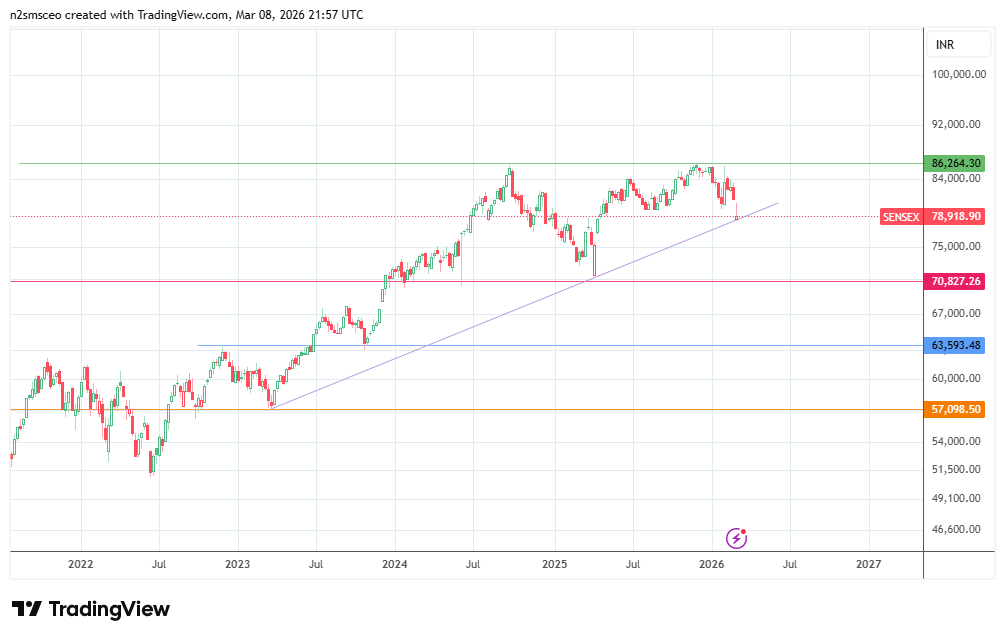
The Economic Times reported that the Sensex index experienced a sharp drawdown following four sessions of heavy volatility. The index closed just below 78,880. On 4 March, the Sensex fell to 11-month lows after crude oil prices spiked sharply following that weekend’s geopolitical escalation in the Middle East.
The Sensex forecasts for 2026 have been shaken up by the oil shock and risk-off scenario now playing out. The geopolitical risk premium is now the dominant driver of Sensex forecasts for 2026.
Sensex Forecasts 2026: Macro Drivers
The key macro drivers of the Sensex for 2026 are as follows:
- Oil and geopolitics
- Foreign portfolio flows vs domestic flows
- Earnings breadth
- RBI policy
- Risk sentiment
1. Oil and Geopolitics
The Middle East geopolitical situation has now emerged as the major price driver for the Sensex. Sensex forecasts 2026 calls will now have to accommodate the impact of rising oil prices, which have escalated as a major influence, especially for equities, which now face a major selloff risk heading into the 2nd quarter. India’s heavy reliance on oil imports and the attendant inflationary impact of any price spikes are major headwinds.
2. Foreign vs Domestic Portfolio Flows
Whenever there is such a shock as has been seen in global equities due to the Middle East escalation, foreign portfolio funds in the Sensex are typically the first to take flight. The 2026 Sensex forecasts will also be influenced by whether foreign portfolio selling continues or stabilizes, and by the extent to which domestic liquidity can step in as a buffer for the exchange. A Reuters report identified volatility and sentiment on the Sensex as influenced by flows, in addition to oil shocks.
3. Earnings Breadth & Revisions
The Sensex’s 2026 earnings breadth forecasts are likely to see revisions. Initial forecasts had assumed recovery in earnings and broader participation. These forecasts could face radical revisions due to the geopolitical situation and the attendant oil price spikes.

4. RBI Policy
The prior assumptions were that the Reserve Bank of India (RBI) would maintain its easing policy and that this would boost the value of Indian equities. The oil price shock is now set to be a major spoiler of these initial assumptions. If higher oil prices create an inflationary environment, the RBI could delay any further easing.
5. Risk sentiment
Higher volatility will lower the multiples that can be paid for the index. Currently, the volatility index of Indian exchanges is rising due to the oil price shock and the risk-off sentiment that is playing out.
Sensex Forecasts 2026: Institutional Targets
A Reuters poll of 32 analysts conducted in February 2026 has projected a mid-2026 price target of 87,293 for the Sensex index and an end-2026 forecast of 89,625. This represents a downgrade from earlier polls.
Morgan Stanley’s Sensex forecast for 2026, as reported by the Economic Times, is 95,000 by December 2026 for the base case and 107,000 for the bull case. It is currently unclear if these targets were set before the oil shock.
Base case: The base case scenario sees a recovery to the high-80s, driven by stabilized oil prices with no residual inflationary effects. It also sees normalization in foreign portfolio investment flows and no deterioration in earnings revisions. The bias here is for the index to grind towards 89,000 by the end of 2026.
Bull case: Earnings breadth and liquidity will accelerate. This is based on the de-escalation of the geopolitical standoff in the Middle East and on the RBI’s rate flexibility. The bull case sees the Sensex hitting 95,000 on the low end, and 107,000 on the higher end.
Bear case: the base case scenario sees oil shocks and persistent foreign portfolio selling continuing down the road, driven by elevated oil prices, a weaker Rupee, and inflationary pressures. Valuations will become compressed, and the Sensex will struggle to reclaim prior highs.
Sensex Forecasts 2026: Technical Outlook
The index remains in an uptrend, as the recent decline has bounced off the ascending trendline connecting price dip points from March 2023 to date.
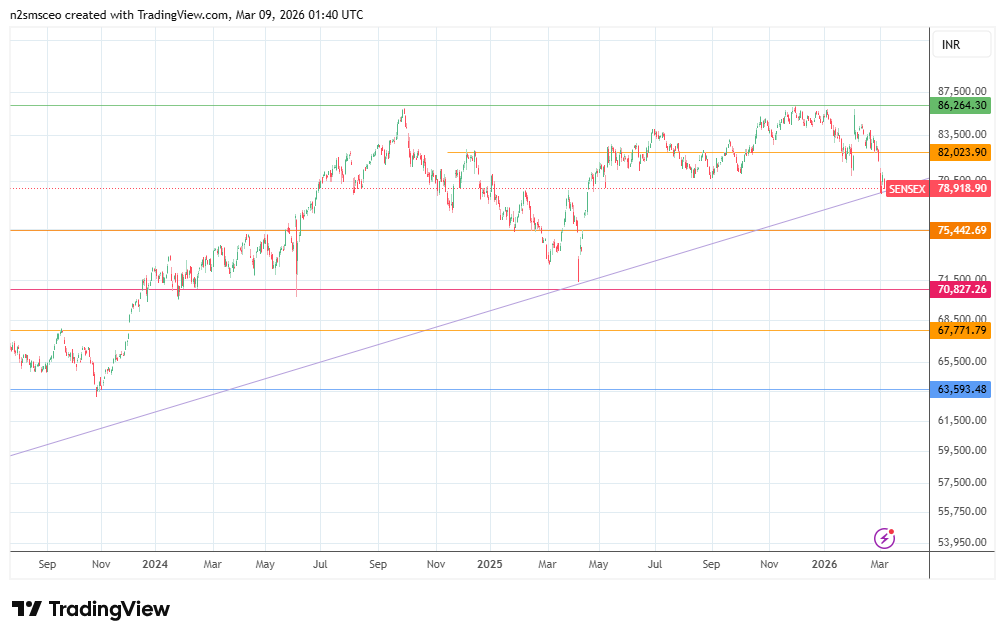
If this trendline is degraded, the 23 January 2024 and 7 April 2025 lows at 70,827 become the next plausible target for the bears in the medium term. The 75442 support, formed by the 24 January 2025 low, is a potential pitstop. Below this level, 63,593 becomes a further target down the road, with an intervening target formed by the prior double top of 20 July/15 September 2023 now acting as role-reversed support at 67771.
On the flip side, an extension of the recovery bounce brings the 82,000 psychological resistance and the prior high from December 2024 into the picture as the next upside target. Further recovery sees the Sensex recovering its January 2026 highs at 86,264.