



India is the world’s third-largest crude oil importer, and Indian exchanges have significant exposure to foreign portfolio investment funds. As India enters the new week in a risk-off environment created by the oil price shock, the Nifty 50 index fell by 1.73% to 24028 points on Monday, 9 March. This drop pushed the Nifty 50 index to near one-year lows and has sparked concerns that bullish forecasts for 2026 may now be in jeopardy due to Rupee weakness, a potential trade deficit, and inflation.
Two opposing forces are now at work regarding the Nifty 50’s valuation.
a) Oil-price shock: An oil spike will produce negative effects on India’s economy, specifically on the stock markets (foreign portfolio outflows, trade deficit, and a weaker currency).
b) RBI intervention: The Rupee operates under a managed float, so the Reserve Bank of India (RBI) is under a mandate to intervene to contain any stress situations on the Rupee and to use policy tools to manage the pricing and supply of derivatives of crude oil to curtail the risk premia.
Nifty 50 Forecasts: Macro Drivers
Three macro fundamentals are expected to drive the price action on the Nifty 50 index this week. These are:
- Oil price direction (the biggest driver)
- INR stability and RBI policy
- Foreign portfolio flows
1. Oil price direction
Brent crude surged to nearly $120 in overnight trading, sending oil prices to near 4-year highs. The oil price shock had a paradoxical effect, dragging down energy sector indices and causing a selloff in the stocks of Indian oil marketers and refiners. If crude oil prices remain elevated, markets will continue to reprice inflation risk, financial conditions, and the INR’s price trajectory.
2. INR stability and the RBI

The Rupee suffered its largest weekly drop in a month as the geopolitical situation in the Middle East began to unfold. Under the managed float system that it uses to control any untoward decline in the Rupee, the Reserve Bank of India (RBI) is said to have deployed $12 billion in interventions to curtail these losses. Furthermore, the oil shock’s impact on consumer prices means the RBI may halt its easing cycle or even start raising rates. These have a direct impact on investor sentiment towards Nifty 50-listed equities.
3. Foreign portfolio flows
According to a Reuters report, $2.4 billion of foreign portfolio funds flowed out of Indian equities in the first week of March, corresponding to when the geopolitical situation began to unravel in Iran. These foreign portfolio flows are likely to stay sensitive to the situation and the general risk sentiment.
Nifty 50 Index Weekly Forecast Scenarios
Base case: Choppy market action with downside skew while crude oil prices remain high. This could benefit those who sell at the rallies until there is clear evidence of oil prices trending downwards. The narrative here is that an oil shock and fears about the current account pose an inflationary threat, which could drag the index lower.
Bull case: a relief rally is triggered by a steady decline in oil prices and the stabilization of the Rupee. The index’s rally could be short-lived if a lasting resolution to the geopolitical situation does not support crude oil price declines.
Bear case: a downside extension is the expected outcome if crude oil prices remain near highs and there is further supply disruption. Persisting foreign portfolio fund outflows and renewed Rupee weakness are other triggering factors, as company stocks in the consumer, financial, and energy sectors will face more pressure.
Nifty 50 Forecast: Technical Outlook
The uptick in the Nifty 50 index is set to test the overhead resistance at 23342. If the bulls uncap this barrier, there could be a momentum shift that signals a move to the upside objective and secondary resistance at 24916.
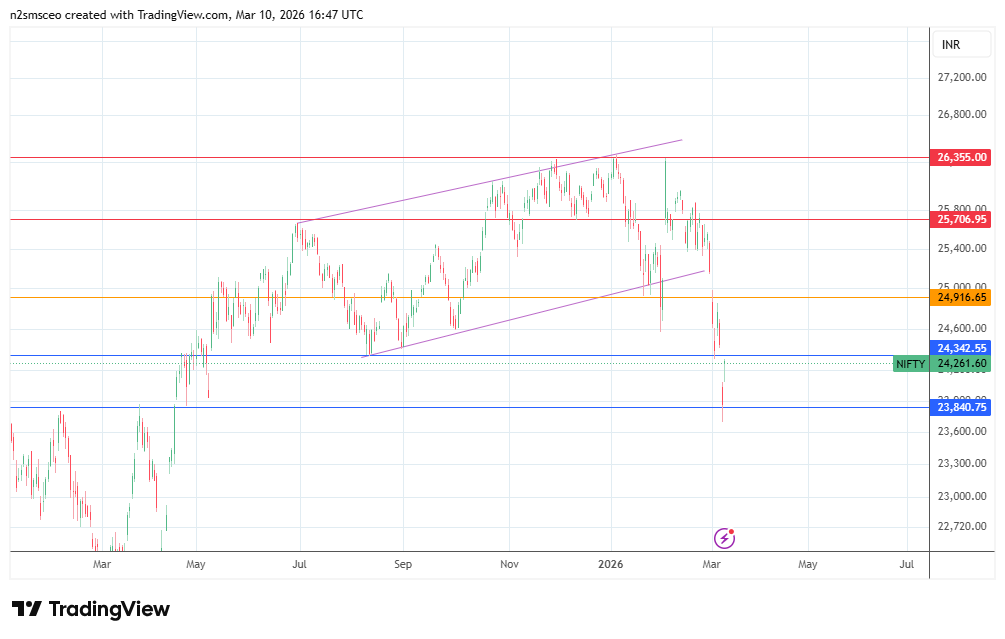
On the other hand, a failure to clear the resistance at 24342 and a subsequent pullback will trigger a retracement to the 23840 support. If this pivot gives way, the 21 November 2024 and 17 April 2025 historical troughs at 23246 form the next bearish objective.