


- The GBP/INR forecasts for the week is for the pair to trade within the 122-124 price range for the week if the current situation persists.
The current setup has the pair trading on a war-oil volatility narrative. The pair is being driven more by the impact of the oil shock on the Rupee and the Reserve Bank of India’s response, than by the inherent fundamentals of the component currencies.
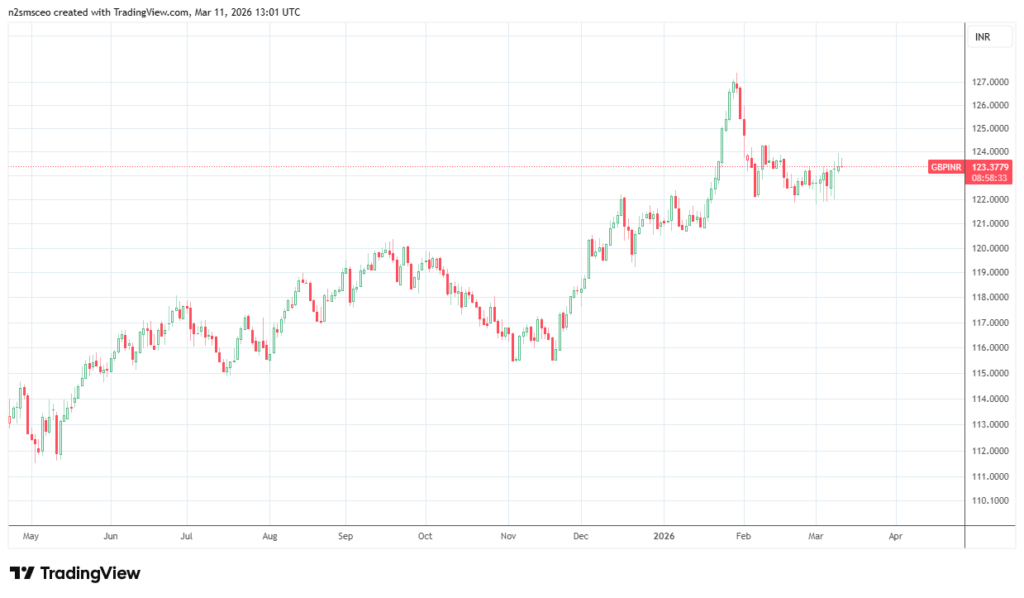
The GBP/INR has traded in the 122-124 price range in the past week. Volatility has dropped off over the last two sessions, leaving the price trading tightly around the 123.30-123.72 range in the current session.
GBP/INR Forecasts: Macro Drivers
The major tape drivers are the INR’s response to the war-oil risk premium (the major driver), the receding expectations for a Bank of England rate cut, and the change in implied volatility on USD/INR due to higher hedging costs.
1. War-oil risk premium impact on the INR (major driver)
The Rupee remains highly sensitive to crude oil prices as long as India remains the 3rd largest importer of the product. Brent crude has had two very sharp drops in the last two trading days. The latest 8% drop in the late New York session on 10 March, which sent prices below $90 per barrel, led to a corresponding rebound in the Rupee. The GBPINR lost 56 pips, even though it managed slight gains on the day, with an RBI intervention fingered as partly responsible for the Rupee’s recovery, alongside the decline in oil prices.
2. Changes to BoE Easing Expectations
The volatility in oil prices remains a major watch factor for central banks, as higher prices could stoke global inflation. The Pound remains vulnerable to the war-oil risk premium, but with prices still hovering close to $90/barrel, industry watchers now expect the Bank of England to cut rates in the second quarter, not earlier. The GBP/INR could benefit from more stable oil prices, but if UK growth is threatened, a deeper repricing of a BoE rate cut comes back to the table.
3. Higher volatility due to rising hedge costs
The one-month implied volatility on the USD/INR, the major pairing for the Rupee, has spiked. This pair is a proxy for any hedging stresses involving the INR. The heightened volatility means there is potential for two-way volatility in GBP/INR, with the risk of overshoots in both directions.
GBP/INR Forecasts: Catalysts for the Week
The three catalysts for the week remain the following:
1. Oil direction (the primary driver)
If Brent crude prices accelerate, the Rupee weakens, and GBP/INR rises. A retracement in oil prices will cap the pair’s upside.
2. Rupee stability/RBI intervention
The RBI’s willingness to intervene in the face of extreme distortions in the Rupee’s movements is part of its managed float mandate. If the RBI sells dollars, as it is suspected of having done several times since the onset of the Iran war, it enables the Rupee’s rebound. This is a factor that any trader who is long the GBP/INR must always watch out for.
3. BoE rates narrative

If BoE rate-cut expectations are repriced further (especially if UK growth worsens), this can quickly unwind losses on the INR and cap the GBP/INR’s upside.
GBP/INR Forecasts: Catalysts for the Week
The three catalysts for the week remain the following:
1. Oil direction (the primary driver)
If Brent crude prices accelerate, the Rupee weakens, and GBP/INR rises. A retracement in oil prices will cap the pair’s upside.
2. Rupee stability/RBI intervention
The RBI’s willingness to intervene in the face of extreme distortions in the Rupee’s movements is part of its mandate for a managed float. If the RBI sells dollars, as it is suspected of having done several times since the onset of the Iran war, it enables the Rupee’s rebound. This is a factor that any trader who is long the GBP/INR must always watch out for.
3. BoE rates narrative
If BoE rate-cut expectations are repriced further (especially if UK growth worsens), this can quickly unwind losses in the INR and cap the upside in GBP/INR.
The weekly forecast scenarios outline the base, bull, and bear case setups for the pair.
Base case: the pair is expected to remain choppy within the defined weekly range, with a mild bias towards an upside skew. Therefore, range trading within the 122-124 price band is expected to be the order of the week, with volatile oscillations as oil headlines and INR hedge flows dominate. The Pound is not expected to contribute meaningfully to the base case scenario.
Bull case: the GBP/INR trades higher. The triggers come from either oil prices heading back into three digits or headlines from the Strait of Hormuz. The US Navy has already confirmed it is receiving a deluge of requests to clear the blockage, but it has turned them down due to the high risk of such operations. RBI smoothing is not expected to do much in this circumstance. This scenario will see the GBP/INR clearing the 124 band cap, driven by INR weakness.
Bear case: Improving risk sentiment due to a fall in oil prices or other headlines pointing to conflict de-escalation would likely send GBP/INR below the 122 lower band. Deeper repricing of BoE rate cuts also favours a bear case scenario.
Expect two-way volatility chops and not a clear trend.
GBP/INR Technical Outlook
Following the retreat from the 29 January high at 127.36, price action is now consolidating between 121.93 and 124.00. The bulls need to uncap the range’s upper boundary at 124.00 to usher in the Feb 2026 high at 125.95. This is the barrier standing between the breakout move and a reclaim of the all-time high at 127.36.
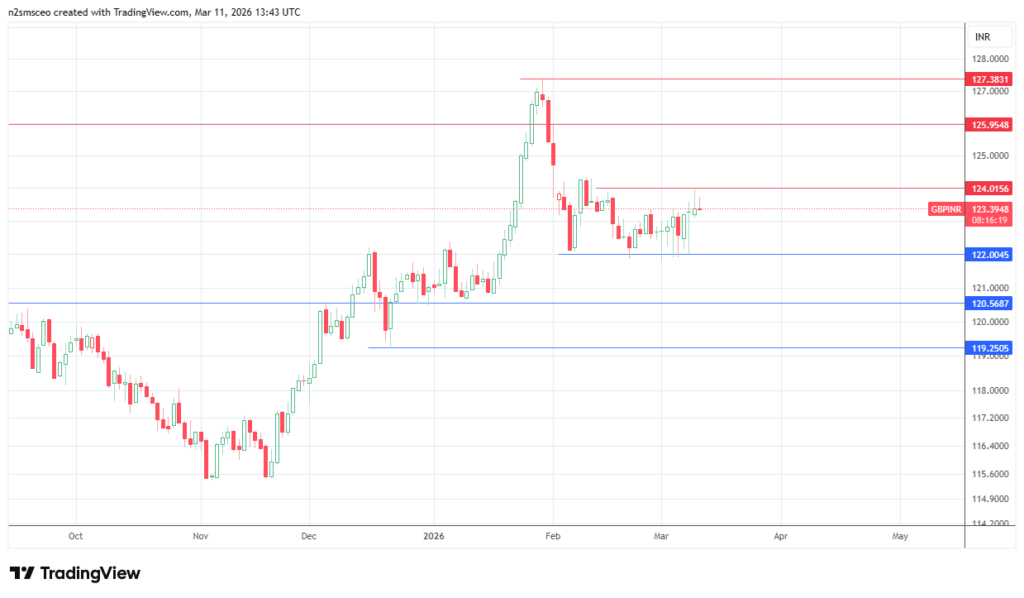
On the flip side, a continuation of the retreat will follow a breakdown of the 123.93 lower boundary. This will expose the 120.56 support formed by the late Dec-2025 and February 2026 lows. The 119.25 low of 22 December 2025 only becomes a viable target if the 120.56 pivot gives way under bearish pressure.