


- Silver price declined sharply in early February, going from $121 to below $70
- The greyish metal has rebounded in the last two weeks and its strong structural demand in AI and green energy could return it above $100
- Gold has outperformed silver amid stronger safe haven demand but silver's industrial demand provides a strong safeguard
Silver prices hit an all-time high of $121.88 on January 29, 2026, thanks to a wave of geopolitical anxiety, tariff-driven safe-haven demand, and rising industrial demand. Then, on February 1, 2026, they fell to what can only be called a historic wipeout.
But in the last two weeks, prices have made a big comeback, going back to the $90 level in recent sessions before settling around $87.50 as of this writing. What caused this quick change, and will the gains last? In the meantime, why has gold been more stable overall in early 2026? We discuss these trends below.
Why Silver Dropped Sharply in Early February
The dramatic drop from $120 to under $70 wasn’t just a random dip; it was a classic case of a market getting ahead of its own headlights. The parabolic move in January, along with the CME raising margin requirements, caused a bubble burst after a 144% gain in 2025. This made leveraged traders sell off, which caused a chain reaction of selling.
The drop wasn’t caused by underlying weakness. Instead, it came from forced selling. Too much borrowed money had piled into gains during January’s rally. Once the sentiment shifted, sparked by rumors the new Fed chair pick, Kevin Warsh, the rush to exit crushed positions across the board. Falling prices fed more exits, deepening the plunge.
However, physical demand did not vanish. Industrial users did not suddenly stop needing silver. What happened was a forced liquidation of speculative paper positions, and that distinction matters enormously for how we interpret the subsequent recovery.
What Is Driving Silver Price Recovery
The rebound from under $70 to the current $90 zone has been built on more solid foundations than the January spike, and that is precisely why it deserves more analytical attention.
First, the Supreme Court’s February 20 ruling striking down Trump’s sweeping IEEPA tariffs reignited safe-haven and monetary demand across precious metals. With Trump’s Section 122 counter-tariffs at 10% now in play and further escalation threatened, the geopolitical uncertainty premium remains well embedded in precious metals pricing.
Second, the post-Lunar New Year reopening of Chinese markets injected a critical wave of physical buying. As markets in Shanghai and Hong Kong reopened following the Lunar New Year holiday ending February 17, a liquidity vacuum was filled by a wave of physical buying from Chinese industrial users and retail investors. This is not speculative demand, it is structural.

Is Gold Truly Outperforming Silver?
A sudden fall in the gold-silver ratio brought it down from more than 100:1 to near 58–60:1 by late February 2026. Back at the beginning of that year, many investors leaned toward gold, seeing it as safer after it hit $5,000 without much fuss. Yet that thinking overlooks something key. When gold climbs fast like this, it often means central banks are uneasy. That is evident in places such as China and Turkiye, where reliance on the dollar is quietly fading.
The demand for solar, electric vehicles, and AI data centers in industry is growing quickly. And most of the speculative leverage that caused the crash in January has been removed, which means the market is in a better place to handle the next rally.
Silver Price Forecast
Silver will face its immediate resistance at $91.57, with the second hurdle likely at $96.30. The RSI is close to 53, which means that the upside momentum is steady. The primary support is at the Volume Weighted Moving Average (VWMA) at $81.49, with the second one at $76.88.
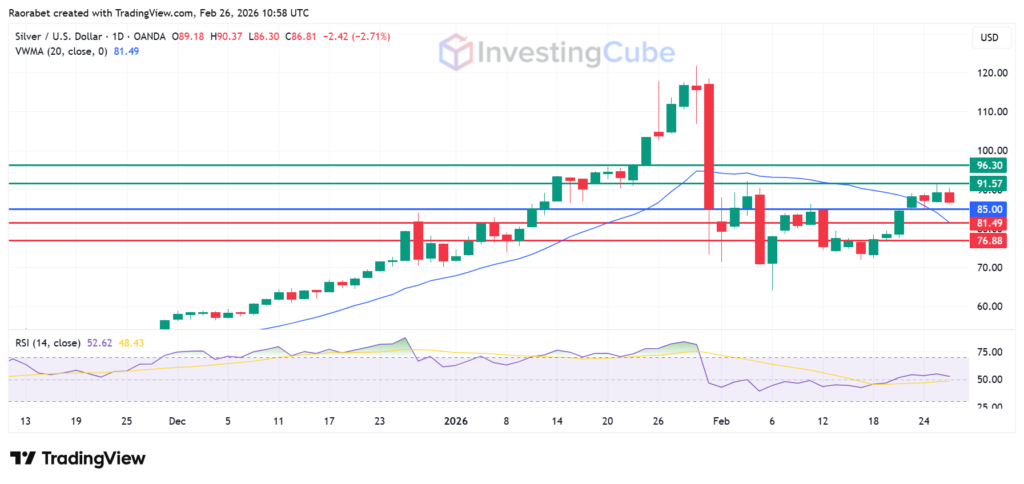
Silver price on the daily chart with the main support and resistance levels on February 26,2026. Created on TradingView
The crash was mostly caused by hedge funds aggressively taking profits after a strong January. This got worse when exchanges raised their margin requirements, which made traders with a lot of debt close their positions and left a gap in the market.
Central banks buying gold and institutional safe-haven flows are better for gold than for other metals. Silver is both an industrial metal and a precious metal, so it often has problems when people are worried about global manufacturing growth or slowing demand for solar panels.
The key trigger will be US GDP data and Fed commentary. If economic growth signals a soft landing, silver might struggle. However, any signs of sticky inflation could propel the metal back toward triple digits.