



- Brent crude price predictions see a further escalation in price following the geopolitical escalation in the Middle East.
Combined US-Israel strikes on Iran on Saturday have led to the deaths of Supreme Leader Ayatollah Khamenei, former President Mohamed Ahmadinejad, and several key political and military figures in Iran, in what is a major escalation of Middle East geopolitics. Iran has responded with missile strikes on several countries deemed to be US allies in the region, and has sealed off the Straits of Hormuz through which 20% of total global crude oil supply is shipped.
The situation has reshaped crude oil price predictions for 2026 following the major shift in the geopolitical risk premium. Crude oil prices (Brent) spiked by more than 8% on the resumption of trading, as markets shifted from risk-off sentiment to a full supply-shock state. Major oil companies and tankers have effectively suspended shipping operations through the Strait of Hormuz.
The spike in crude oil prices reflects crude oil being traded as a crisis asset, with markets repricing the risk arising from the conflict and the closure of the Strait of Hormuz.
The current situation about the shipping of crude is as follows:
- Multiple ships have been informed that no ship is permitted to pass the Strait of Hormuz, with the Iranian navy patrolling the area.
- Japanese shippers have stopped all Hormuz operations.
- Major oil and gas companies have also suspended LNG, crude, and fuel shipments through the Strait of Hormuz, resulting in significant disruptions to traffic. This is as per a Reuters report.
Brent Crude Live Chart
Before markets closed for February, Brent crude was already showing signs of bullish action after indications emerged that mediation talks between the US and Iran had broken down. Brent crude closed at $72.48 per barrel, up 2.45% on 27 February. This was the highest level since August 2025, as traders began to brace for the risk of a potential supply disruption.
This risk has now materialized, and Brent crude is trading at $79.16 as of writing, up from $82.37 earlier in the Asian session.
Brent Crude Oil Price Prediction (Near-term)
The near-term crude oil price prediction bias is now bullish, with price action opening in Asia on a huge bullish gap. Key upside paths now under discussion include the following scenarios.
- Barclays’ crude oil price prediction indicates a potential to hit $80 on US-Iran tensions.
- A Reuters report also suggests that OPEC+ could debate a potential production boost so that emerging supply can kick in and mitigate the Hormuz disruption.

The story has evolved from the Iranian supply, which appears to have been significantly shuttered following the strikes, to the chokepoint situation in Hormuz.
The disruption at the Straits of Hormuz has effectively jeopardized export routes for Saudi Arabia, the UAE, Iraq, and Qatar. This is now the biggest crisis regarding crude oil supply in decades.
Base case: a bullish gap higher when trading resumes (already actualized), as the markets now have to reprice the death of the Iranian leader and an ongoing Hormuz supply disruption.
Bull case: the Strait of Hormuz is closed for a while, which could spark a bullish push towards the $80 price mark.
Bear case: the bear case scenario can only stem from a rapid de-escalation of the crisis, with a reopening of the Strait of Hormuz to shipping traffic. If OPEC+ also acts to offset the supply disruption and reroutes supply to alternative (but more expensive) channels, this would help. However, these actions must be forceful and sustained; any price dips may just be due to profit-taking and provide opportunities for additional dip-buying.
Brent Crude Price Prediction: Key Metrics to Watch
- Shipping supply flow data
- OPEC+ production data
- Any further headlines that show escalation, retaliation, or de-escalation.
Crude Oil Price Prediction: Technical Outlook
The bullish gap has effectively breached the long-term descending trendline, which has capped prices to the upside since September 2023.
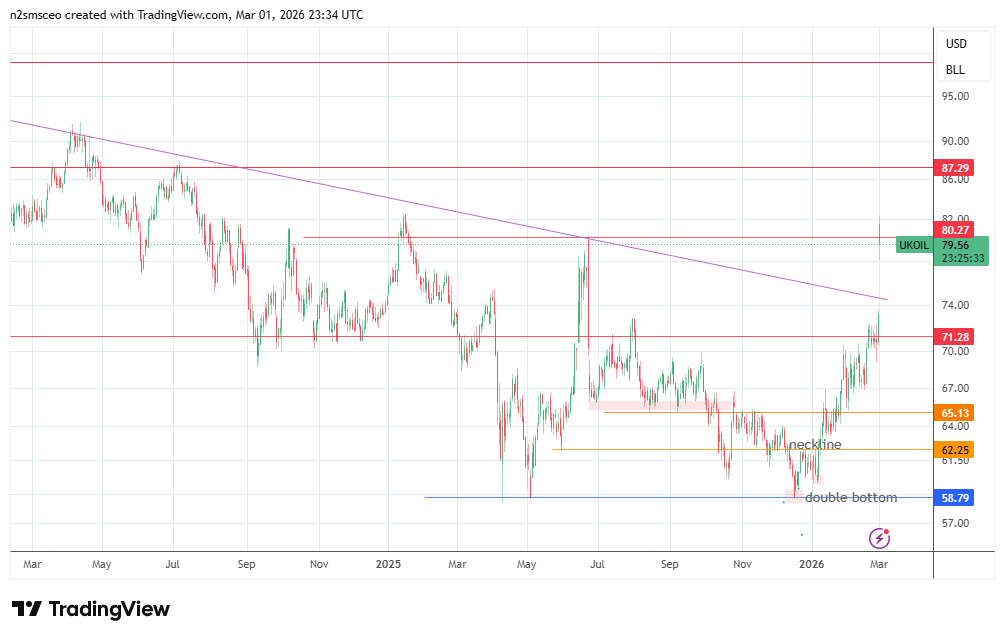
The trendline break is now pushing the next resistance at 80.27, the prior high of 23 June 2025. If this barrier is uncapped, the next target for the bulls would be at the 87.29 resistance, formed by the high of 18 March 2024 and 3 July 2024. The 15 January 2025 high at 82.58 could be a pitstop.
On the flip side, gap closure would send the price back below the trendline, but further correction can only be seen if the 75.50 and 71.28 support levels are degraded. In this scenario, the 13 August and 5 September 2025 lows at 65.13 would become the next downside target.