


- The 'Twin Assassins": A climbing US Dollar Index (99.05) and a 10-year yield hit of 4.138% have increased the opportunity cost of holding non-yielding bullion.
- Resilient jobs data has nearly erased hopes for a March rate cut, shifting the focus to upcoming Non-Farm Payroll (NFP) data as a potential volatility trigger.
Today, the gold market is facing an unprecedented “safe-haven paradox”. Yet even as the Middle East battle is entering day six and oil prices are soaring, bullion has had a rude wake up. On March 6, 2026 the spot gold sank to close nearly $5080.88 necessarily broke us on 1.2%. It raised sharply following a record in not overcoming with high up to $5194.59.
A soaring US dollar and exploding treasury yields are responsible for this decline — both of which, at the moment, serve as “twin assassins” to non-yielding assets.
Market Overview: The Yield-Dollar Squeeze
The dramatic $110 intraday declined underscores a change in investors priorities. Geopolitical concerns normally push gold higher, but secondary effects of the conflict —namely roaring energy prices — have fanned inflation concerns again.
- The Dollar Strength: The US dollar index climbed to 99.05, making gold more costly for foreign buyers.
- The Yield Surge: The 10-year US treasury yield hit the three week high of 4.138%. In this yield climbing environment, the opportunity cost of gold weighs heavily.
The Oil-Inflation Link
Crude oil prices have surged; WTI is almost 9 percent to $81.29 and Brent above $85.61. This 18% cumulative profit, since the fighting began, cuts both ways. In the near term, that is bearish for gold because it makes central banks maintain interest rates “ higher for longer” to fight energy-fed inflation. But in the long run, it will only further reinforce gold’s role as the supreme hedge against currency the base and systematic inflation.
Monetary Policy: Rate Cut Hopes Evaporate
The fantasy best case for gold bulls — Fed rate slashes in short order — is diminishing. Recently jobless claims data showed a resilient US labor market holding steady at 213,000.
Market pricing of a rate cut in March has been almost completely erased. At present, pricing implies that total easing by 2026 has been cut to just 40 bp from a tad over 59bp. A potential surprise in a non-farm payroll data, now expected at 59,000 jobs added to USD employers in October could add a further technical breakdown for gold towards the psychological support level of $5000.

Technical Outlook and Prediction
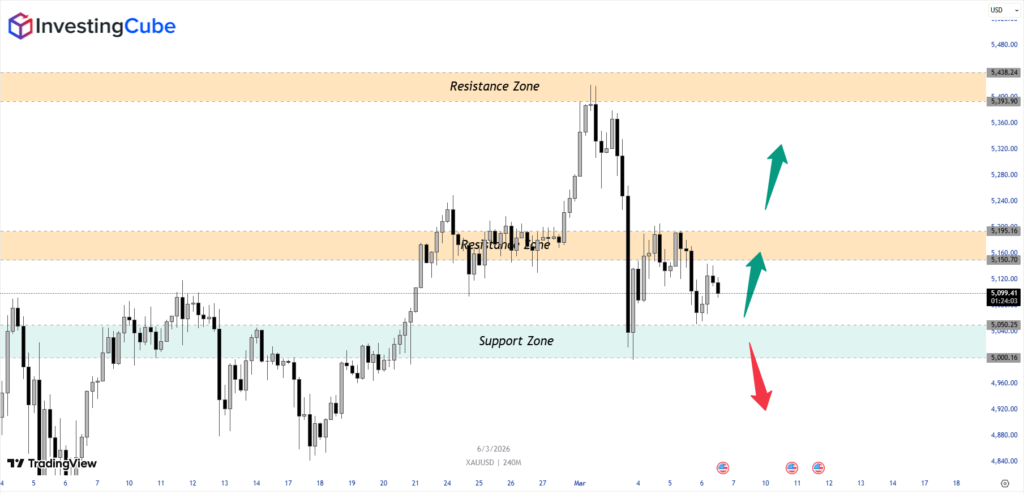
Short-Term: Bearish to neutral expect price action to range between $5000 and $5150 as the market takes in this evolvement of the US dollar routine and strife in the bond market.
High volatility in a medium-term, gold could easily retrace the $5400 mark should the conflict involving US and Iran escalate again. On the other hand, if oil prices were to stabilize and yields continued climbing, a test below $5000 is plausible.
In the long-term, the view stays bullish. Goal is most likely going to target $5600 or beyond. Structural support is provided for gold prices, due to massive US physical deficits and long-term geopolitical restructuring.
The Verdict
We are probably in the “darkness before the dawn”. Although the level $5080 is a strong step back from the high of $5596 heat in January, the underlying support continues to hold. For traders looking to go long, the area between $5000 and $5050 can be viewed as an essential support level. A bounce here, combined with cooling of the dollar’s rally, then could clear a path for some recovery. But until “yield logic” turns to safe-haven logic,” expect choppy price action with a downward bias.
Frequently Asked Questions
While war typically helps drive up gold prices, this conflict has sent oil surging. This has sparked fears of inflation which in turn drove a stronger US dollar and rising treasury yields. These “twin assassins” render gold more expensive to purchase and pricier to hold than interest-bearing asset.
In the short term, $5000 to $5050 is a psychological and technical support level in the near term. On the positive side, gold must run above $5150 again in order to regain bullish momentum with an intermediate target of $5400 adding itself if geopolitical tensions make things worse.
The February NFP report is a key catalyst. If jobs are stronger than the expected 59,000 that it would make a Fed rate cut less likely and lead to a stronger dollar which will put further down with pressure on gold prices.